Ramadaan preparatory reminders- Fiqh of fasting

In the name of Allah, The Most Gracious The Most Merciful.

Let’s touch on the basics of Fasting in preparation for Ramadaan in sha Allah. It is hoped this will inform us of the primary reasons we fast, what is required of us and what to hope for.

May Allah, The Supreme Creator, permit us to fast for none but Him alone, may He reward us for our endeavours, and may He permit us to strive to avoid that which nullifies the fast, and strive to adhere to what maintains and perfects it, in accordance with the teachings of His final prophet peace be upon him.  Ameen.

DISCLAIMER: This is for educational purposes and serves as an introduction to the issues pertaining to fasting. Parents/guardians are advised to supervise the following read as some issues which pertain to married adults have been mentioned. Please consult a knowledgeable Islamic scholar for details, particularly for questions and advice related to individual circumstances. We are not scholars and thus cannot issue fatwa, however we endeavour relate to you the words of the scholars who have studied the authentic teachings of Islam from the Qur’an and the Sunnah of prophet Muhammad upon him be peace. And ultimately, Allah knows best.

 

blue squares banner

Fiqh of Fasting – Part 7  (adapted mainly from Sh. Yahya Adel Ibrahim with notes from others)

Summary of Siyam (Fasting) Essentials

What is the meaning of “Siyam?”

The word “siyam” comes from the root word “sowm,” which means “to abstain from.”

Did Muslims fast before 2 A.H.?

Yes, in fact the Prophet sala Allahu alihi wasSalaam and his companions (may Allah be pleased with them) used to fast on various days, including:

1. Day of Ashura (the exodus) when Allah delivered Musa sala Allahu alihi wasSalaam and the Muslims of that time from the evil of Pharaoh. The Prophet (upon him be peace) taught us to fast two days—either the day before or after plus the actual day of Ashura.

2. On the day of Arafat, if not making Hajj

3. The first 9 Days of dhul-Hijjah

4. Mondays & Thursdays through out the year

5. The middle three days of each lunar month (13th, 14th & 15th) when he moon is at its brightest

6. There are some proofs by way of Khadija (May Allah be pleased with her) who reports that the Prophet (peace be upon him) used to fast before the prophethood—but we do not know the exact days.

Why was Siyam ordered?

The answer to this question lies only with Allah. However, we can find that there are many benefits and bits of wisdom behind this pious and sincere act.

1. Increases one’s Taqwa (remembrance of Allah in daily affairs), as is stated in the Quran: Surah Baqara verse 183.

2. Trains the body, mind and spirit to bear hardships while remaining patient.

3. Trains the body, mind and spirit to hold back from the natural desires of the human: food, drink, anger, lust, etc.

4. To help one understand what the impoverished go though.

What is the importance of the month of Ramadan?

This is the month in which the gates of heaven are opened and the gates of hell are closed. This is the month where every dua’ reaches Allah. This is the month where the Muslims are protected from the evil whisperings of the shayateen. This is the month where one plants the seeds of worship, the seeds of taqwa in the earth and harvests the good deeds for sustenance throughout the year. And most importantly, this is the month in which the Quran was revealed—more specifically, on the night of Lailat-ul-Qadr.

Who must fast?

1. One who is Muslim
2. One who has Aql (mental faculties are sound and understands the responsibility of fasting)
3. One who has reached the age of puberty (signs include: growth of pubic hair or having wet dreams/emitting maniy, or reaching 15 years of age, occurrence of menses)
4. One who is Kaadir (able to maintain the fast)

What is the requirement for the fast?

Very simply, the fast begins with the niya (intention-this need not be verbal, rather intention resides in the heart )—this is a pre Requisite/ Shart—and then refraining from food, drink and things that break the fast, until the time for Maghrib has arrived.

It must be noted by the reader that one cannot just wake up in the morning and proclaim his fast for that day. This was only allowed for the Prophet sala Allahu alihi wasSalaam. Rather, for the followers, there needs to be mental recognition of the fast BEFORE FAJR in other than the month of Ramadan.

What breaks the fast?

1. Eating

2. Drinking

3. Sexual relations of any type that leads to male or female sexual discharge

4. Haid (menstrual bleeding)

5. Nifas (post natal bleeding)

6. Intentional vomiting

7. Needles that give you nourishment

For further clarification on some issues:

a. Blood testing is okay

b. If one needs to take Insulin then that person cannot fast

c. Using the puffer for asthma patients is okay—the respiratory type only.

(in sha Allah, we have posted another more detailed article on things which nullify the fast)
What happens if a couple has intimate relations during the fast?

• If the couple have intercourse intentionally then they have to make up that day and they have to fast 60 days consecutively, or if unable feed 60 people or Kafarah

What is Kafarah?

This is given only as expiation for sexual infractions during the fast. There are three methods of expiation:

1. Freeing of a slave

2. Fast for 60 consecutive days. If one day is missed then you would start from the beginning again

3. If you are unable to fast, for a legitimate reason (sick, old,etc.) then you may feed 60 miskeen (poor) people. They have to be Muslim people and it can happen on one day as a feast. Also, one can just give the money to feed 60 people. This is considered a debt for that person and they should fulfil it before their death. If they do die then the relatives can either fast for them or feed the miskeen.

What about those that cannot fast, but are of age?

Of those who are excused from the fast are those who have a long-term sickness, the pregnant woman, the woman who is breast-feeding and the traveller. For the traveller, the fast is to be made up. But for the others, they are to pay the Fidya (please note, there is a scholarly difference of opinion regarding who can pay fidyah instead of making up fasts- please consult a scholar for your own case, see the links below). Fidya is to pay for a meal for one miskeen person for everyday that is missed. Like the Kafarah, one can arrange to give 30 days worth of money at one time, or arrange a feast for 30 miskeen people on one day.

PLEASE NOTE however, regarding pregnant and nursing mothers and sickness, please ask a highly knowledge Islamic scholar for individual cases. see this and this-is fidyah enough for pregnant women/sick people or not & should they make up the fast?) . Regarding pregnant and nursing mothers and sick people whose illness goes away and making up missed fasts, see these (who is exempt) and (how to make up fasts for ladies/mothers) and (how to make up missed fasts- sickness and all else)

Confused about your case? Contact Islamic Sharia Council

The Sunnan of Fasting

1. The sahoor and iftaar should be done with the family. If the family is not available then one should make an effort to never break the fast alone.

2. To hurry up with breaking the iftaar—not to delay it. But the sahoor can be delayed right up until the time for Fajr enters.

3. To break the fast with dates, or at least 3 sips of water.

4. To make dua’ of breaking the fast. (“Dhahaba al-zamau’a, wa abtallat al-‘urooq wa thabata al-ajr insha Allah (Thirst has gone, the veins are moist, and the reward is assured, if Allaah wills).” see Arabic below )

break the fasting dua


5. To increase in acts of ibada (recitation of the Quran) and this should continue after the month of Ramadan has passed.

6. To give more sadaqa (charity).

7. To offer the tahajud prayers and the tarrawih prayers (in congregation).

8. To feed other Muslims, even if they are not needy—meaning to invite people to your house for the iftaar. In fact, when you invite people the host receives the reward that his guest earned on that day (while the guest retains his own reward). This is true even for the one who finances an iftaar, or one who prepares the food.

The Makrooh (hated things) of Fasting

1. To be excessive in rinsing with water, during wudu or other times. Having too much water in the mouth might cause a person to swallow some.

2. To unnecessarily taste food. There cannot be any swallowing and the tongue should be cleaned of any residual taste.

3. Kissing your spouse.

4. To sexually excite/touch your spouse.

5. To lie, to make ghiba (back biting), to do nameema (telling lies to cause two parties to fight). In fact, those who practice nameema do not enter paradise with the first set of Muslims.

6. To not pray the tarrawih or tahajjud in the last 10 days.

What are some the Voluntary Fasts that one may do?

1. The fast of the Prophet Dawood (peace be upon him) was mentioned by Prophet Muhammad (sallallahu alaihi wasallam) as the best. It includes one day of fasting and one day of resting, continuously.
2. The best months for fasting include: Sha’ban, Muharram, Ramadan,Dhul Hijja.
3. The 13th, 14th & 15th of every Islamic month. The reward of fasting these three days is like having fasted an entire year.
4. Mondays and Thursdays—for these are the two days that the angels rise and descend with your deeds; i.e. the gates of heaven are open.(This refers to Maghrib time)

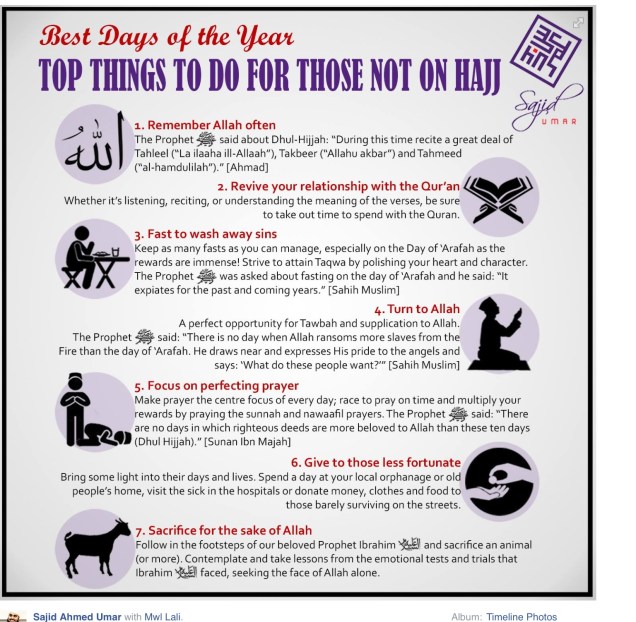
5. The 9th day of Dhul Hijja (for the ones not performing the hajj).This is the day of Arafat and fasting on this day ensures that the minor sins for the previous year and the coming year are forgiven.

purple stripes banner

May Allah make this benefit us, and this advice is to us before it is to you our beloved readers. Allah forgive any errors in this. amin

May Allah allow us to succeed this Ramadan and may He forgive us for He is the Oft-Forgiving, The Forbearing!

Thurrock Muslims

Islam explained (post 1) A brief Introduction to Islam

In the name of Allah, the Most Gracious, The Most Merciful


A Brief Introduction to Islam


Welcome dear curious reader. Whether you’re a Muslim or not, it is anticipated that you will learn much from this endeavour. Sadly, Islam is still largely misunderstood by much of the population. Thus, we took the initiative to tell you the TRUTH about Islam.

Let’s begin!

Islam is one of the world’s major religions, followed by approximately 1.7 billion people and growing. About 1 in 5 people in the world follow Islam.

Islam, like other Abrahamic Faiths, teaches the belief in One God. However, Islam is 100% monotheistic, that is, we believe God is The One, The Eternal, The Creator, who doesn’t have any partners or family or children, and God alone deserves to be worshipped. We also believe that God (Allah) sent many prophets and messengers and revealed books to guide us. We also believe in Adam, Abraham, Noah, Moses, Jesus and Muhammad (upon them be peace). Muhammad (upon him be peace) is the final Messenger of Allah, and the Qur’an (Koran)  is the final revealed book of Guidance for all mankind.

All the prophets of Allah called to the same message: to worship The One True God (Allah) only, with sincerity and without making any partners, idols or rivals.


Islam means to submit your will to God (Allah), with sincerity, and in peace.  Followers of Islam are called Muslims. Islam is a complete way of life. It influences everything including: worship, food, dress-code, relationships, interactions, business, health, money, law and order, life and death.

Muslims believe in an afterlife, that is, there will be a judgement, heaven and hell. We believe that our ancient enemy, Satan, is constantly plotting our downfall and encouraging disobedience to God. We can fight the Satan away by remembering Allah frequently. As humans, we make mistakes, so we always ask Allah to forgive us. We acknowledge we aren’t perfect, but have to try our best to do good and keep away from sins.

We believe our purpose in life is to worship Allah alone, following the example of the prophet Muhammad (upon him be peace).

The prophet Muhammad peace be upon him stressed the importance of excellent moral conduct and principles. Some of these key values are sincerity, patience, strength, dedication, cooperation in good, consideration, removal of evil, educating oneself and others, upholding the family, and establishing justice with EVERYONE, whoever they may be.

Here are some more details:

1. Allah-The Supreme Creator and Lord of all creation. The One True God worthy of worship. Allah is the Eternal, uncreated Creator.  He is One, Self-sufficient, independent from and separate from His creation. Allah does not have any partners or children. There is nothing like Allah. Allah is the All-Knowing, All-Seeing, All-Hearing, Provider, Cherisher, Sustainer and Originator of the universe. It is essential to affirm the Oneness of Allah in His Lordship, His names and attributes and His exclusive right to be worshipped without partners or associates.

You can find a superb description of Allah in chapter 112 of the Qur’an:

2. Islam– Means submission to the will of the One Supreme Creator of the universe known as ‘Allah’ or The One True God.

3. Muslim- One who submits his/her will to the Will of Allah. The purpose in life is to worship Allah, not because He needs us (remember He is Self-Sufficient, Self-Subsisting) but because we need Him. It is in everyone’s natural disposition to recognise Allah’s Lordship and His right to be worshipped exclusively.

4.Messengers and prophets– Allah did not leave creation without guidance. He sent prophets and messengers, who were human beings, to warn their nations and remind them to worship Allah alone. We believe in Adam, Noah, Abraham, Moses and Jesus among others, peace be upon them all. Incidentally, we believe Jesus was born from the virgin Mary, miraculously without a father. Jesus is not the son of God, because God (Allah) is One, without partners, associates or children. Humans and created beings have children, and God is unlike His creation! Therefore, we respect and believe in Jesus peace be upon him as a messenger of God who never claimed divinity, but rather, he called to the worship of The One True God (Allah) alone without partners.

5. Scriptures and revealed books– Allah sent the messengers with scriptures to guide the people to come back to the worship of One True God alone. We believe in the original scriptures, such as the Torah, Psalms and Gospel (the current day versions have been altered by man over time and are thus no longer in the original form). All the messengers and prophets (peace be upon them all) professed Islamic Monotheism. The previous messengers were sent with revelations for their people at their times. Thereafter, Allah sent a final messenger to guide,remind and warn us.

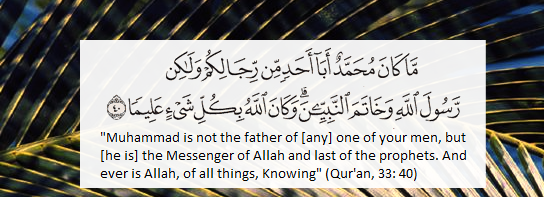
palm tree banner witha ayah 40 surah ahzab

6. The Final prophet and messenger and final book of revelation– Allah sent the final prophet Muhammad (peace be upon him) as the last messenger after whom no new messenger will be sent to mankind. Allah revealed the final book of revelation,The Qur’an, to the prophet Muhammad, who conveyed this to his people. The Qur’an is the verbatim words of Allah.

The miracle is that the Qur’an has been preserved from change since its revelation over 1400 years ago, as Allah guaranteed to guard it from corruption.

Verily, We, it is We Who have sent down the Dhikr (i.e. the Qur’an) and surely, We will guard it (from corruption) .

[Qur’an, 15:9- English interpretation]

The message Muhammad was sent with and the final revealed book (The Qur’an)  abrogates all other books and laws before it. Muhammad peace be upon him also called to the Oneness of God and called people to worship Allah alone without partners (Islamic Monotheism), the same message of the previous prophets. The prophet Muhammad came with Islam, and the Qur’an, and this is the message all nations after him are to follow, as commanded by Allah. Indeed, it is through obeying God (Allah) that we hope to attain eternal bliss in the afterlife.

To be continued… Next page

Continue reading

IS TERRORISM A MUSLIM MONOPOLY? WATCH THIS- SHOCK ALERT

In The Name of Allah (The One True God to be worshipped).


IS TERRORISM A MUSLIM MONOPOLY? 

Dr Zakir Naik- Scholar of comparative religion & medical Dr.


https://www.youtube.com/watch?v=yfhc32Pca9s 


OMG… who hijacked history? Aren’t those facts surprisingly enlightening. Why are we hardly ever told of these incidents in history, of terror, genocide and anarchy at the hands of people who never identified with the Islamic faith- yes, think Spanish inquisition, Hitler, Milosevic, IRA bomb blasts, Vietnam war but to name a few… none of the perpetrators here were Muslim…

Lesson to learn– Terrorism knows no race, no religion, no region. STOP JUDGING, and LEARN THE TRUTH ABOUT ISLAM.

With peace,

Thurrock Muslims.

Continue reading

Do You Want Halal Meat/Poultry Available in Your Town? Fill this Survey in 3 minutes! (Grays, Basildon, Brentwood, surrounding areas)

Do You Want Halal Meat/Poultry Available in Your Town? Fill this Survey in 3 minutes! (Grays, Basildon, Brentwood, surrounding areas)


Asalamu alaykum respected readers, the title says it all, let us know ASAP in sha Allah, just fill in this 3 minute survey!

Click on this link  https://www.surveymonkey.co.uk/r/CKKDRP2 

Spread the survey link to your Muslim neighbours, friends, family, colleagues!

Link back to our blog for more updates: http://wp.me/p4GU3D-il 

and subscribe for free by emailing us or type your email address in the subscribe box on the left hand side, or just contact us below : )

← Back

Thank you for your response. ✨

Keep cool

Thurrock Muslims

What is Hijab? 9 Things You Should Know

In the name of Allah, The Most Gracious, The Most Merciful.

What is Hijab? 9 Things You Should Know


It’s been in the limelight time and time again, in parliament, in the media, in school, on the streets, virtually everywhere. Some hold it as a sign of emancipation, others ignorantly perceive it to be otherwise. For sure, it’s been heavily debated, and heavily misunderstood.

It’s the Hijab.

Did you know that Hijab is more than a scarf wThurrockMuslims picture Islam prayer hall musallarapped around your head?

Let’s break this down.

1-Hijab, is an Arabic word, meaning a screen, a cover, a barrier.

2- It’s often associated with modesty, Muslims and Islam. Incidentally, orthodox female followers of other faiths such as Judaism and Christianity also choose to cover (usually concealing the hair, with the neck exposed).

3- The Islamic Hijab is a command from Allah (The One True God), which Muslims strive sincerely to implement in their lives [see Qur’an 24:30-31 and Qur’an 33:59].

4- Muslim men also have a Hijab to observe.

5- Hijab is more than clothing, it extends to attitude too- it’s external and internal.

6- Hijab helps to promote a morally upright society, where God-Consciousness thrives.

7- Hijab is worn by millions of women worldwide. Many state that they have never felt more liberated since adopting the dress code.

8-Many people have fought for the right to wear Hijab (including the head cover, the outer gown and face veil).

9- There are about 8 conditions of Hijab. Check out our upcoming post!

Thurrock Muslims

Share this by linking back to us http://wp.me/p4GU3D-g7

(Please request permission before copying any of the pictures on www.ThurrockMuslims.wordpress.com, by contacting us . JazakAllah khair!)


We’re blessed, but deprived…

In the name of Allah.

Who doesn’t have a smartphone/tablet/laptop/electronic gadget of some sort today?

In fact, many of us probably have one of these, or one of each, or even more than one of each…

Yes, so Alhamdulillah, we’re blessed with these fabulous gadgets that we use for hours on end.

We have all the time to use our digital darlings, but we’re deeply deprived.

Why?

Because which of us doesn’t have a Qur’an application on our devices, or a means to access it via WiFi or internet, but we chose to avoid it.

We have the time to make consecutive phone calls and messages. Minutes turn to hours. Granted, we’re busy- but we’ve got five, ten, fifteen minutes to spare to update our social media accounts, to browse the web, to take selfies…

When will we decide to read a verse or two of the Qur’an? It’s not that we don’t have time for it, it’s that we won’t make time for it…

Don’t we know what we’re missing out on? Our hearts are heavy, our minds are overwhelmed, our problems are many, yet we have the solutions, in the Qur’an. If only we would read.

The Qur’an is a healing, guidance and a mercy for the believers. Please read a few lines from Surah Ar-Rahman.


 أعوذ بالله من الشيطان الرجيم

Quranexplorer.com chapter 55

Surat Ar-Raĥmān (The Beneficent)سورة الرحمن
Ar-Rahmaan | 78 verses | The Beneficent | Sura #55 | Medinan
Search | Recitation | Topics | Uthmani Script | Words | Quran Teacher
1
الرَّحْمَـٰنُ

The Most Gracious (Allah)!

2
عَلَّمَ الْقُرْآنَ

He has taught (you mankind) the Qur’an (by His Mercy).

3
خَلَقَ الْإِنسَانَ

He created man.

4
عَلَّمَهُ الْبَيَانَ

He taught him eloquent speech.

5
الشَّمْسُ وَالْقَمَرُ بِحُسْبَانٍ

The sun and the moon run on their fixed courses (exactly) calculated with measured out stages for each (for reckoning).

6
وَالنَّجْمُ وَالشَّجَرُ يَسْجُدَانِ

And the herbs (or stars) and the trees both prostrate themselves (to Allah – See V.22:18) (Tafsir Ibn Kathir)

7
وَالسَّمَاءَ رَفَعَهَا وَوَضَعَ الْمِيزَانَ

And the heaven: He has raised it high, and He has set up the Balance.

8
أَلَّا تَطْغَوْا فِي الْمِيزَانِ

In order that you may not transgress (due) balance.

9
وَأَقِيمُوا الْوَزْنَ بِالْقِسْطِ وَلَا تُخْسِرُوا الْمِيزَانَ

And observe the weight with equity and do not make the balance deficient.

10
وَالْأَرْضَ وَضَعَهَا لِلْأَنَامِ

And the earth: He has put down (laid) for the creatures.

11
فِيهَا فَاكِهَةٌ وَالنَّخْلُ ذَاتُ الْأَكْمَامِ

Therein are fruits and date-palms producing sheathed fruit-stalks (enclosing dates).

12
وَالْحَبُّ ذُو الْعَصْفِ وَالرَّيْحَانُ

And also corn, with (its) leaves and stalk for fodder, and sweet-scented plants.

13
فَبِأَيِّ آلَاءِ رَبِّكُمَا تُكَذِّبَانِ

Then which of the Blessings of your Lord will you both (jinn and men) deny?

Allah grant us the tawfiq to read, ponder and act on His noble Book. May Allah save us from the devil’s plots. Allahumma salli alaa Muhammad sallallahu alayhi wasallam. Ameen

JazakAllah khair.

please share : )  http://wp.me/p4GU3D-hN 

Thurrock Muslims

It’s the Day of Arafat Today- Let’s Pray Our Sins are Forgiven!!!


Bismillah!

‘It was reported from Abu Qutaadah (may Allaah be pleased with him) that the Messenger of Allaah (peace and blessings of Allaah be upon him) was asked about fasting on the Day of ‘Arafaah. He said, “It expiates for the sins of the previous year and of the coming year.” Narrated by Muslim.’ sheikh sajid umar what to do ten days dhul hijjah


IMPORTANT NOTES:

  • Reciting Takbeer: Let us not forget to make the Takbeer following the obligatory prayers, starting after Fajr on Arafat day, till when the sun sets on the 13th of Dhul Hijjah. (see below for details).

 ‘It is Sunnah to recite takbeer at any time during the first ten days of Dhu’l-Hijjah and all the days of Tashreeq, starting from the beginning of the month of Dhu’l-Hijjah (i.e., from sunset on the last day of Dhu’l-Qa’dah) until the end of the days of al-Tashreeq, which is when the sun sets on the thirteenth day of Dhu’l-Hijjah).

 With regard to at certain times, it starts from Fajr on the day of ‘Arafah and lasts until the sun sets on the last day of the days of Tashreeq, in addition to the takbeer that may be recited at any time. So when a person says the tasleem at the end of the obligatory prayer, he should pray for forgiveness (by saying Astaghfir-Allaah) three times, and say, “Allaahumma anta al-salaam wa minka al-salaam, tabaarakta yaa dhaa’l-jalaali wa’l-ikraam (“O Allaah, You are al-Salaam [the One Who is free from all defects and deficiencies), and from You is all peace, blessed are You, O possessor of majesty and honour)”, then start the takbeer. 

{Takbeer: Allaahu akbar, Allaahu akbar, laa ilaaha ill-Allaah, Allaahu akbar, Allaahu akbar, wa lillaahi’l-hamd(Allaah is Most Great, Allaah is Most Great, there is no god but Allaah, Allaah is Most Great, Allaah is Most Great, and to Allaah be praise). }

 This is for those who are not on Hajj. The pilgrims should start the takbeer recited after prayer from Zuhr on the Day of Sacrifice (the 10th of Dhu’l-Hijjah).

 And Allaah knows best.

 See Majmoo’ Fataawa Ibn Baaz (may Allaah have mercy on him), 13/17; al-Sharh al-Mumti’ by Ibn ‘Uthaymeen (may Allaah have mercy on him), 5/220-224.’ [see http://islamqa.info/en/36627]

Keep us in your prayers!

Alhamdulillah. May Allah have mercy on us all and forgive us,guide us and grant us jannat-al-firdaus, wasallallahu ala nabiyinaa Muhammad sallallahu alayhi wasallam! ameen.

Thurrock Muslims


LAYLAT-UL-QADR! It might just be tonight!!!!

asalamu alaykum!

BISMILLAH


save surah qadr


In the name of Allah, the Beneficent, the Merciful
Verily, We have sent it (this Qur’ân) down in the night of Al-Qadr (Decree)[] (1) And what will make you know what the night of Al-Qadr (Decree) is? (2) The night of Al-Qadr (Decree) is better than a thousand months (i.e. worshipping Allâh in that night is better than worshipping Him a thousand months, i.e. 83 years and 4 months) (3) Therein descend the angels and the Rûh [Jibril (Gabriel)] by Allâh’s Permission with all Decrees, (4) (All that night), there is Peace (and Goodness from Allâh to His believing slaves) until the appearance of dawn.[] (5)

[QUR’AN CHAPTER 97, ENGLISH INTERPRETATION]


It’s toooooo special to miss!!!!!

Quick tips:


  • And if you are a lady on your menses, you can ibadah other than prayer: see this


  • Some reminders from our respected lecturers in the Ramadan Revival, this night, increase in Qiyam (standing in prayer at night), reading Qur’an, making dua- lots of it, pour our hearts out to Allah! We can also give zakah if one lunar year passed on the wealth which reached the nisaab, and do other good deeds, like istighfar (seeking forgiveness from Allah –click to see amazing this dua) sadaqah, reminding each other of Allah, dhikr- remembering Allah, salat and salam on rasoolullah sallallahu alayhi wasallam!


It was narrated from Abu Hurayrah (may Allaah be pleased with him) that the Prophet (peace and blessings of Allaah be upon him) said:  “Whoever stays up and prays on Laylat al-Qadr out of faith and in the hope of reward, his previous sins will be forgiven.” Agreed upon.

Rasoolullah sallallahu alayhi wasallam taught ‘Aisha radi Allahu anhaa what to say on laylat-ul-qadr:

laylqadr dua

Transliteration: Allahumma innaka ‘afuwwun, tuHibul’afwa fa’fu ‘annee 

Let’s revive the sunnah and flee to Allah! please remember us in your duas, and like and share this in sha Allah!

May Allah forgive all of us who believe and admit us to  paradise, by His mercy. Allah abundantly bless rasoollullah. ameen

(References: Qur’an, Sunnah, Tafsir ibn Katheer abridged vol. 10, Darrusalam, IslamQA)

LAYLAT-UL-QADR! famous dua

asalamu alaykum!

BISMILLAH


save surah qadr


In the name of Allah, the Beneficent, the Merciful
Verily, We have sent it (this Qur’ân) down in the night of Al-Qadr (Decree)[] (1) And what will make you know what the night of Al-Qadr (Decree) is? (2) The night of Al-Qadr (Decree) is better than a thousand months (i.e. worshipping Allâh in that night is better than worshipping Him a thousand months, i.e. 83 years and 4 months) (3) Therein descend the angels and the Rûh [Jibril (Gabriel)] by Allâh’s Permission with all Decrees, (4) (All that night), there is Peace (and Goodness from Allâh to His believing slaves) until the appearance of dawn.[] (5)

[QUR’AN CHAPTER 97, ENGLISH INTERPRETATION]


How to observe laylatul Qadr: click here


It was narrated from Abu Hurayrah (may Allaah be pleased with him) that the Prophet (peace and blessings of Allaah be upon him) said:  “Whoever stays up and prays on Laylat al-Qadr out of faith and in the hope of reward, his previous sins will be forgiven.” Agreed upon.

Rasoolullah sallallahu alayhi wasallam taught ‘Aisha radi Allahu anhaa what to say on laylat-ul-qadr:

laylqadr dua

Let’s revive the sunnah and flee to Allah! please remember us in your duas, and like and share this in sha Allah!

May Allah forgive all of us who believe and admit us to  paradise, by His mercy. Allah abundantly bless rasoollullah. ameen

(References: Qur’an, Sunnah, Tafsir ibn Katheer abridged vol. 10, Darrusalam, IslamQA)

Ramadaan preparatory reminders- Fiqh of fasting

In the name of Allah, The Most Gracious The Most Merciful.

Let’s touch on the basics of Fasting in preparation for Ramadaan in sha Allah. It is hoped this will inform us of the primary reasons we fast, what is required of us and what to hope for.

May Allah, The Supreme Creator, permit us to fast for none but Him alone, may He reward us for our endeavours, and may He permit us to strive to avoid that which nullifies the fast, and strive to adhere to what maintains and perfects it, in accordance with the teachings of His final prophet peace be upon him.  Ameen.

DISCLAIMER: This is for educational purposes and serves as an introduction to the issues pertaining to fasting. Parents/guardians are advised to supervise the following read as some issues which pertain to married adults have been mentioned. Please consult a knowledgeable Islamic scholar for details, particularly for questions and advice related to individual circumstances. We are not scholars and thus cannot issue fatwa, however we endeavour relate to you the words of the scholars who have studied the authentic teachings of Islam from the Qur’an and the Sunnah of prophet Muhammad upon him be peace. And ultimately, Allah knows best.


blue squares banner

Fiqh of Fasting – Part 7  (adapted mainly from Sh. Yahya Adel Ibrahim with notes from others)

Summary of Siyam (Fasting) Essentials

What is the meaning of “Siyam?”

The word “siyam” comes from the root word “sowm,” which means “to abstain from.”

Did Muslims fast before 2 A.H.?

Yes, in fact the Prophet sala Allahu alihi wasSalaam and his companions (may Allah be pleased with them) used to fast on various days, including:

1. Day of Ashura (the exodus) when Allah delivered Musa sala Allahu alihi wasSalaam and the Muslims of that time from the evil of Pharaoh. The Prophet (upon him be peace) taught us to fast two days—either the day before or after plus the actual day of Ashura.

2. On the day of Arafat, if not making Hajj

3. The first 9 Days of dhul-Hijjah

4. Mondays & Thursdays through out the year

5. The middle three days of each lunar month (13th, 14th & 15th) when he moon is at its brightest

6. There are some proofs by way of Khadija (May Allah be pleased with her) who reports that the Prophet (peace be upon him) used to fast before the prophethood—but we do not know the exact days.

Why was Siyam ordered?

The answer to this question lies only with Allah. However, we can find that there are many benefits and bits of wisdom behind this pious and sincere act.

1. Increases one’s Taqwa (remembrance of Allah in daily affairs), as is stated in the Quran: Surah Baqara verse 183.

2. Trains the body, mind and spirit to bear hardships while remaining patient.

3. Trains the body, mind and spirit to hold back from the natural desires of the human: food, drink, anger, lust, etc.

4. To help one understand what the impoverished go though.

What is the importance of the month of Ramadan?

This is the month in which the gates of heaven are opened and the gates of hell are closed. This is the month where every dua’ reaches Allah. This is the month where the Muslims are protected from the evil whisperings of the shayateen. This is the month where one plants the seeds of worship, the seeds of taqwa in the earth and harvests the good deeds for sustenance throughout the year. And most importantly, this is the month in which the Quran was revealed—more specifically, on the night of Lailat-ul-Qadr.

Who must fast?

1. One who is Muslim
2. One who has Aql (mental faculties are sound and understands the responsibility of fasting)
3. One who has reached the age of puberty (signs include: growth of pubic hair or having wet dreams/emitting maniy, or reaching 15 years of age, occurrence of menses)
4. One who is Kaadir (able to maintain the fast)

What is the requirement for the fast?

Very simply, the fast begins with the niya (intention-this need not be verbal, rather intention resides in the heart )—this is a pre Requisite/ Shart—and then refraining from food, drink and things that break the fast, until the time for Maghrib has arrived.

It must be noted by the reader that one cannot just wake up in the morning and proclaim his fast for that day. This was only allowed for the Prophet sala Allahu alihi wasSalaam. Rather, for the followers, there needs to be mental recognition of the fast BEFORE FAJR in other than the month of Ramadan.

What breaks the fast?

1. Eating

2. Drinking

3. Sexual relations of any type that leads to male or female sexual discharge

4. Haid (menstrual bleeding)

5. Nifas (post natal bleeding)

6. Intentional vomiting

7. Needles that give you nourishment

For further clarification on some issues:

a. Blood testing is okay

b. If one needs to take Insulin then that person cannot fast

c. Using the puffer for asthma patients is okay—the respiratory type only.

(in sha Allah, we will try to post another more detailed article on things which nullify the fast)
What happens if a couple has intimate relations during the fast?

• If the couple have intercourse intentionally then they have to make up that day and they have to fast 60 days consecutively, or if unable feed 60 people or Kafarah

What is Kafarah?

This is given only as expiation for sexual infractions during the fast. There are three methods of expiation:

1. Freeing of a slave

2. Fast for 60 consecutive days. If one day is missed then you would start from the beginning again

3. If you are unable to fast, for a legitimate reason (sick, old,etc.) then you may feed 60 miskeen (poor) people. They have to be Muslim people and it can happen on one day as a feast. Also, one can just give the money to feed 60 people. This is considered a debt for that person and they should fulfil it before their death. If they do die then the relatives can either fast for them or feed the miskeen.

What about those that cannot fast, but are of age?

Of those who are excused from the fast are those who have a long-term sickness, the pregnant woman, the woman who is breast-feeding and the traveller. For the traveller, the fast is to be made up. But for the others, they are to pay the Fidya (please note, there is a scholarly difference of opinion regarding who can pay fidyah instead of making up fasts- please consult a scholar for your own case, see the links below). Fidya is to pay for a meal for one miskeen person for everyday that is missed. Like the Kafarah, one can arrange to give 30 days worth of money at one time, or arrange a feast for 30 miskeen people on one day.

PLEASE NOTE however, regarding pregnant and nursing mothers and sickness, please ask a highly knowledge Islamic scholar for individual cases. see this and this-is fidyah enough for pregnant women/sick people or not & should they make up the fast?) . Regarding pregnant and nursing mothers and sick people whose illness goes away and making up missed fasts, see these (who is exempt) and (how to make up fasts for ladies/mothers) and (how to make up missed fasts- sickness and all else)

Confused about your case? Contact Islamic Sharia Council

The Sunnan of Fasting

1. The sahoor and iftaar should be done with the family. If the family is not available then one should make an effort to never break the fast alone.

2. To hurry up with breaking the iftaar—not to delay it. But the sahoor can be delayed right up until the time for Fajr enters.

3. To break the fast with dates, or at least 3 sips of water.

4. To make dua’ of breaking the fast. (“Dhahaba al-zamau’a, wa abtallat al-‘urooq wa thabata al-ajr insha Allah (Thirst has gone, the veins are moist, and the reward is assured, if Allaah wills).” see Arabic below )

break the fasting dua


5. To increase in acts of ibada (recitation of the Quran) and this should continue after the month of Ramadan has passed.

6. To give more sadaqa (charity).

7. To offer the tahajud prayers and the tarrawih prayers (in congregation).

8. To feed other Muslims, even if they are not needy—meaning to invite people to your house for the iftaar. In fact, when you invite people the host receives the reward that his guest earned on that day (while the guest retains his own reward). This is true even for the one who finances an iftaar, or one who prepares the food.

The Makrooh (hated things) of Fasting

1. To be excessive in rinsing with water, during wudu or other times. Having too much water in the mouth might cause a person to swallow some.

2. To unnecessarily taste food. There cannot be any swallowing and the tongue should be cleaned of any residual taste.

3. Kissing your spouse.

4. To sexually excite/touch your spouse.

5. To lie, to make ghiba (back biting), to do nameema (telling lies to cause two parties to fight). In fact, those who practice nameema do not enter paradise with the first set of Muslims.

6. To not pray the tarrawih or tahajjud in the last 10 days.

What are some the Voluntary Fasts that one may do?

1. The fast of the Prophet Dawood (peace be upon him) was mentioned by Prophet Muhammad (sallallahu alaihi wasallam) as the best. It includes one day of fasting and one day of resting, continuously.
2. The best months for fasting include: Sha’ban, Muharram, Ramadan,Dhul Hijja.
3. The 13th, 14th & 15th of every Islamic month. The reward of fasting these three days is like having fasted an entire year.
4. Mondays and Thursdays—for these are the two days that the angels rise and descend with your deeds; i.e. the gates of heaven are open.(This refers to Maghrib time)

5. The 9th day of Dhul Hijja (for the ones not performing the hajj).This is the day of Arafat and fasting on this day ensures that the minor sins for the previous year and the coming year are forgiven.

purple stripes banner

May Allah make this benefit us, and this advice is to us before it is to you our beloved readers.

May Allah allow us to succeed this Ramadan and may He forgive us for He is the Oft-Forgiving, The Forbearing!

Thurrock Muslims