Covid-19 Reflections- Selflessness

In the name of Allah, The Most Beneficent, The Most Merciful.

Assalaamu’ alaykum warahmatullahi wabarakatuhu Dear Community,

I’ve been thinking about how the Coronavirus pandemic can teach us many lessons about our faith and values. Our strengths, weaknesses and capabilities as humans.

As the crisis unfolded in a bid for survival we humans reacted in various ways, some panicked while others kept calm. Then came mass hysteria which resulted in a lot of panic buying. Stockpiling by some led to more panic by the rest, flocking to stores, shortages of shelf stock and hiking of prices by some retailers. A truly bizarre and thought provoking situation.

Thankfully most of us came to our senses and started considering our fellow population.

Allah The Most Merciful knows His creation better than we know ourselves. It is only natural we should be merciful to one another as reported in the Hadiths of Sahih Bukhari and Muslim:

Abu Hurairah (May Allah be pleased with him) reported: Messenger of Allah (ﷺ) said, “Allah has divided mercy into one hundred parts; and He retained with Him ninety-nine parts, and sent down to earth one part. Through this one part creatures deal with one another with compassion, so much so that an animal lifts its hoof over its young lest it should hurt it”.

Sadly despite this calamity it has not brought out the best of humanity in certain shameless opportunists. Please be careful of manipulative scams and take care against thieves and con artists particularly online.

May Allah guide us and make us kind to our fellow humans. Ameen.

Now, it is time we asked ourselves how we reacted and if it was a good way to react. To remind ourselves to be faithful, that everything is in the Hands of Allah, namely life, death, gain and loss. Wealth and poverty can be tough tests of life. But Materialism, greed, selfishness can skew our perception of reality.

Allah warns us in Surah Al Humazah (Qur’an 104:3)

“He thinks that His wealth will make him immortal..”

Inevitably we shall all return to Allah and we must pray to be taken in a state of imaan. We must remember that Allah is Ar-Razaq (The One Who Provides) as He tells us in Surah Adh-Dhaariyat (Qur’an, 51:58):

“ Verily, Allah is the All-provider, Owner of Power, the Most Strong.“

Allah is free of need and the Only One that can save us.

Humanity needs one another, a totally self-centred mentality is actually quite self-defeating. Mankind heavily depends on social and physical interactions to stay sane. Having said this, there are boundaries and limits Allah has set out for us to which we must respect in order to thrive. This social distancing is quite refreshing at a time when personal space boundaries have been eroded to near extinction!

Here are some of the small kindnesses that we can do to help others:

> giving within your means

> giving with an open heart

> shopping responsibly (it has been a while since the shopping frenzies and congrats to the supermarkets for responding well to encourage consideration).

> wash hands and maintain personal hygiene (high time a large portion of us should be washing hands after basic human functions)

>share, volunteer, help the elderly/pregnant women/vulnerable groups of people. (Cook food or do groceries, give positive comforting advice.)

>If you have children get them involved as part of their home-schooling to teach them good Islamic character and looking after neighbours… someone’s got to break the ice no?

>heed government advice as much as possible. Stay safe, stay at home. Isolate if needed.

Life under lockdown as restrictive as it can be, is proving necessary to protect the NHS and the population. Many people can be asymptomatic so it is crucial to keep your distance and limit contact to protect the vulnerable such as the elderly, pre/postnatal women, mothers with young children and those with weakened immune systems . In fact everyone should be cautious as we have seen even the healthy and all age groups are susceptible.

Muhammad Rasool Allah (peace be upon him) set us the best example. Let us follow and treat this minor hardship with patience, seeking reward from Allah. Let us maintain social distance to protect others without differentiating their background. Remember Surah Al Maaida (Qur’an 5:32):

“And if anyone saved a life, it would be as if he saved the life of all mankind.“

Now it’s time to look at myself and see where I am on this scale of selflessness and how to improve, maybe its time for you to evaluate yourself too.

Take care and please share the word.

Thurrock Muslims.

Covid-19 Reflections- Forgiveness

In the name of Allah, The Most Beneficent, The Most Merciful.

Assalaamu’ alaykum warahmatullahi wabarakatuhu Dear Community,

Recently mankind has been gripped by a global pandemic, the coronavirus Covid-19. As it stands thousands have been affected, thousands deceased and thousands are at risk.

As Muslims we understand that Allah created life with a purpose (for us to worship only Him) and we shall eventually return to Him. Therefore it is incumbent upon us to assess and amend our current ways from one of heedlessness, disobedience and unaccountability to one of virtue, honesty and sincerity.

Allah The Almighty tells us in the Qur’an chapter 67 (Surah Al- Mulk) verse1-2:

“Blessed be He in Whose Hand is the dominion; and He is Able to do all things.

Who has created death and life that He may test you which of you is best in deed. And He is the All-Mighty, the Oft-Forgiving..”

Allah Glory be to Him is All Knowing and has power over everything. He knows what has, does and will happen and why.

Here is our wake up call. A blessing in disguise.

This is our chance to seek Allah’s forgiveness, follow His guidance and share the message of peace and submission to Allah. This is our chance for self-improvement, enjoining good and forbidding evil. We have long been complacent about the ill doings of society and often very much a part of it ourselves. It is time to leave ignorance and immorality behind and start living the way Allah wants us to.

Sincere repentance requires us to stop wrongdoing, to beg Allah’s pardon, do good and keep it going. We must purify our intention and do everything out of obedience to Allah.

Sadaqa averts calamity so give charity, particularly to our close community, relatives and especially to our displaced brothers and sisters of war torn poverty stricken lands. Now is the time to be the kind stranger and bring our nation together. We have a duty.

This is a reminder to myself more than anything and to share with the ummah in general for the sake of Allah, as Allah says in the Qur’an Chapter 51 Surah Adh-Dhariyat verse 55:

“And remind, for indeed, the reminder benefits the believers.“

We too are imperfect fellow human beings. So may Allah forgive us and please let us forgive each other for our shortcomings.

Praise be to Allah. We ask Allah to bless us with good, have mercy on us and guide us to the Straight Path. Ameen.

Stay safe.

Thurrock Muslims

GET READY FOR RAMADAN! Thurrock Muslims -Ramadan preparatory reminders- Fiqh of fasting


GET READY FOR RAMADAN 1441AH

Ramadaan preparatory reminders- Fiqh of fasting


Share this vital information with others! https://wp.me/p4GU3D-Cz

Let’s get ready for Ramadan in obedience to our Most Merciful Rabb, Allah!

It is hoped this will inform us of the primary reasons we fast, what is required of us and what to hope for.

May Allah, The Supreme Creator, permit us to fast for none but Him alone, may He reward us for our endeavours, and may He permit us to strive to avoid that which nullifies the fast, and strive to adhere to what maintains and perfects it, in accordance with the teachings of His final prophet peace be upon him.  Ameen.

DISCLAIMER: This is for educational purposes and serves as an introduction to the issues pertaining to fasting. Parents/guardians are advised to supervise the following read as some issues which pertain to married adults have been mentioned. Please consult a knowledgeable Islamic scholar (and trustworthy medical professional) for details, particularly for questions and advice related to individual circumstances. We are not scholars and thus cannot issue fatwa, however we endeavour relate to you the words of the scholars who have studied the authentic teachings of Islam from the Qur’an and the Sunnah of prophet Muhammad upon him be peace. And ultimately, Allah knows best.

blue squares banner

Fiqh of Fasting – Part 7  (adapted mainly from Sh. Yahya Adel Ibrahim with notes from others)

Summary of Siyam (Fasting) Essentials

What is the meaning of “Siyam?”

The word “siyam” comes from the root word “sowm,” which means “to abstain from.”

Did Muslims fast before 2 A.H.?

Yes, in fact the Prophet sala Allahu alihi wasSalaam and his companions (may Allah be pleased with them) used to fast on various days, including:

1. Day of Ashura (the exodus) when Allah delivered Musa sala Allahu alihi wasSalaam and the Muslims of that time from the evil of Pharaoh. The Prophet (upon him be peace) taught us to fast two days—either the day before or after plus the actual day of Ashura.

2. On the day of Arafat, if not making Hajj

3. The first 9 Days of dhul-Hijjah

4. Mondays & Thursdays through out the year

5. The middle three days of each lunar month (13th, 14th & 15th) when he moon is at its brightest

6. There are some proofs by way of Khadija (May Allah be pleased with her) who reports that the Prophet (peace be upon him) used to fast before the prophethood—but we do not know the exact days.

Why was Siyam ordered?

The answer to this question lies only with Allah. However, we can find that there are many benefits and bits of wisdom behind this pious and sincere act.

1. Increases one’s Taqwa (remembrance of Allah in daily affairs), as is stated in the Quran: Surah Baqara verse 183.

2. Trains the body, mind and spirit to bear hardships while remaining patient.

3. Trains the body, mind and spirit to hold back from the natural desires of the human: food, drink, anger, lust, etc.

4. To help one understand what the impoverished go though.

What is the importance of the month of Ramadan?

This is the month in which the gates of heaven are opened and the gates of hell are closed. This is the month where every dua’ reaches Allah. This is the month where the Muslims are protected from the evil whisperings of the shayateen. This is the month where one plants the seeds of worship, the seeds of taqwa in the earth and harvests the good deeds for sustenance throughout the year. And most importantly, this is the month in which the Quran was revealed—more specifically, on the night of Lailat-ul-Qadr.

Who must fast?

1. One who is Muslim
2. One who has Aql (mental faculties are sound and understands the responsibility of fasting)
3. One who has reached the age of puberty (signs include: growth of pubic hair or nocturnal emissions, emitting maniy, or reaching 15 years of age, occurrence of menses)
4. One who is Kaadir (able to maintain the fast)

What is the requirement for the fast?

Very simply, the fast begins with the niya (intention-this need not be verbal, rather intention resides in the heart)—this is a pre Requisite/ Shart—and then refraining from food, drink and things that break the fast, until the time for Maghrib has arrived.

It must be noted by the reader that one cannot just wake up in the morning and proclaim his fast for that day. This was only allowed for the Prophet sala Allahu alihi wasSalaam. Rather, for the followers, there needs to be mental recognition of the fast BEFORE FAJR in other than the month of Ramadan.

What breaks the fast?

1. Eating

2. Drinking

3. Sexual relations/intimate acts of any type that leads to male or female sexual discharge,

4. Haid (menstrual bleeding)

5. Nifas (post natal bleeding)

6. Intentional vomiting

7. Needles that give you nourishment

For further clarification on some issues:

a. Blood testing is okay

b. If one needs to take Insulin then that person cannot fast

c. Using the puffer for asthma patients is okay—the respiratory type only.

(in sha Allah, see more detailed article on things which nullify the fast)
What happens if a couple has intimate relations during the fast?

• If the couple have intercourse intentionally then they have to make up that day and they have to fast 60 days consecutively, or if unable feed 60 people or Kafarah

What is Kafarah?

This is given only as expiation for sexual infractions during the fast. There are three methods of expiation:

1. Freeing of a slave

2. Fast for 60 consecutive days. If one day is missed then you would start from the beginning again

3. If you are unable to fast, for a legitimate reason (sick, old,etc.) then you may feed 60 miskeen (poor) people. They have to be Muslim people and it can happen on one day as a feast. Also, one can just give the money to feed 60 people. This is considered a debt for that person and they should fulfil it before their death. If they do die then the relatives can either fast for them or feed the miskeen.

What about those that cannot fast, but are of age?

Of those who are excused from the fast are those who have a long-term sickness, the pregnant woman, the woman who is breast-feeding and the traveller. For the traveller, the fast is to be made up. But for the others, they are to pay the Fidya (please note, there is a scholarly difference of opinion regarding who can pay fidyah instead of making up fasts- please consult a scholar for your own case, see the links below). Fidya is to pay for a meal for one miskeen person for everyday that is missed. Like the Kafarah, one can arrange to give 30 days worth of money at one time, or arrange a feast for 30 miskeen people on one day.

PLEASE NOTE however, regarding pregnant and nursing mothers and sickness, please ask a highly knowledge Islamic scholar for individual cases. see this and this-is fidyah enough for pregnant women/sick people or not & should they make up the fast?) . Regarding pregnant and nursing mothers and sick people whose illness goes away and making up missed fasts, see these (who is exempt) and (how to make up fasts for ladies/mothers) and (how to make up missed fasts- sickness and all else)

Confused about your case? Contact a knowledgabe Mufti (try calling up on the Ask the Sheikh programmes on Eman Channel, or similar.)

The Sunnan of Fasting

1. The sahoor and iftaar should be done with the family. If the family is not available then one should make an effort to never break the fast alone.

2. To hurry up with breaking the iftaar—not to delay it. But the sahoor can be delayed right up until the time for Fajr enters.

3. To break the fast with dates, or at least 3 sips of water.

4. To make dua’ of breaking the fast. (“Dhahaba al-zamau’a, wa abtallat al-‘urooq wa thabata al-ajr insha Allah (Thirst has gone, the veins are moist, and the reward is assured, if Allaah wills).” see Arabic below )

break the fasting dua

5. To increase in acts of ibada (recitation of the Quran) and this should continue after the month of Ramadan has passed.

6. To give more sadaqa (charity).

7. To offer the tahajud prayers and the tarrawih prayers (in congregation).

8. To feed other Muslims, even if they are not needy—meaning to invite people to your house for the iftaar. In fact, when you invite people the host receives the reward that his guest earned on that day (while the guest retains his own reward). This is true even for the one who finances an iftaar, or one who prepares the food.

The Makrooh (hated things) of Fasting

1. To be excessive in rinsing with water, during wudu or other times. Having too much water in the mouth might cause a person to swallow some.

2. To unnecessarily taste food. There cannot be any swallowing and the tongue should be cleaned of any residual taste.

3. Kissing your spouse.

4. To sexually excite/touch your spouse.

5. To lie, to make ghiba (back biting), to do nameema (telling lies to cause two parties to fight). In fact, those who practice nameema do not enter paradise with the first set of Muslims.

6. To not pray the tarrawih or tahajjud in the last 10 days.

What are some the Voluntary Fasts that one may do?

1. The fast of the Prophet Dawood (peace be upon him) was mentioned by Prophet Muhammad (sallallahu alaihi wasallam) as the best. It includes one day of fasting and one day of resting, continuously.
2. The best months for fasting include: Sha’ban, Muharram, Ramadan,Dhul Hijja.
3. The 13th, 14th & 15th of every Islamic month. The reward of fasting these three days is like having fasted an entire year.
4. Mondays and Thursdays—for these are the two days that the angels rise and descend with your deeds; i.e. the gates of heaven are open.(This refers to Maghrib time)

5. The 9th day of Dhul Hijja (for the ones not performing the hajj).This is the day of Arafat and fasting on this day ensures that the minor sins for the previous year and the coming year are forgiven.

Allah knows best!

purple stripes banner

May Allah make this benefit us, and this advice is to us before it is to you our beloved readers.

May Allah allow us to succeed this Ramadan and may He forgive us for He is the Oft-Forgiving, The Forbearing! May Allah forgive us for any errors in this and grant us correctness. Wasallallahu alaa nabiyina Muhammad.Amin

ThurrockMuslims.com

Be generous, like, share and teach others for the sake of Allah– https://wp.me/p4GU3D-Cz

support our work

Disclaimer:

Continue reading →

Abu Ayyub al Ansari and Abu Dar Al Ghifari (RA) 2 Great Men- thurrockmuslims.com

Thurrockmuslims.com

Why don’t Muslims celebrate Christmas? Thurrock Muslim Community

Why don’t Muslims celebrate Christmas?


In the name of Allah, The Most Gracious The Most Merciful.

Peace people!

Guess what, it’s December again and we’re fast approaching the holiday period.

So we’re all dazzled by the funky lights, surrounded by lofty pine trees, bombarded with special offers and advertisements and perhaps even, confronted by some big old man in a red hat and suit… and ho, ho, how has this got anything to do with this post? Well, I’m getting to it : ]

giftbx

Now since we are in Britain, and it has traditionally been known as a Christian country, Christmas day, i.e. 25 December is considered a national holiday. You can argue all you want that its been commercialised and it’s no longer a religious thing, but my friend, that’s not the point.

Let’s have a look at the history of Christmas:

According to Britannica Encyclopaedia, Christmas has become a Christian festival where Christians believe they are celebrating the birth of Christ, or Jesus. Historically, however, the date coincides with pagan Roman festivals which celebrated the winter solstice. It is believed that early Christians wanted to celebrate the 25th to coincide with the pagan festival. There is no clear statement in the New testament supporting the celebration of Jesus’ birth on the 25th. Nevertheless, it is still widely celebrated in that manner.

So basically in a nutshell, Christmas day has pagan origins!

And did you know, there are many groups and sections of society who do not celebrate Christmas, such as Jewish people, some atheists, and even some Christians (trust me, I googled it…)! 

Now I’m going to tell you WHY MUSLIMS DON’T CELEBRATE CHRISTMAS, with due respect and no offence intended my friend. : )

In Islam, the MOST IMPORTANT belief is that of Islamic monotheism. That is, we are commanded to submit to and believe in Allah (The One True God), and attribute complete Oneness to Allah as He deserves in His Lordship, Names and Attributes and right to be worshipped alone.

Consequently, as a Muslim, i.e. one who submits to Allah (The One True God), we believe that we must abandon and turn away from anything that contradicts the principles of Islamic monotheism. Polytheism, idolatry and ascribing partners to Allah are MAJOR SINS! The biggest sin which Allah will not forgive, is ascribing partners to Him !

‘Verily, Allah forgives not that partners should be set up with Him (in worship), but He forgives except that (anything else) to whom He wills; and whoever sets up partners with Allah in worship, he has indeed invented a tremendous sin.’ [Qur’an, chapter 4, verse 48- English interpretation]

Allah is so self-sufficient, it does not befit His Majesty to take a son or wife, or to beget or be begotten. He does not resemble His creation, for He is the uncreated Creator, and there is no similitude to Him.

In fact, a remarkably concise description of Allah can be found in chapter 112 of The Noble Qur’an, which is the verbatim words of Allah, and Allah’s final revealed book to mankind.

Have a listen to this chapter here:

Regarding Jesus (peace be upon him), in Islam we believe he was a mighty messenger of Allah. Jesus, or Isa in Arabic, was born a miraculous birth, from the virgin Mary. We refer to Jesus as ‘Isa ibnu Maryam, which means Jesus son of Mary. Jesus did not have a father, and he is not the son of God/Allah, because as we mentioned earlier, it does not befit the majesty of Allah to beget. Allah decreed that Jesus would be born miraculously without a father from the pure chaste virgin Mary. We respect them very much and we know that Jesus never claimed divinity, rather Jesus called his people to worship Allah alone, the same message each prophet and messenger of Allah called to. Jesus’ (peace be upon him) story can be found in the Qur’an in numerous places. (for more information, please see the upcoming post on chapter 19 of the Qur’an entitled Maryam!)

Incidentally, Paganism supports polytheism. Polytheism means worshipping multiple deities. Therefore, the Christian Trinity is essentially polytheism. And as previously mentioned in this blog, Islam means submission to the One True God, Allah, and our purpose in life is to acknowledge Allah’s complete Oneness, to uphold Islamic monotheism, and to attribute absolute Oneness to Allah in His Lordship, names and attributes and right to be worshipped alone.

handshak

I hope you understand now, why we don’t celebrate Christmas, why we don’t exchange Christmas greetings and why we don’t give or take cards and gifts on this occasion. It’s nothing to do with you personally, so please don’t take it personally! Because the truth is, as Muslims, the most important One to us is Allah, and the only reason we are alive is for Allah, to serve Him, to worship Him, because we need to worship Him and He doesn’t need us to do that. Whether or not we worship Him, it does not detract or add to His majesty at all. Rather He is The Self-Sufficient, The Majestic, The Rich, Free of all needs. The Lord of all that exists, He is Allah.

Besides, our kind behaviour and gifts to you is not supposed to be limited to a certain day of the year, as Muslims we are required to deal with everyone in a just manner at all times, exhibiting the best character.  If we have fallen short in fulfilling our rights towards you as our neighbours, please do forgive us. We make mistakes, after all we are human. Although, we endeavour to follow the best example of excellent moral conduct,as taught to us by Allah’s final prophet and messenger, Muhammad peace be upon him.

I’ll leave you with a verse from the Qur’an to get you thinking.

‘Say (O Muhammad صلى الله عليه وسلم): “I am only a man like you. It has been revealed to me that your Ilah (God) is One Ilah (God – i.e. Allah). So whoever hopes for the Meeting with his Lord, let him work righteousness and associate none as a partner in the worship of his Lord.” ‘

[Qur’an, chapter 18: v110, english interpretation]

Thanks for reading.

Peace.

ThurrockMuslims.com

EID PRAYER GRAYS MOSQUE/THURROCK 2019- EID UL ADHAA 1440AH 11th AUG2019 (males and females welcome)


EID PRAYER GRAYS MOSQUE/THURROCK- EID UL ADHAA 1440AH –  11th AUG2019

(males and females welcome)


Asalamu alaykum warahmatullahi wabarakatuh!

EID MUBARAK!

Taqaballallaahu minaa wa minkum! May Allah accept (good deeds) from us and from you. ameen

EID PRAYERS IN GRAYS ** SEE BELOW

We are still witnessing the best 10 days of the year, Alhamdulillah. Allah, The Self-Sufficient, The Most Generous, has honoured us with Islam and Iman, and before us we have a magnificent festival, Eid-ul-Adha, The festival of Sacrifice, on the 10th day of this sacred month of Dhul-Hijjah 1440. Let us congratulate one another on this joyous occasion.

May Allah accept (good deeds) from us and from you. ameen

ALERT -GRAYS /THURROCK EID PRAYER ANNOUNCEMENT BELOW*:

IMPORTANT- EID PRAYER ANNOUNCEMENT 10 DHUL HIJJAH 1440/ Sunday 11th AUGUST 2019:

EID PRAYER TO BE HELD AT GRAYS MOSQUE IN SHA ALLAH,  MEN AND WOMEN INVITED, SEPARATE FACILITIES IN SHA ALLAH. 

Please arrive early, prayer starts:

 Eid prayer jama’ah (congregation) will be held locally in GRAYS MOSQUE

TIME: 3 jamats

730am

830am

930am ( all men only jamats)

WOMAN ONLY CONGREGATION AT 1030AM (ARRIVE EARLY)

Car parking requires fee on surrounding roads/ car parks.

Washroom and ablution facilities at Mosque, but please come prepared.

DIRECTIONS: Grays Mosque (Thurrock Islamic Education & Cultural Association), Park Way Centre, Park Road, Thurrock, Grays, Essex, RM17 6RB (minutes walk away from Morrisons shopping centre and Grays train/bus station.)

**Alternative arrangements available in various locations and times on Eid day, including:**

Early 830am Eid prayer jamah for men and women, North Stifford, Grays

830am for 845am start in sha Allah

Venue: Stifford Hall Hotel

High Road

North Stifford

Grays

RM16 5UE

All welcome to the After Party / Mingle and celebration straight after the prayer We welcome everyone to meet fellow brother and sisters after the prayer. All are welcome to bring light refreshments / snacks / tea for the after get together in the same prayer hall. Parking is £3/car The hall is under new management and are asking for a £3/car parking charge. We have tried to get them to waive this charge, but the new management are not willing to waive this charge so all may be required to pay the parking charge once at the hotel. In order to keep things moving on time, we kindly request that parking charges be paid after the eid prayer has been concluded.

Pay by phone or at reception.

(FORWARDED)

IMPORTANT:

Please take a few moments for the sake of Allah to discover the obligations, sunnahs and etiquettes of Eid-ul-adhaa:

The etiquettes of Eid, the takbeer etc.

Udhiyah- animal of an’aam class (either sheep,camel, cow etc.) offered as a sacrifice as an act of worship to Allah, The Self-Sufficient Provider.

HOW TO PRAY EID PRAYER HERE

Some top tips (see above links for references from Qur’an and sunnah):

1- Do make an arrangement immediately to offer the udhiyah, if you have not done so already. You can do it with various Islamic charities in the UK, in sha Allah. Let us offer sacrificial animals in obedience to Allah, following the way of His final prophet Muhammad peace be upon him. Let’s share this bounty with our brothers and sisters around the world, in sha Allah!

2- Keep pronouncing the Takbeer, this is a great Sunnah! Remind each other! (starts on 1st Dhul Hijjah until sunset on the last of the days of Tashreeq, i.e. 13th Dhul Hijjah. Also read the takbeer after the obligatory prayers, starting from after Fajr on the 9th of Dhul Hijjah to after Asr on 13th of Dhul Hijjah.)

The Takbeer is:

Allahu Akbar, Allahu akbar, Allahu Akbar, laa ilaha illAllah, Allahu Akbar, Allahu Akbar, Allahu Akbar, wa lillaahilHamd. (Allah is Most Great, Allah is Most Great, Allah is Most Great, There is no true god worthy of worship, except Allah. Allah is Most Great, Allah is Most Great, Allah is Most Great and all praise be to Allah.)

الله اكبر، الله اكبر، الله اكبر، لا إله الا الله، الله اكبر، الله اكبر، ولله الحمد

3-Have ghusl in the morning before going out to pray

4- If possible, make an effort to delay eating until after the Eid salah and eat from the udhiyah if you offered a sacrifice.

5- Men should go out wearing their finest clothes, perfume etc.When going out or in the presence of non-mahram men, women should avoid perfume. Women can wear their fine clothes so long as it is concealed by a full and complete, unadorned Hijab. When in female only environments, or among their mahram relatives, women may adorn themselves appropriately. My dear readers, let us remind ourselves that obedience to Allah takes precedence over all else.

6- Pray the Eid prayer in congregation

7- Congratulate one another! Taqabbal Allahu minnaa wa minkum (May Allah accept (the fast and worship) from us and from you)

8- Go out to pray one route, and return by another. Check out the links above for more!

9-Keep up with the abundant dhikr, this last of the ten best days of the year!!!

say: Subhanallah, Alhamdulillah, wa laa ilaha illAllah, wallahuakbar!

Let’s send salutations on the final prophet of Allah, Muhammad Sallallahu alayhi wasallam!

Jazakallah khair everyone who helped organise, and those who informed us, May Allah elevate you  us and our families.

Pray for us and share for the sake of Allah!

May Allah forgive us, for He is the Perpetual Forgiver and may Allah guide us to unite upon belief in His Oneness. Allahumma salli wasallim alaa nabiyinaa muhammad salllallahu alayhi wasallam. ameen

Thurrock Muslim Community

ThurrockMuslims.com

Contact us and stay connected by signing up:

← Back

Thank you for your response. ✨

Continue reading →

VIRTUES OF THE FIRST 10 DAYS DHUL HIJJAH! [SACRIFICE]

IN THE NAME OF ALLAH


VIRTUES OF THE FIRST 10 DAYS OF DHUL HIJJAH!  [SACRIFICE]


QURBANI/UDHIYAH- SACRIFICING AN ANIMAL IN OBEDIENCE TO ALLAH

Check out the previous post with some amazing tips on how to make the best of these 10 days

Best 10 days of the year

Want to know what udhiyah/Qurbani is? Read this:

Definition of udhiyah and ruling thereon


What is meant by udhiyah (sacrifice)? Is it obligatory or Sunnah?.

Praise be to Allaah.
The word udhiyah means an animal of the ‘an’aam class (i.e., camel, cow, sheep or goat) that is slaughtered during the days of Eid al-Adha because of the Eid and as an act of worship, intending to draw closer to Allaah thereby.

This is one of the rituals of Islam prescribed in the Book of Allaah and the Sunnah of His Messenger (peace and blessings of Allaah be upon him), and according to the consensus of the Muslims.

In the Qur’aan:

1 – Allaah says (interpretation of the meaning):

“Therefore turn in prayer to your Lord and sacrifice (to Him only)”

[al-Kawthar 108:2]

2 – Allaah says (interpretation of the meaning):

“Say (O Muhammad): Verily, my Salaah (prayer), my sacrifice, my living, and my dying are for Allaah, the Lord of the ‘Aalameen (mankind, jinn and all that exists).

He has no partner. And of this I have been commanded, and I am the first of the Muslims”

[al-An’aam 6:162]

The word nusuk (translated here as sacrifice) means sacrifice; this is the view of Sa’eed ibn Jubayr. And it was said that it means all acts of worship, including sacrifice, which is more comprehensive.

3 – Allaah says (interpretation of the meaning):

“And for every nation We have appointed religious ceremonies, that they may mention the Name of Allaah over the beast of cattle that He has given them for food. And your Ilaah (God) is One Ilaah (God Allaah), so you must submit to Him Alone (in Islam). And (O Muhammad) give glad tidings to the Mukhbitoon [those who obey Allaah with humility and are humble from among the true believers of Islamic Monotheism]”

[al-Hajj 22:34]

In the Sunnah:

1 – It was narrated in Saheeh al-Bukhaari (5558) and Saheeh Muslim (1966) that Anas ibn Maalik (may Allaah be pleased with him) said: “The Prophet (peace and blessings of Allaah be upon him) sacrificed two white rams speckled with black. He slaughtered them with his own hand, said ‘Allaahu akbar’ and put his foot on their necks.”

2 – It was narrated that ‘Abd-Allaah ibn ‘Umar (may Allaah be pleased with him) said: “The Prophet (peace and blessings of Allaah be upon him) stayed in Madeenah for ten years, offering sacrifice (every year on Eid).” Narrated by Ahmad, 4935; al-Tirmidhi, 1507; classed as hasan by al-Albaani in Mishkaat al-Masaabeeh, 1475.

3 – It was narrated from ‘Uqbah ibn ‘Aamir (may Allaah be pleased with him) that the Prophet (peace and blessings of Allaah be upon him) shared out sacrificial animals amongst his companions, and ‘Uqbah got a sheep that was six months old. He said, “O Messenger of Allaah, I got a sheep that is six months old.” He said, “Offer it as a sacrifice.” Narrated by al-Bukhaari, 5547.

4 – It was narrated from al-Baraa’ ibn ‘Aazib (may Allaah be pleased with him) that the Prophet (peace and blessings of Allaah be upon him) said: “Whoever offers a sacrifice after the prayer has completed his rituals (of Eid) and has followed the way of the Muslims.” Narrated by al-Bukhaari, 5545.

The Prophet (peace and blessings of Allaah be upon him) offered sacrifices, as did his companions (may Allaah be pleased with them). And he said that sacrifice is the way of the Muslims.

Hence the Muslims are unanimously agreed that it is prescribed in Islam, as was narrated by more than one of the scholars.

But they differed as to whether it is Sunnah mu’akkadah (a confirmed Sunnah) or it is obligatory and it is not permissible to omit it.

The majority of scholars are of the view that it is Sunnah mu’akkadah. This is the view of al-Shaafa’i, Maalik and Ahmad according to his most well-known view.

Others were of the view that it is obligatory. This is the view of Abu Haneefah and one of the views narrated from Ahmad. This was also the view favoured by Ibn Taymiyah who said: “This is one of the views narrated in the madhhab of Maalik, or it appears to be the view of Maalik.”

From Risaalat Ahkaam al-Udhiyah wa’l-Dhakaah by Ibn ‘Uthaymeen (may Allaah have mercy on him).

Shaykh Muhammad ibn ‘Uthaymeen (may Allaah have mercy on him) said: “Udhiyah is Sunnah mu’akkadah for the one who is able to do it, so a person should offer the sacrifice on behalf of himself and the members of his household.”

Fataawa Ibn ‘Uthaymeen, 2/661.

REMINDER: 

If a person wants to offer an udhiyah, then it is haraam – according to the more correct view – for him to remove anything from his hair or nails until he offers his sacrifice, regardless of whether he offers his sacrifice at the beginning of the time for it, immediately after the Eid prayer, or at the end of the time, i.e., before sunset on the thirteenth of Dhu’l-Hijjah.

That is because of the report narrated by Muslim in his Saheeh (1977) from Umm Salamah (may Allah be pleased with her), who said: The Messenger of Allah (blessings and peace of Allah be upon him) said: “Whoever has an animal to sacrifice, when the new moon of Dhu’l-Hijjah appears, let him not remove anything from his hair or nails, until he has offered his sacrifice.”

https://islamqa.info/en/175381


May Allah enable us to draw near to Him with obligatory and voluntary acts of worship. Allahumma salli alaa Rasoolullah ameen.

Keep us in your duas !

Wasalam

Thurrock Muslims

THURROCKMUSLIMS.COM

share the good: http://wp.me/p4GU3D-n3

Continue reading →

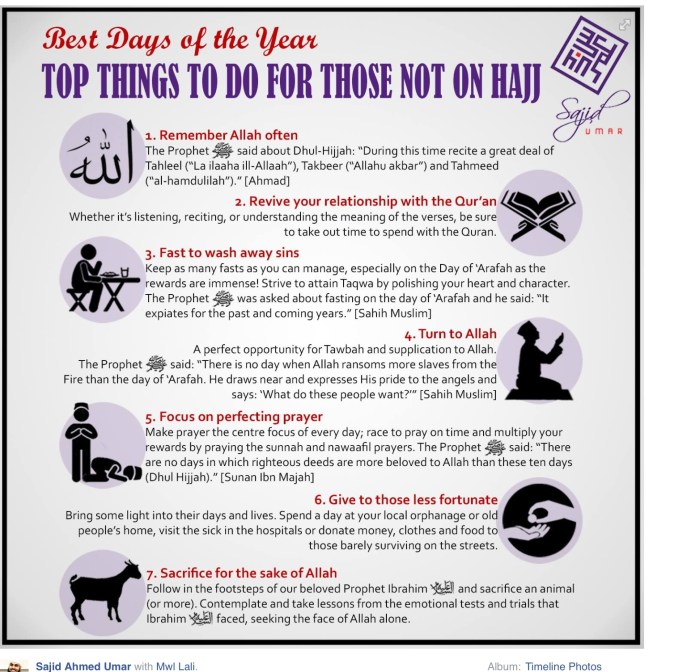
It’s the Day of Arafat soon- Fasting-Let’s Pray Our Sins are Forgiven!ThurrockMuslims.com

It’s the Day of Arafat soon- Let’s Pray Our Sins are Forgiven!!!


‘It was reported from Abu Qutaadah (may Allaah be pleased with him) that the Messenger of Allaah (peace and blessings of Allaah be upon him) was asked about fasting on the Day of ‘Arafaah. He said, “It expiates for the sins of the previous year and of the coming year.” Narrated by Muslim.’ sheikh sajid umar what to do ten days dhul hijjah

IMPORTANT NOTES:

  • Reciting Takbeer: Let us not forget to make the Takbeer following the obligatory prayers, starting after Fajr on Arafat day, till when the sun sets on the 13th of Dhul Hijjah. (see below for details).

 ‘It is Sunnah to recite takbeer at any time during the first ten days of Dhu’l-Hijjah and all the days of Tashreeq, starting from the beginning of the month of Dhu’l-Hijjah (i.e., from sunset on the last day of Dhu’l-Qa’dah) until the end of the days of al-Tashreeq, which is when the sun sets on the thirteenth day of Dhu’l-Hijjah).

 With regard to at certain times, it starts from Fajr on the day of ‘Arafah and lasts until the sun sets on the last day of the days of Tashreeq, in addition to the takbeer that may be recited at any time. So when a person says the tasleem at the end of the obligatory prayer, he should pray for forgiveness (by saying Astaghfir-Allaah) three times, and say, “Allaahumma anta al-salaam wa minka al-salaam, tabaarakta yaa dhaa’l-jalaali wa’l-ikraam (“O Allaah, You are al-Salaam [the One Who is free from all defects and deficiencies), and from You is all peace, blessed are You, O possessor of majesty and honour)”, then start the takbeer. 

{Takbeer: Allaahu akbar, Allaahu akbar, laa ilaaha ill-Allaah, Allaahu akbar, Allaahu akbar, wa lillaahi’l-hamd(Allaah is Most Great, Allaah is Most Great, there is no god but Allaah, Allaah is Most Great, Allaah is Most Great, and to Allaah be praise). }

 This is for those who are not on Hajj. The pilgrims should start the takbeer recited after prayer from Zuhr on the Day of Sacrifice (the 10th of Dhu’l-Hijjah).

 And Allaah knows best.

 See Majmoo’ Fataawa Ibn Baaz (may Allaah have mercy on him), 13/17; al-Sharh al-Mumti’ by Ibn ‘Uthaymeen (may Allaah have mercy on him), 5/220-224.’ [see http://islamqa.info/en/36627]

Keep us in your prayers!

Alhamdulillah. May Allah have mercy on us all and forgive us,guide us and grant us jannat-al-firdaus, wasallallahu ala nabiyinaa Muhammad sallallahu alayhi wasallam! ameen.

Thurrock Muslim Community

Thurrockmuslims.com

Sign up to get regular updates from us: here

PLEASE SHARE THIS LINK AND EARN REWARD IN SHA ALLAH : ) https://wp.me/p4GU3D-z8

Disclaimer

A MUST LEARN DUA! -Sayyid al-istighfar- Thurrockmuslims.com

In the Name of Allah, The Most Gracious, The Most Merciful


 Sayyid-al-istighfaar (The Best Form of Seeking Forgiveness) 


sayyid al istighfar

اللَّهُمَّ أَنْتَ رَبِّي لَا إِلَهَ إِلَّا أَنْتَ ، خَلَقْتَنِي وَأَنَا عَبْدُكَ ، وَأَنَا عَلَى عَهْدِكَ وَوَعْدِكَ مَا اسْتَطَعْتُ أَعُوذُ بِكَ مِنْ شَرِّ مَا صَنَعْتُ ، أَبُوءُ لَكَ بِنِعْمَتِكَ عَلَيَّ وَأَبُوءُ بِذَنْبِي ، فَاغْفِرْ لِي فَإِنَّهُ لَا يَغْفِرُ الذُّنُوبَ إِلَّا أَنْتَ

(Transliteration of Arabic –approximate representation)

Allaahumma anta rabbiy laa ilaaha illa anta, khalaqtani wa ana ‘abduka wa ana ‘ala ‘ahdika wa wa’dika ma astata’tu. A’oodhu bika min sharri ma sana’tu, aboo’u laka bi ni’matika ‘alayya wa aboo’u laka bi dhanbi, faghfir li fa innahu laa yaghfir al-dhunooba illa anta

(English translation)

 ‘O Allaah, You are my Lord, none has the right to be worshipped except You, You created me and I am Your servant and I abide to Your covenant and promise as best I can, I take refuge in You from the evil of which I committed. I acknowledge Your favour upon me and I acknowledge my sin, so forgive me, for verily none can forgive sin except You.’

source: from Sunnah, mentioned here 

Listen to/ hear the dua and learn how to say it (video below):

https://duas.com/dua/233/dua-and-remembrance-in-the-morning-and-evening-1


Evidence: from Sunnah sources, Hadith narration


It was narrated from Shaddaad ibn Aws (may Allah be pleased with him) from the Prophet (blessings and peace of Allah be upon him):

“The best of prayers for forgiveness is: Allaahumma anta rabbiy laa ilaaha illa anta, khalaqtani wa ana ‘abduka wa ana ‘ala ‘ahdika wa wa’dika ma astata’tu. A’oodhu bika min sharri ma sana’tu, aboo’u laka bi ni’matika ‘alayya wa aboo’u laka bi dhanbi, faghfir li fa innahu laa yaghfir al-dhunooba illa anta (O Allaah, You are my Lord, there is no god but You. You have created me and I am Your slave and I am keeping my promise and covenant to You as much as I can. I seek refuge with You from the evil of what I do. I acknowledge Your blessing and I acknowledge my sin, so forgive me, for there is none who can forgive sin except You).” He said: “Whoever says this during the day, believing in it firmly, and dies on that day before evening comes, he will be one of the people of Paradise, and whoever says it at night, believing firmly in it, and dies before morning comes, he will be one of the people of Paradise.” Narrated by al-Bukhaari (6306)

And Allah knows best.

source: http://islamqa.info/en/126934

Please share for the sake of Allah, spread the good, spread the rewards!

With this link: https://thurrockmuslims.com/2019/08/05/sayyid-al-istighfar/(opens in a new tab)

Please do sign up to our website via email and never miss an update!

Share and be a part of the sadaqah Jariyah and spreading Islam, belief in Allah’s Oneness, and the sunnah/practices of The final prophet Muhammad Sallallahu alayhi wasallam!

Wasalamu alaykum

Thurrock Muslim Community

ThurrockMuslims.com

Disclaimer

POWERFUL WORDS FOR EVERY INTELLIGENT INDIVIDUAL- THURROCKMUSLIMS.COM

POWERFUL WORDS FOR EVERY INTELLIGENT INDIVIDUAL- THURROCKMUSLIMS.COM


Need I say more…

https://www.youtube.com/watch?v=uLS5xZhYje0

Love it.

May Allah grant us all good guidance and protection and honour and Allah’s abundant blessings be upon His final messenger Muhammad peace be upon him. Ameen.

Thurrockmuslims.com

About

Share this in Sha Allah! https://thurrockmuslims.com/2019/07/24/powerful-words-for-every-intelligent-individual–thurrockmuslims-com/