The Inevitable

https://www.youtube.com/watch?v=sBQ1785Wwb8


Surah Al-Haaqqa
In the name of Allah, the Beneficent, the Merciful
The Inevitable (i.e. the Day of Resurrection)! (1) What is the Inevitable? (2) And what will make you know what the Inevitable is? (3) Thamûd and ‘Ad people denied the Qâri’ah [the striking Hour (of Judgement)]! (4) As for Thamûd, they were destroyed by the awful cry! (5) And as for ‘Ad, they were destroyed by a furious violent wind! (6) Which Allâh imposed on them for seven nights and eight days in succession, so that you could see men lying overthrown (destroyed), as if they were hollow trunks of date-palms! (7) Do you see any remnants of them? (8) And Fir’aun (Pharaoh), and those before him, and the cities overthrown [the towns of the people of [Lut (Lot)] committed sin, (9) And they disobeyed their Lord’s Messenger, so He seized them with a strong punishment. (10) Verily! When the water rose beyond its limits [Nûh’s (Noah) Flood], We carried you (mankind) in the floating [ship that was constructed by Nûh (Noah)]. (11) That We might make it a (Noah’s ship)an admonition for you, and that it might be retained by the retaining ears. (12) 
Then when the Trumpet will be blown with one blowing (the first one), (13) And the earth and the mountains shall be removed from their places, and crushed with a single crushing. (14) Then on that Day shall the (Great) Event befall. (15) And the heaven will be rent asunder, for that Day it (the heaven) will be frail, and torn up. (16) And the angels will be on its sides, and eight angels will, that Day, bear the Throne of your Lord above them. (17) That Day shall you be brought to Judgement, not a secret of you will be hidden. (18) 
Then as for him who will be given his Record in his right hand will say: “Here! read my Record! (19) “Surely, I did believe that I shall meet my Account!” (20) So he shall be in a life, well-pleasing. (21) In a lofty Paradise, (22) The fruits in bunches whereof will be low and near at hand. (23) Eat and drink at ease for that which you have sent on before you in days past! (24) 
But as for him who will be given his Record in his left hand, will say: “I wish that I had not been given my Record! (25) “And that I had never known, how my Account is! (26) “Would that it had been my end (death)! (27) “My wealth has not availed me; (28) “My power (and arguments to defend myself) have gone from me!” (29) (It will be said): “Seize him and fetter him; (30) Then throw him in the blazing Fire. (31) “Then fasten him with a chain whereof the length is seventy cubits!” (32) Verily, He used not to believe in Allâh, the Most Great, (33) And urged not on the feeding of Al¬Miskîn (the poor),[] (34) So no friend has he here this Day, (35) Nor any food except filth from the washing of wounds, (36) None will eat it except the Khâti’ûn (sinners, disbelievers, polytheists). (37) 
So I swear by whatsoever you see, (38) And by whatsoever you see not, (39) That this is verily the word of an honoured Messenger [i.e. Jibril (Gabriel) or Muhammad SAW which he has brought from Allâh]. (40) It is not the word of a poet, little is that you believe! (41) Nor is it the word of a soothsayer (or a foreteller), little is that you remember! (42) This is the Revelation sent down from the Lord of the ‘Alamin (mankind, jinn and all that exists). (43) And if he (Muhammad SAW) had forged a false saying concerning Us (Allâh swt), (44) We surely would have seized him by his right hand (or with power and might), (45) And then we certainly would have cut off his life artery (Aorta), (46) And none of you could witheld Us from (punishing) him. (47) And verily, this (Qur’ân) is a Reminder for the Muttaqûn (pious – see V.2:2) (48) And verily, We know that there are some among you that belie (this Qur’ân). (Tafsir At-Tabarî) (49) And indeed it (this Qur’ân) will be an anguish for the disbelievers (on the Day of Resurrection).[] (50) And Verily, it (this Qur’ân) is an absolute truth with certainty[] (51) So glorify the Name of your Lord, the Most Great.[] (52)

SubhanAllah, what a striking and powerful Surah.


Oh Allah help us act upon the Qur’an! Allahumma salli wa sallim ‘alaa rasoolillah. Ameen!

Please share this post for the sake of Allah, and get the reward for conveying the book of Allah! (link back to blog URL : http://wp.me/p4GU3D-hy ]


With love,

Thurrock Muslims

You need to spare 7 minutes…

and listen to this…

https://www.youtube.com/watch?v=6K9O6lKk00s

Do Muslims celebrate Christmas?

In the name of Allah, The Most Gracious The Most Merciful.

Peace y’all! Hope your all well.

It’s December.

giftbx

You know what that means?

Think Britain, national holiday, Christmas, Jesus…

You can argue all you want that it’s been commercialised and it’s no longer a religious thing, but my friend, that’s not the point.

Christmas day, i.e 25th December is attributed to the Christian faith, yet did you know it has its roots in PAGANISM?


Let’s have a look at the history of Christmas:

According to Britannica Encyclopaedia, Christmas has become a Christian festival where Christians believe they are celebrating the birth of Christ, or Jesus. Historically, however, the date coincides with pagan Roman festivals which celebrated the winter solstice. It is believed that early Christians wanted to celebrate the 25th to coincide with the pagan festival. There is no clear statement in the New testament supporting the celebration of Jesus’ birth on the 25th. Nevertheless, it is still widely celebrated in that manner.

So basically in a nutshell, Christmas day has pagan origins!

Well,  DO MUSLIMS CELEBRATE CHRISTMAS? 

In all honesty and with due respect, the answer is -they don’t.

Choosing not to celebrate Christmas is NOT a personal attack on those who wish to celebrate it. It’s a personal decision deeply rooted in our internal religious beliefs.

As Muslims, we believe there’s no compulsion in religion. Just as you’re not compelled to believe, we aren’t compelled to disbelieve.  : )

“There is no compulsion in religion. Verily, the Right Path has become distinct from the wrong path. Whoever disbelieves in taghoot (false gods) and believes in Allah, then he has grasped the most trustworthy handhold that will never break.” [QUR’AN CHAPTER 2:256]  

“Say: ‘O you mankind! Now truth (i.e. the Quran and the Prophet Muhammad), has come to you from your Lord. So whosoever receives guidance, he does so for the good of his own self; and whosoever goes astray, he does so to his own loss; and I am not (set) over you as a Wakeel (disposer of affairs to oblige you for guidance).’”[QUR’AN CHAPTER 10:108] 

“Whosoever does righteous good deeds, it is for (the benefit of) his ownself; and whosoever does evil, it is against his ownself. And your Lord is not at all unjust to (His) slaves.[QUR’AN CHAPTER 41:46] 

We highly encourage you to look into Islam though, because we want you to share the delight and happiness, we want the best for all. : D

As Muslims, our life mission is to serve Allah (The One True God) without ascribing any partners/rivals to Him. We are completely MONOTHEISTIC. Anything that opposes the principles of Islamic monotheism is a no-go for us.

Islamic monotheism  entails belief in and submission to Allah (The One True God), by attributing complete Oneness to Allah as He deserves in His Lordship, Names and Attributes and right to be worshipped alone.

And a Muslim, i.e. one who submits to Allah (The One True God), relentlessly steers away from anything that contradicts the principles of Islamic monotheism. Polytheism, idolatry and ascribing partners to Allah are MAJOR SINS! The biggest sin which Allah will not forgive, is ascribing partners to Him !


‘Verily, Allah forgives not that partners should be set up with Him (in worship), but He forgives except that (anything else) to whom He wills; and whoever sets up partners with Allah in worship, he has indeed invented a tremendous sin.’ [Qur’an, chapter 4, verse 48- English interpretation]

Allah is so self-sufficient, it does not befit His Majesty to take a son or wife, or to beget or be begotten. He does not resemble His creation, for He is the uncreated Creator, and there is no similitude to Him.

In fact, a remarkably concise description of Allah can be found in chapter 112 of The Noble Qur’an, which is the verbatim words of Allah, and Allah’s final revealed book to mankind.

Have a listen to this chapter here:

Regarding Jesus (peace be upon him), in Islam we believe he was a mighty messenger of Allah. Jesus, or Isa in Arabic, was born a miraculous birth, from the virgin Mary. We refer to Jesus as ‘Isa ibnu Maryam, which means Jesus son of Mary. Jesus did not have a father, and he is not the son of God/Allah, because as we mentioned earlier, it does not befit the majesty of Allah to beget. Allah decreed that Jesus would be born miraculously without a father from the pure, chaste, virgin Mary. We respect them very much and we know that Jesus never claimed divinity, rather Jesus called his people to worship Allah alone, the same message each prophet and messenger of Allah called to. Jesus’ (peace be upon him) story can be found in the Qur’an in numerous places. (for more information, please see the post on chapter 19 of the Qur’an entitled Maryam!)

Incidentally, Paganism supports polytheism. Polytheism means worshipping multiple deities. Therefore, the Christian Trinity is essentially polytheism. And as previously mentioned in this blog, Islam means submission to the One True God, Allah, and our purpose in life is to acknowledge Allah’s complete Oneness, to uphold Islamic monotheism, and to attribute absolute Oneness to Allah in His Lordship, names and attributes and right to be worshipped alone.

handshak

Not celebrating Christmas, is not contrary to British values, it’s contrary to polytheistic & pagan values. That’s it.

It would be hypocritical and contradictory to be a monotheist, but continue to indulge in polytheistic & pagan traditions. Don’t you think?

I hope you understand now, why we don’t celebrate Christmas, why we don’t exchange Christmas greetings and why we don’t give or take cards and gifts on this occasion. It’s nothing to do with you personally, so please don’t take it personally! Because the truth is, as Muslims, the most important One to us is Allah, and the only reason we are alive is for Allah, to serve Him, to worship Him, because we need to worship Him and He doesn’t need us to do that. Whether or not we worship Him, it does not detract or add to His majesty at all. Rather He is The Self-Sufficient, The Majestic, The Rich, Free of all needs. The Lord of all that exists.

Besides, our kind behaviour and gifts to you is not supposed to be limited to a certain day of the year, as Muslims we are required to deal with everyone in a just manner at all times, exhibiting the best character.  If we have fallen short in fulfilling our rights towards you as our neighbours, please do forgive us. We make mistakes, after all we are human. Although, we endeavour to follow the best example of excellent moral conduct,as taught to us by Allah’s final prophet and messenger, Muhammad peace be upon him.

I’ll leave you with a verse from the Qur’an to get you thinking.

‘Say (O Muhammad صلى الله عليه وسلم): “I am only a man like you. It has been revealed to me that your Ilah (God) is One Ilah (God – i.e. Allah). So whoever hopes for the Meeting with his Lord, let him work righteousness and associate none as a partner in the worship of his Lord.” ‘

[Qur’an, chapter 18: v110, english interpretation]

Thanks for reading.

Peace.

Thurrock Muslims


Dear reader.. part 2

bismillah


Dear Reader,

This is my second letter to you.

Hey I know its been a while! Thanks for your patience though.

So you tried getting rich, but failed… or maybe you made it.

So you tried fame, and maybe you got it, but at times, with fame, comes shame…some love you, some don’t…

So you tried getting a degree, but you didn’t quite hack it… or maybe you did, and then a bachelors wasn’t enough, so you got a masters, then a phd, and now you’re very intelligent… well at least you think you are… : )

So can you tell me why you were born the day you were? Can you tell the day you will pass away? Can you tell me what colour my bedroom floor is? Can you?

Nope. Because you can’t see it. But that doesn’t mean you were not born on the day you were, or that you won’t pass away one day, or that my bedroom floor is colourless…

Although you cannot be an eye-witness on many an occasion, nor can you physically witness everything that exists or happens, you do agree with me that these things are true because they have signs which point to their reality.

You know you were born that day, because you have a birth certificate to prove it. You know you will die one day, because you see people losing their lives everyday. You know my bedroom floor has a colour, otherwise it wouldn’t be a normal floor.

So I’m sure you’d agree, you don’t always have to see things plainly in order to ascertain their existence. Yet there are signs which indicate they exist.

The universe and all within it points to the existence of a Supreme Creator.

And the Supreme Creator,is unique, there is no similitude to Allah. Allah is The Supreme One True God, The Uncreated Lord of the universe and all within it, the One who created everything in pairs as a sign to remind us of His Oneness, and His right to be worshipped alone. He is The Rich, The Free of all needs, The Most High. The Self-Sustaining, The Self-Existing, The Universal Witness… The Ever-Living, The Eternal, The One who is not born, nor does He die. He is the First and the Last. The Originator..

And we will return to Him…everything will perish except Him…

Because man is a mere fragile created being…

And our purpose on earth is to establish the remembrance of The Creator, Allah.

Allah is our Provider, our Sustainer, our Helper, our Master, our Lord, our Protector.

We need Him. And we need to worship Him, to fulfil our purpose, because He deserves exclusive worship.

So then, we now know that the purpose in life is to worship Allah (The One True God), Alone.

You see, Allah doesn’t need us to worship Him. He is the Owner of power. Allah is forever Self-Sufficeint. He is not bound by time and location, for He created these. Allah tells us in the Qur’an that He is The Rich, Free of all needs and wants, The Praiseworthy.

He did not need us when we were non-existent, He doesn’t need us now, and He will never need us.

Allah doesn’t need us to worship Him, rather He deserves our worship… and we need Him.. we depend on Him.. He is our Provider, our Protector, our Creator, our Lord.

and we NEED to worship Him… because that is the purpose for which we were created.


( 56 )   And I did not create the jinn and mankind except to worship Me.
( 57 )   I do not want from them any provision, nor do I want them to feed Me.
( 58 )   Indeed, it is Allah who is the [continual] Provider, the firm possessor of strength.
( 59 )   And indeed, for those who have wronged is a portion [of punishment] like the portion of their predecessors, so let them not impatiently urge Me.
( 60 )   And woe to those who have disbelieved from their Day which they are promised.[QUR’AN  CHAPTER 51 VERSES 56-60] 

Whether we worship Him or not, it does not detract or add to His Might and Power whatsoever, Allah is the All-Powerful, the unyielding in strength. Allah possesses the ultimate power, so what are we?… we have to inevitably submit to Him. We have no other refuge, only Allah grants true security.

So won’t we run back to Him?

and with that, I’m going to call it a day, my friend.

With love and peace,

Thurrock Muslims

p.s. guess you’re wondering, how do we worship Allah? Follow our blog, and you’ll find out, God willing : )

I’m in Love….

bismillah

With this.

https://www.youtube.com/watch?v=4ybk3Txn3Ls

Sit alone, click play, shut your eyes, listen with your heart…

(Scroll down for English interpretation- I know you’re busy, but DON’T be lazy to read this!)

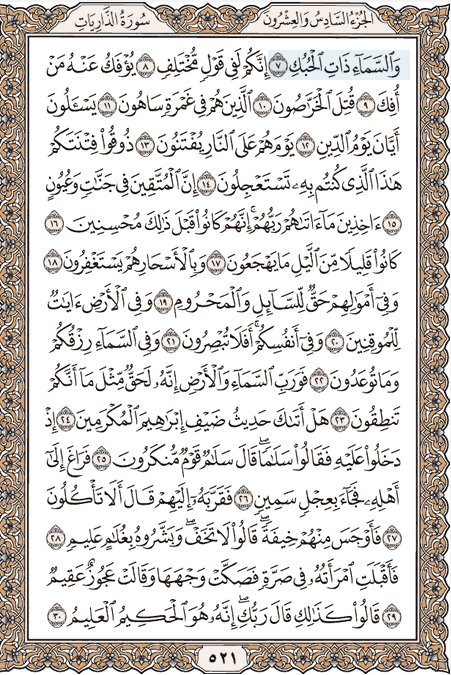
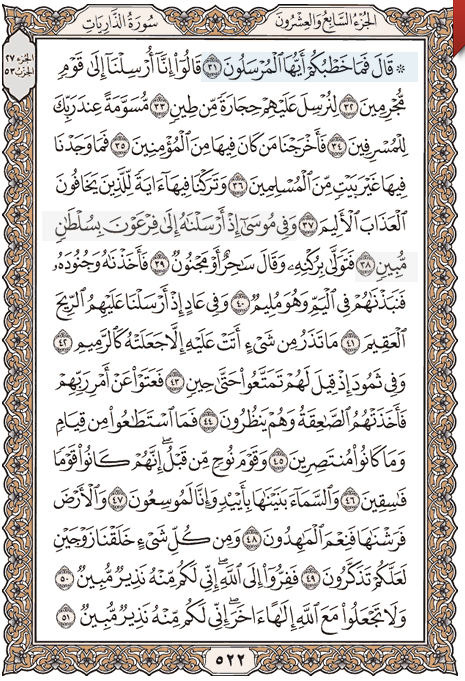
zariyat 1 zariyat 2 zariyat 3 zariyat 4

Read at QURAN KSU 

In the Name of Allah, The Most Gracious, The Most Merciful.


( 1 )   By those [winds] scattering [dust] dispersing
( 2 )   And those [clouds] carrying a load [of water]
( 3 )   And those [ships] sailing with ease
( 4 )   And those [angels] apportioning [each] matter,
( 5 )   Indeed, what you are promised is true.
( 6 )   And indeed, the recompense is to occur.
( 7 )   By the heaven containing pathways,
( 8 )   Indeed, you are in differing speech.
( 9 )   Deluded away from the Qur’an is he who is deluded.
( 10 )   Destroyed are the falsifiers
( 11 )   Who are within a flood [of confusion] and heedless.
( 12 )   They ask, “When is the Day of Recompense?”
( 13 )   [It is] the Day they will be tormented over the Fire
( 14 )   [And will be told], “Taste your torment. This is that for which you were impatient.”
( 15 )   Indeed, the righteous will be among gardens and springs,
( 16 )   Accepting what their Lord has given them. Indeed, they were before that doers of good.
( 17 )   They used to sleep but little of the night,
( 18 )   And in the hours before dawn they would ask forgiveness,
( 19 )   And from their properties was [given] the right of the [needy] petitioner and the deprived.
( 20 )   And on the earth are signs for the certain [in faith]
( 21 )   And in yourselves. Then will you not see?
( 22 )   And in the heaven is your provision and whatever you are promised.
( 23 )   Then by the Lord of the heaven and earth, indeed, it is truth – just as [sure as] it is that you are speaking.
( 24 )   Has there reached you the story of the honored guests of Abraham? –
( 25 )   When they entered upon him and said, “[We greet you with] peace.” He answered, “[And upon you] peace, [you are] a people unknown.
( 26 )   Then he went to his family and came with a fat [roasted] calf
( 27 )   And placed it near them; he said, “Will you not eat?”
( 28 )   And he felt from them apprehension. They said, “Fear not,” and gave him good tidings of a learned boy.
( 29 )   And his wife approached with a cry [of alarm] and struck her face and said, “[I am] a barren old woman!”
( 30 )   They said, “Thus has said your Lord; indeed, He is the Wise, the Knowing.”
( 31 )   [Abraham] said, “Then what is your business [here], O messengers?”
( 32 )   They said, “Indeed, we have been sent to a people of criminals
( 33 )   To send down upon them stones of clay,
( 34 )   Marked in the presence of your Lord for the transgressors.”
( 35 )   So We brought out whoever was in the cities of the believers.
( 36 )   And We found not within them other than a [single] house of Muslims.
( 37 )   And We left therein a sign for those who fear the painful punishment.
( 38 )   And in Moses [was a sign], when We sent him to Pharaoh with clear authority.
( 39 )   But he turned away with his supporters and said,” A magician or a madman.”
( 40 )   So We took him and his soldiers and cast them into the sea, and he was blameworthy.
( 41 )   And in ‘Aad [was a sign], when We sent against them the barren wind.
( 42 )   It left nothing of what it came upon but that it made it like disintegrated ruins.
( 43 )   And in Thamud, when it was said to them, “Enjoy yourselves for a time.”
( 44 )   But they were insolent toward the command of their Lord, so the thunderbolt seized them while they were looking on.
( 45 )   And they were unable to arise, nor could they defend themselves.
( 46 )   And [We destroyed] the people of Noah before; indeed, they were a people defiantly disobedient.
( 47 )   And the heaven We constructed with strength, and indeed, We are [its] expander.
( 48 )   And the earth We have spread out, and excellent is the preparer.
( 49 )   And of all things We created two mates; perhaps you will remember.
( 50 )   So flee to Allah. Indeed, I am to you from Him a clear warner.
( 51 )   And do not make [as equal] with Allah another deity. Indeed, I am to you from Him a clear warner.
( 52 )   Similarly, there came not to those before them any messenger except that they said, “A magician or a madman.”
( 53 )   Did they suggest it to them? Rather, they [themselves] are a transgressing people.
( 54 )   So leave them, [O Muhammad], for you are not to be blamed.
( 55 )   And remind, for indeed, the reminder benefits the believers.
( 56 )   And I did not create the jinn and mankind except to worship Me.
( 57 )   I do not want from them any provision, nor do I want them to feed Me.
( 58 )   Indeed, it is Allah who is the [continual] Provider, the firm possessor of strength.
( 59 )   And indeed, for those who have wronged is a portion [of punishment] like the portion of their predecessors, so let them not impatiently urge Me.
( 60 )   And woe to those who have disbelieved from their Day which they are promised.


Oh My God! I’m lost for words…yet bursting to say something…

I keep clicking replay…

I can listen to this all day… I feel something in my heart when I read and listen to this. I see warnings, reminders, promises. I see truth. I see proof. I see meaning. I see no error. I feel a sense of emergency, of urgency. I feel I have to make a move. I have to act upon it. I feel I found the purpose in life.

I feel I need to run back to The One Who gave me life, The One Who will cause me to die, The One Who will resurrect me, and punish or reward me accordingly.

I need to run back to Allah alone.

So do you.

Be objective. Be sincere. Be open minded. I’m sure you’ll feel something too.

Oh Allaah the One Who changes the hearts, keep my heart firm upon Your religion!  Guide us to preserve on Your straight path forever. Allahumma salli wasallim alaa nabiyinaa Muhammad  sallallahu alayhi wasallam. Ameen.


With love for the sake of The One.

Thurrock Muslims.

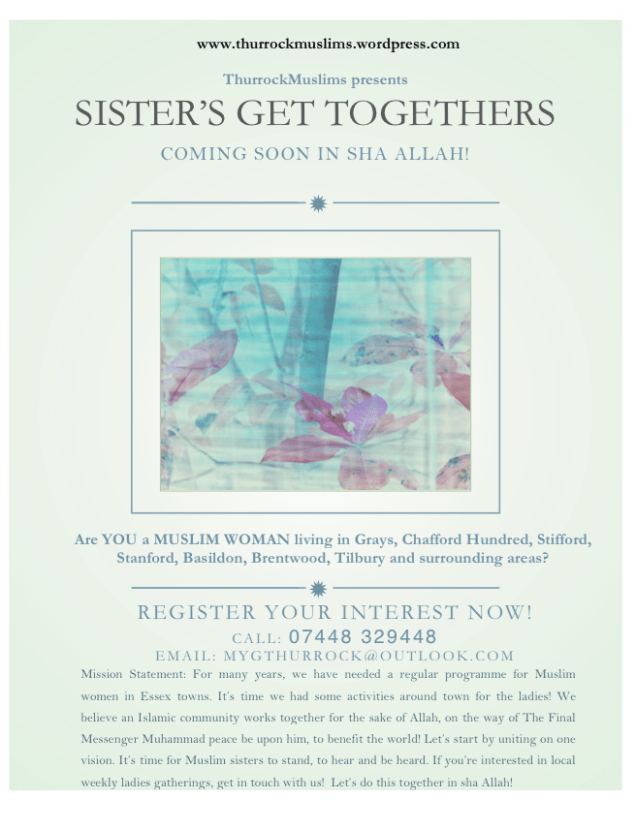
SISTER’S WEEKLY GATHERING COMING SOON IN TOWN!

IN THE NAME OF ALLAH!

sisters weekly gathering mygthurrock new no 2015

CONTACT US AND REGISTER BELOW!!!


← Back

Thank you for your response. ✨

Abu Bakr As-Siddeeq!(#Love)

Bismillah

Asalamu alaykum

SubhanAllah, have you heard the story of the companion, Abu Bakr As-Siddeeq Radi Allahu anh…

He was the best friend of the best of creation, Rasoolullah Muhammad Sallallahu alayhi wasallam.

Abu Bakr’s friendship with the final messenger of Allah, was a true friendship based on love… on trust… on loyalty… on truthfulness.

What an amazing companion radi Allahu anh! There are accounts of his love for the messenger of Allah, narrations of how he stuck with the messenger peace be upon him, in his most testing times, when he was opposed by his people, when he was threatened by the idolators, when he was turned out from his birthtown, Abu Bakr stuck with him through thick and thin. He enthusiastically accompanied him on the migration to Madinah. He preferred the messenger Muhammad peace be upon him to himself, radi Allahu anh. Because he believed that Muhammad peace be upon truly was the messenger of Allah.

He loved the messenger dearly, for the sake of Allah.

And that’s what you call a true friendship.

Hear more about this truthful companion Radi Allahu anh!

Love and share!


May Allah grant us perfect love for Him alone, and love for His messenger sallallahu alayhi wasallam, the way the companions like amazing Abu bakr Radi Allahu anh loved him.

ameen ya Rab al alameen.

With Love for the sake of Allah!

Thurrock Muslims.

Muharram 1437

Asalaamu alaykum

In the Name of Allah.


Dear readers, we entered the new Islamic year just last week, walhamdulillah.

We are now in the first month of Hijri year 1437, Muharram.
overcast moon

Muharram is a month of great virtue. It is of the four sacred months out of twelve months in the Islamic calendar.

Allaah says (interpretation of the meaning):

“Verily, the number of months with Allaah is twelve months (in a year), so was it ordained by Allaah on the Day when He created the heavens and the earth; of them four are Sacred (i.e. the 1st, the 7th, the 11th and the 12th months of the Islamic calendar). That is the right religion, so wrong not yourselves therein”

[al-Tawbah 9:36]


Allah, The Almighty, has made it a sacred month of great virtue. May He allow us to abstain from sins, to turn to Him in repentance, and to run back to Him with good deeds, for verily, the good deeds remove the evil deeds.

And Allah is The Most Generous. Oh Allah we ask for Your peace and blessings upon The final prophet Muhammad peace be upon him. Ameen ya Rabb al ‘aalameen.

It is encouraged to fast in Muharram, particularly the 10th (Ashoora’), and the preceding day with it (Tasooaa’). Let us take advantage of these beautiful autumn days, in sha Allah.


It was proven from the Prophet (peace and blessings of Allaah be upon him) that the best fasting after Ramadaan is fasting in the month of Muharram.

It was narrated that Abu Hurayrah (may Allaah be pleased with him) said: The Messenger of Allaah (peace and blessings of Allaah be upon him) said: “The best fasting after Ramadaan is the month of Allaah Muharram, and the best prayer after the obligatory prayer is prayer at night.” Narrated by Muslim, 1163. 

Regarding the significance of fasting on Ashoora’ :

The reason why the Prophet (peace and blessings of Allaah be upon him) fasted on the day of ‘Ashoora’ and urged the people to do likewise is mentioned in the hadeeth narrated by al-Bukhaari (1865) from Ibn ‘Abbaas (may Allaah be pleased with him), who said: The Prophet (peace and blessings of Allaah be upon him) came to Madeenah and saw the Jews fasting on the day of ‘Ashoora’. He said, “What is this?” They said, “This is a good day, this is the day when Allaah saved the Children of Israel from their enemy and Moosa fasted on this day.” He (peace and blessings of Allah be upon him) said, “We are closer to Moosa than you.” So he fasted on this day and told the people to fast. 


Fasting the day of ‘Ashoora’ does expiate (minor sins) for the past year, because the Prophet (peace and blessings of Allaah be upon him) said: “Fasting the day of ‘Arafah I hope Allaah will expiate thereby for the year before it and the year after it, and fasting the day of ‘Ashoora’  I hope Allaah will expiate thereby for the year that came before it.” Narrated by Muslim, 1162.


‘Abd-Allaah ibn ‘Abbaas (may Allaah be pleased with him) said: When the Messenger of Allaah (peace and blessings of Allaah be upon him) fasted on the day of ‘Ashoora and told the people to fast, they said, “O Messenger of Allaah, this is a day that is venerated by the Jews and Christians.” The Messenger of Allaah (peace and blessings of Allaah be upon him) said, “Next year, if Allaah wills, we will fast on the ninth day.” But by the time the following year came, the Messenger of Allaah (peace and blessings of Allaah be upon him) had passed away.

 Narrated by Muslim, 1916.


It is expected that 9th Muharram 1437 will coincide with Friday 23rd October 2015, and Saturday 24th October 2015 will be the 10th, or Ashoora’. May Allah grant us sincerity and the ability to seize the opportunity this Ashoora’ by fasting to gain His reward, love and forgiveness, through implementing the Sunnah of His final messenger Muhammad sallallahu alayhi wasallam. ameen

With love for the sake of Allah


Thurrock Muslims

Muharram 1437

Continue reading

It’s the Day of Arafat Today- Let’s Pray Our Sins are Forgiven!!!


Bismillah!

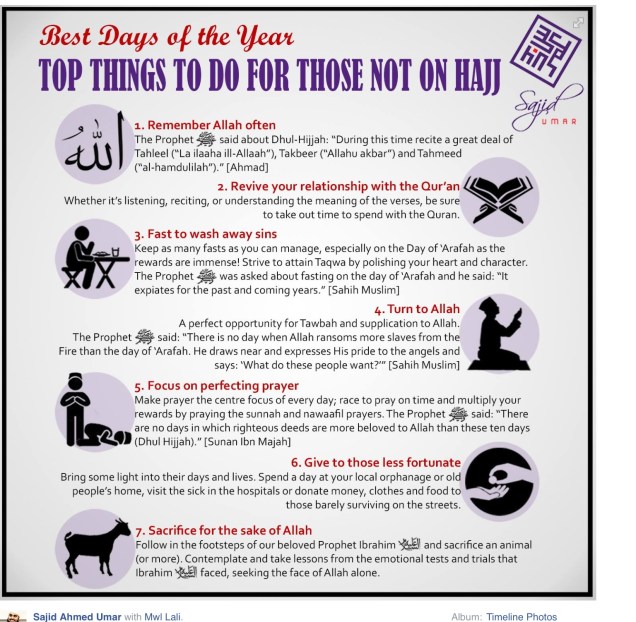
‘It was reported from Abu Qutaadah (may Allaah be pleased with him) that the Messenger of Allaah (peace and blessings of Allaah be upon him) was asked about fasting on the Day of ‘Arafaah. He said, “It expiates for the sins of the previous year and of the coming year.” Narrated by Muslim.’ sheikh sajid umar what to do ten days dhul hijjah


IMPORTANT NOTES:

  • Reciting Takbeer: Let us not forget to make the Takbeer following the obligatory prayers, starting after Fajr on Arafat day, till when the sun sets on the 13th of Dhul Hijjah. (see below for details).

 ‘It is Sunnah to recite takbeer at any time during the first ten days of Dhu’l-Hijjah and all the days of Tashreeq, starting from the beginning of the month of Dhu’l-Hijjah (i.e., from sunset on the last day of Dhu’l-Qa’dah) until the end of the days of al-Tashreeq, which is when the sun sets on the thirteenth day of Dhu’l-Hijjah).

 With regard to at certain times, it starts from Fajr on the day of ‘Arafah and lasts until the sun sets on the last day of the days of Tashreeq, in addition to the takbeer that may be recited at any time. So when a person says the tasleem at the end of the obligatory prayer, he should pray for forgiveness (by saying Astaghfir-Allaah) three times, and say, “Allaahumma anta al-salaam wa minka al-salaam, tabaarakta yaa dhaa’l-jalaali wa’l-ikraam (“O Allaah, You are al-Salaam [the One Who is free from all defects and deficiencies), and from You is all peace, blessed are You, O possessor of majesty and honour)”, then start the takbeer. 

{Takbeer: Allaahu akbar, Allaahu akbar, laa ilaaha ill-Allaah, Allaahu akbar, Allaahu akbar, wa lillaahi’l-hamd(Allaah is Most Great, Allaah is Most Great, there is no god but Allaah, Allaah is Most Great, Allaah is Most Great, and to Allaah be praise). }

 This is for those who are not on Hajj. The pilgrims should start the takbeer recited after prayer from Zuhr on the Day of Sacrifice (the 10th of Dhu’l-Hijjah).

 And Allaah knows best.

 See Majmoo’ Fataawa Ibn Baaz (may Allaah have mercy on him), 13/17; al-Sharh al-Mumti’ by Ibn ‘Uthaymeen (may Allaah have mercy on him), 5/220-224.’ [see http://islamqa.info/en/36627]

Keep us in your prayers!

Alhamdulillah. May Allah have mercy on us all and forgive us,guide us and grant us jannat-al-firdaus, wasallallahu ala nabiyinaa Muhammad sallallahu alayhi wasallam! ameen.

Thurrock Muslims


Best Ten Days of the Year…What You Need to Know

In the name of Allah, the Most Gracious, The Most Merciful

With about two days to go before Dhul Hijjah starts, let’s get prepared. Find out about sacrifice/udhiyah/qurbani, Hajj, virtuous deeds, fasting and fasting on the day of Arafah, the takbeer, and much more!

Virtues of the Ten Days of Dhul Hijjah


How do the first ten days of the Month of Dhul Hijjah differ from other days of the year?

Adapted from Sheikh Salih Al Munajjid, IslamQA

Praise be to Allaah Who has created Time and has made some times better than others, some months and days and nights better than others, when rewards are multiplied many times, as a mercy towards His slaves. This encourages them to do more righteous deeds and makes them more eager to worship Him, so that the Muslim renews his efforts to gain a greater share of reward, prepare himself for death and supply himself in readiness for the Day of Judgement

land of the rising sun-japanese sunrise clpatThis season of worship brings many benefits, such as the opportunity to correct one’s faults and make up for any shortcomings or anything that one might have missed. Every one of these special occasions involves some kind of worship through which the slaves may draw closer to Allaah, and some kind of blessing though which Allaah bestows His favour and mercy upon whomsoever He will. The happy person is the one who makes the most of these special months, days and hours and draws nearer to his Lord during these times through acts of worship; he will most likely be touched by the blessing of Allaah and will feel the joy of knowing that he is safe from the flames of Hell. (Ibn Rajab, al-Lataa’if, p.8)

The Muslim must understand the value of his life, increase his worship of Allaah and persist in doing good deeds until the moment of death. Allaah says (interpretation of the meaning):

“And worship your Lord until there comes unto you the certainty.” [al-Hijr 15:99]

The mufassireen (commentators) said: “‘The certainty’ means death.”

Among the special seasons of worship are the first ten days of Dhu’l-Hijjah, which Allaah has preferred over all the other days of the year. Ibn ‘Abbaas (may Allaah be pleased with him and his father) reported that the Prophet (peace and blessings of Allaah be upon him) said: “There are no days in which righteous deeds are more beloved to Allaah than these ten days.” The people asked, “Not even jihaad for the sake of Allaah?” He said, “Not even jihaad for the sake of Allaah, except in the case of a man who went out to fight giving himself and his wealth up for the cause, and came back with nothing.” (Reported by al-Bukhaari, 2/457).

Ibn ‘Abbaas (may Allaah be pleased with him and his father) also reported that the Prophet (peace and blessings of Allaah be upon him) said: “There is no deed more precious in the sight of Allaah, nor greater in reward, than a good deed done during the ten days of Sacrifice.” He was asked, “Not even jihaad for the sake of Allaah?” He said, “Not even jihaad for the sake of Allaah, except in the case of a man who went out to fight giving himself and his wealth up for the cause, and came back with nothing.” (Reported by al-Daarimi, 1/357; itsisnaad is hasan as stated in al-Irwaa’, 3/398).


These texts and others indicate that these ten days are better than all the other days of the year, with no exceptions, not even the last ten days of Ramadaan. But the last ten nights of Ramadaan are better, because they include Laylat al-Qadr (“the Night of Power”), which is better than a thousand months. Thus the various reports may be reconciled. (See Tafseer Ibn Katheer, 5/412).


orange tiles

You should know, my brothers and sisters in Islaam, that the virtue of these ten days is based on many things:


  1. Allaah swears an oath by them, and swearing an oath by something is indicative of its importance and great benefit. Allaah says (interpretation of the meaning): “By the dawn; by the ten nights” [al-Fajr 89:1-2]. Ibn ‘Abbaas, Ibn al-Zubayr, Mujaahid and others of the earlier and later generations said that this refers to the first ten days of Dhu’l-Hijjah. Ibn Katheer said: “This is the correct opinion.” (Tafseer Ibn Katheer, 8/413)


2. The Prophet (peace and blessings of Allaah be upon him) testified that these are the best days of this world, as we have already quoted above from saheeh ahaadeeth.

3.The Prophet (peace and blessings of Allaah be upon him) encouraged people to do righteous deeds because of the virtue of this season for people throughout the world, and also because of the virtue of the place – for the Hujjaaj (pilgrims) to the Sacred House of Allaah.

4.The Prophet (peace and blessings of Allaah be upon him) commanded us to recite a lot of Tasbeeh (“Subhan-Allaah“),Tahmeed (“Al-hamdu Lillaah“) and Takbeer (“Allaahu akbar“) during this time. ‘Abdullaah ibn ‘Umar (may Allaah be pleased with him and his father) reported that the Prophet (peace and blessings of Allaah be upon him) said: “There are no days greater in the sight of Allaah and in which righteous deeds are more beloved to Him than these ten days, so during this time recite a great deal of Tahleel (“La ilaaha ill-Allaah“), Takbeerand Tahmeed.” (Reported by Ahmad, 7/224; Ahmad Shaakir stated that it is saheeh).

5.These ten days include Yawm ‘Arafaah (the Day of ‘Arafaah), on which Allaah perfected His Religion. Fasting on this day will expiate for the sins of two years. These days also includeYawm al-Nahar (the Day of Sacrifice), the greatest day of the entire year and the greatest day of Hajj, which combines acts of worship in a way unlike any other day.

6.These ten days include the days of sacrifice and of Hajj.

Question: What must the Muslim avoid during these ten days if he wants to offer a sacrifice?

The Sunnah indicates that the one who wants to offer a sacrifice must stop cutting his hair and nails and removing anything from his skin, from the beginning of the ten days until after he has offered his sacrifice, because the Prophet (peace and blessings of Allaah be upon him) said: “When you see the new moon of Dhu’l-Hijjah, if any one of you wants to offer a sacrifice, then he should stop cutting his hair and nails until he has offered his sacrifice.” According to another report he said: “He should not remove (literally, touch) anything from his hair or skin.” (reported by Muslim with four isnaads, 13/146)

The Prophet’s instruction here makes one thing obligatory and his prohibition makes another haraam, according to the soundest opinion, because these commands and prohibitions are unconditional and unavoidable. However, if a person does any of these things deliberately, he must seek Allaah’s forgiveness but is not required to offer (an extra) sacrifice in expiation; his sacrifice will be acceptable. Whoever needs to remove some hair, nails, etc. because it is harming him, such as having a broken nail or a wound in a site where there is hair, should do so, and there is nothing wrong with that. The state of ihraam is so important that it is permitted to cut one’s hair if leaving it will cause harm. There is nothing wrong with men or women washing their heads during the first ten days of Dhu’l-Hijjah, because the Prophet (peace and blessings of Allaah be upon him) only forbade cutting the hair, not washing it.

The wisdom behind this prohibition of the one who wants to offer a sacrifice from cutting his hair etc., is so that he may resemble those in ihraam in some aspects of the rituals performed, and so that he may draw closer to Allaah by offering the sacrifice. So he leaves his hair and nails alone until the time when he has offered his sacrifice, in the hope that Allaah will save him in his entirety from the Fire. And Allaah knows best.

If a person has cut his hair or nails during the first ten days of Dhu’l-Hijjah because he was not planning to offer a sacrifice, then he decides later, during the ten days, to offer a sacrifice, then he must refrain from cutting his hair and nails from the moment he makes this decision.

Some women may delegate their brothers or sons to make the sacrifice on their behalf, then cut their hair during these ten days. This is not correct, because the ruling applies to the one who is offering the sacrifice, whether or not he (or she) delegates someone else to carry out the actual deed. The prohibition does not apply to the person delegated, only to the person who is making the sacrifice, as is indicated in the hadeeth. The person who is sacrificing on behalf of someone else, for whatever reason, does not have to adhere to this prohibition.

This prohibition appears to apply only to the one who is offering the sacrifice, not to his wife and children, unless any of them is offering a sacrifice in his or her own right, because the Prophet (peace and blessings of Allaah be upon him) used to sacrifice “on behalf of the family of Muhammad,” but there are no reports that say he forbade them to cut their hair or nails at that time.

If a person was planning to offer a sacrifice, then he decides to go and perform Hajj, he should not cut his hair or nails if he wants to enter ihraam, because the Sunnah is only to cut hair and nails when necessary. But if he is performing Tamattu’ [whereby he performs ‘Umrah, comes out of ihraam and enters ihraam anew for Hajj], he should trim his hair at the end of his ‘Umrah because this is part of the ritual.

The things that are described above as being prohibited for the person who is planning to offer a sacrifice are reported in the hadeeth quoted above; the person is not forbidden to wear perfume, have marital relations, wear sewn garments, etc.

Concerning the types of worship to be performed during these ten days: one must understand that these days are a great blessing from Allaah to His slave, which is appreciated properly by the actively righteous. It is the Muslim’s duty to appreciate this blessing and make the most of the opportunity, by devoting these ten days to paying more attention to striving hard in worship. Among His blessings to His slaves, Allaah has given us many ways in which to do good and worship Him, so that the Muslim may be constantly active and consistent in his worship of his Lord.

Among the good deeds which the Muslim should strive to do during the first ten days of Dhu’l-Hijjah are:

  1. Fasting. It is Sunnah to fast on the ninth day of Dhu’l-Hijjah, because the Prophet (peace and blessings of Allaah be upon him) urged us to do good deeds during this time, and fasting is one of the best of deeds. Allaah has chosen fasting for Himself, as is stated in the hadeeth qudsi: “Allaah says: ‘All the deeds of the son of Adam are for him, except for fasting, which is for Me and I am the One Who will reward him for it.’” (Reported by al-Bukhaari, 1805).

    The Prophet (peace and blessings of Allaah be upon him)
     used to fast on the ninth of Dhu’l-Hijjah. Hunaydah ibn Khaalid reported from his wife that some of the wives of the Prophet(peace and blessings of Allaah be upon him) said: “The Prophet (peace and blessings of Allaah be upon him) used to fast on the ninth of Dhu’l-Hijjah, on the day of ‘Aashooraa’, on three days of each month, and on the first two Mondays and Thursdays of each month.” (Reported by al-Nisaa’i, 4/205 and by Abu Dawud; classified by al-Albaani as saheeh in Saheeh Abi Dawud, 2/462).
  2. Takbeer. It is Sunnah to say Takbeer (“Allaahu akbar“),Tahmeed (“Al-hamdu Lillaah“), Tahleel (“La ilaha ill-Allaah“) and Tasbeeh (“Subhaan Allaah“) during the first ten days of Dhu’l-Hijjah, and to say it loudly in the mosque, the home, the street and every place where it is permitted to remember Allaah and mention His name out loud, as an act of worship and as a proclamation of the greatness of Allaah, may He be exalted.Men should recite these phrases out loud, and women should recite them quietly.

Allaah says (interpretation of the meaning):
“That they might witness things that are of benefit to them (i.e., reward of Hajj in the Hereafter, and also some worldly gain from trade, etc.), and mention the name of Allaah on appointed days, over the beast of cattle that He has provided for them (for sacrifice)…” [al-Hajj 22:28]

The majority of scholars agree that the “appointed days” are the first ten days of Dhu’l-Hijjah, because of the words of Ibn ‘Abbaas (may Allaah be pleased with him and his father): “The ‘appointed days’ are the first ten days (of Dhu’l-Hijjah).”
The Takbeer may include the words Allaahu akbar, Allaahu akbar, la ilaaha ill-Allaah; wa Allaahu akbar wa Lillaahi’l-hamd(Allaah is Most Great, Allaah is Most Great, there is no god but Allaah; Allaah is Most Great and to Allaah be praise),” as well as other phrases.
Takbeer at this time is an aspect of the Sunnah that has been forgotten, especially during the early part of this period, so much so that one hardly ever hears Takbeer, except from a few people. This Takbeer should be pronounced loudly, in order to revive the Sunnah and as a reminder to the negligent. There is sound evidence that Ibn ‘Umar and Abu Hurayrah (may Allaah be pleased with them) used to go out in the marketplace during the first ten days of Dhu’l-Hijjah, reciting Takbeer, and the people would recite Takbeer when they heard them. The idea behind reminding the people to recite Takbeer is that each one should recite it individually, not in unison, as there is no basis in Sharee’ah for doing this.

Reviving aspects of the Sunnah that have been virtually forgotten is a deed that will bring an immense reward, as is indicated by the words of the Prophet (peace and blessings of Allaah be upon him): “Whoever revives an aspect of my Sunnah that is forgotten after my death, he will have a reward equivalent to that of the people who follow him, without it detracting in the least from their reward.” (Reported by al-Tirmidhi, 7/443; this is a hasan hadeeth because of corroborating asaaneed).

3. Performing Hajj and ‘Umrah. One of the best deeds that one can do during these ten days is to perform Hajj to the Sacred House of Allaah. The one whom Allaah helps to go on Hajj to His House and to perform all the rituals properly is included in the words of the Prophet (peace and blessings of Allaah be upon him): “An accepted Hajj brings no less a reward than Paradise.


4.Doing more good deeds in general, because good deeds are beloved by Allaah and will bring a great reward from Him. Whoever is not able to go to Hajj should occupy himself at this blessed time by worshipping Allaah, praying (salaat), reading Qur’an, remembering Allaah, making supplication (du’aa’), giving charity, honouring his parents, upholding the ties of kinship, enjoining what is good and forbidding what is evil, and other good deeds and acts of worship.


5.Sacrifice. One of the good deeds that will bring a person closer to Allaah during these ten days is offering a sacrifice, by choosing a high-quality animal and fattening it, spending money for the sake of Allaah. 

6. Sincere repentance. One of the most important things to do during these ten days is to repent sincerely to Allaah and to give up all kinds of disobedience and sin. Repentance means coming back to Allaah and foregoing all the deeds, open and secret, that He dislikes, out of regret for what has passed, giving it up immediately and being determined never to return to it, but to adhere firmly to the Truth by doing what Allaah loves.

If a Muslim commits a sin, he must hasten to repent at once, without delay, firstly because he does not know when he will die, and secondly because one evil deed leads to another.

Repentance at special times is very important because in most cases people’s thoughts turn towards worship at these times, and they are keen to do good, which leads to them recognizing their sins and feeling regret for the past. Repentance is obligatory at all times, but when the Muslim combines sincere repentance with good deeds during the days of most virtue, this is a sign of success, in sha Allaah. Allaah says (interpretation of the meaning): “But as for him who repented, believed and did righteous deeds, then he will be among those who are successful.” [al-Qasas 28:67]

The Muslim should make sure that he does not miss any of these important occasion, because time is passing quickly. Let him prepare himself by doing good deeds which will bring him reward when he is most in need of it, for no matter how much reward he earns, he will find it is less than he needs; the time of departure is at hand, the journey is frightening, delusions are widespread, and the road is long, but Allaah is ever watchful, and to Him will we return and render account. As the Qur’aan says (interpretation of the meaning):

“So whosoever does good equal to the weight of an atom, shall see it,

And whosoever does evil equal to the weight of an atom, shall see it.”

[Qur’an , al-Zalzalah 99:7-8]

There is much to be gained, so make the most of the opportunity afforded by these invaluable and irreplaceable ten days. Hasten to do good works, before death strikes, before one can regret one’s negligence and failure to act, before one is asked to return to a place where no prayers will be answered, before death intervenes between the hopeful one and the things he hopes for, before you are trapped with your deeds in the grave.

O you whose hard heart is as dark as the night, is it not time that your heart was filled with light and became soft? Expose yourself to the gentle breeze of your Lord’s mercy during these ten days, for Allaah will cause this breeze to touch whomever He wills, and whoever is touched by it will be happy on the Day of Judgement. May Allaah bless our Prophet Muhammad and all his Family and Companions.


May Allah the Most Merciful, The Real Bestower help us to implement beneficial knowledge for His pleasure alone. ameen.