Fiqh of Fasting & Zakah Course 2026- TMCC- Islamic University of Madinah Graduate

Fiqh of Fasting & Zakah Course- TMCC- Islamic University of Madinah Graduate

New Course: Fiqh of Fasting & Zakah* 

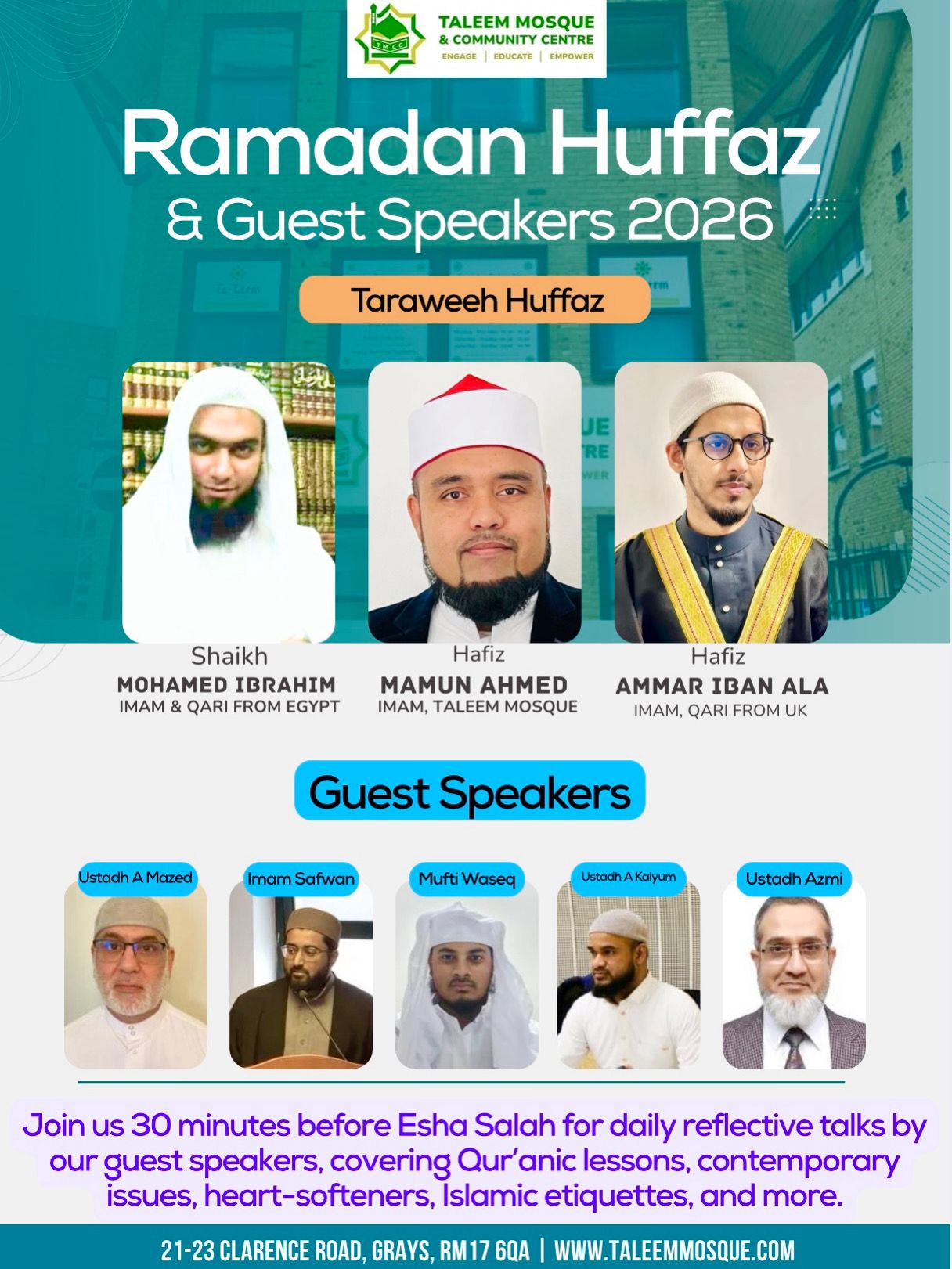
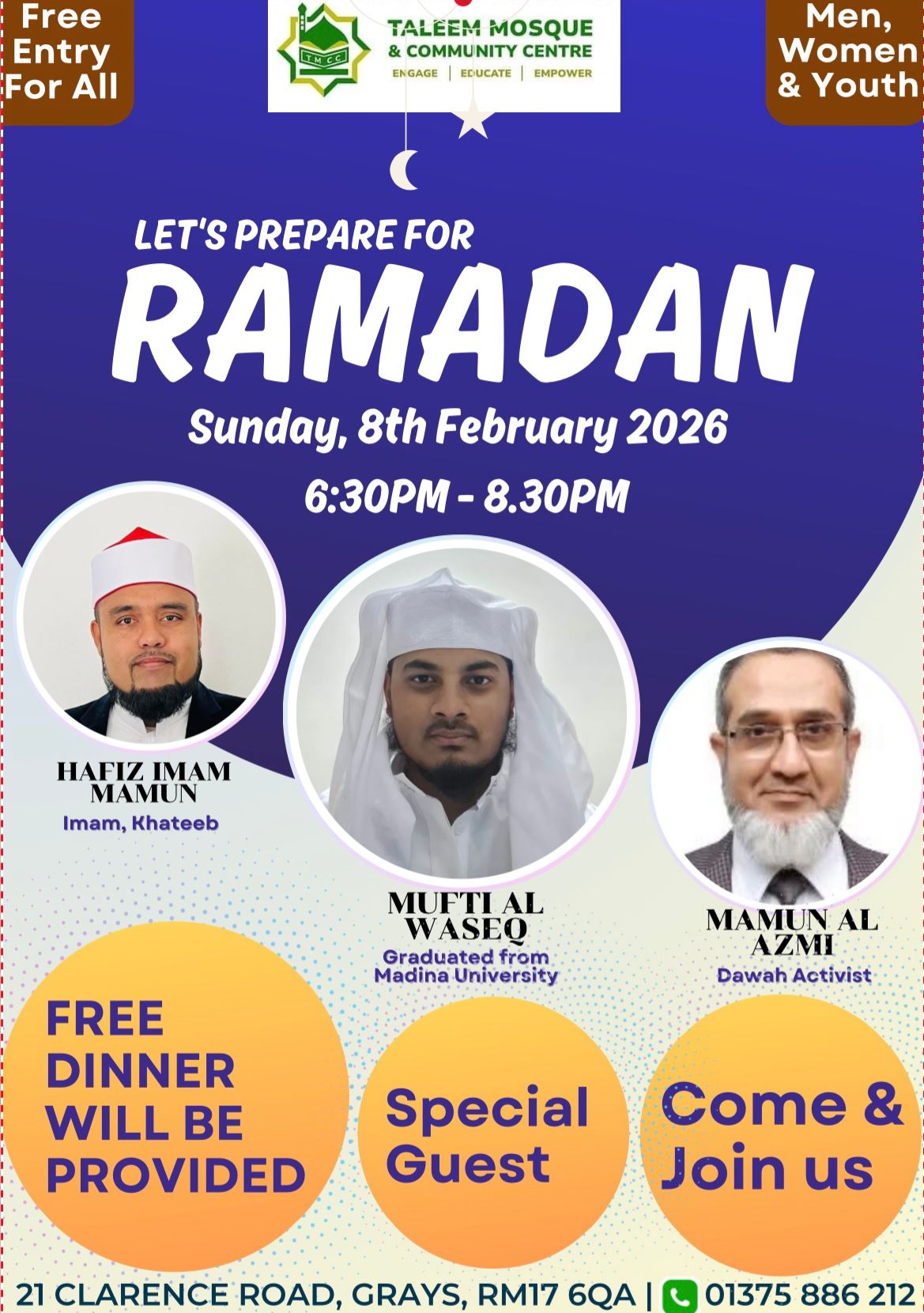
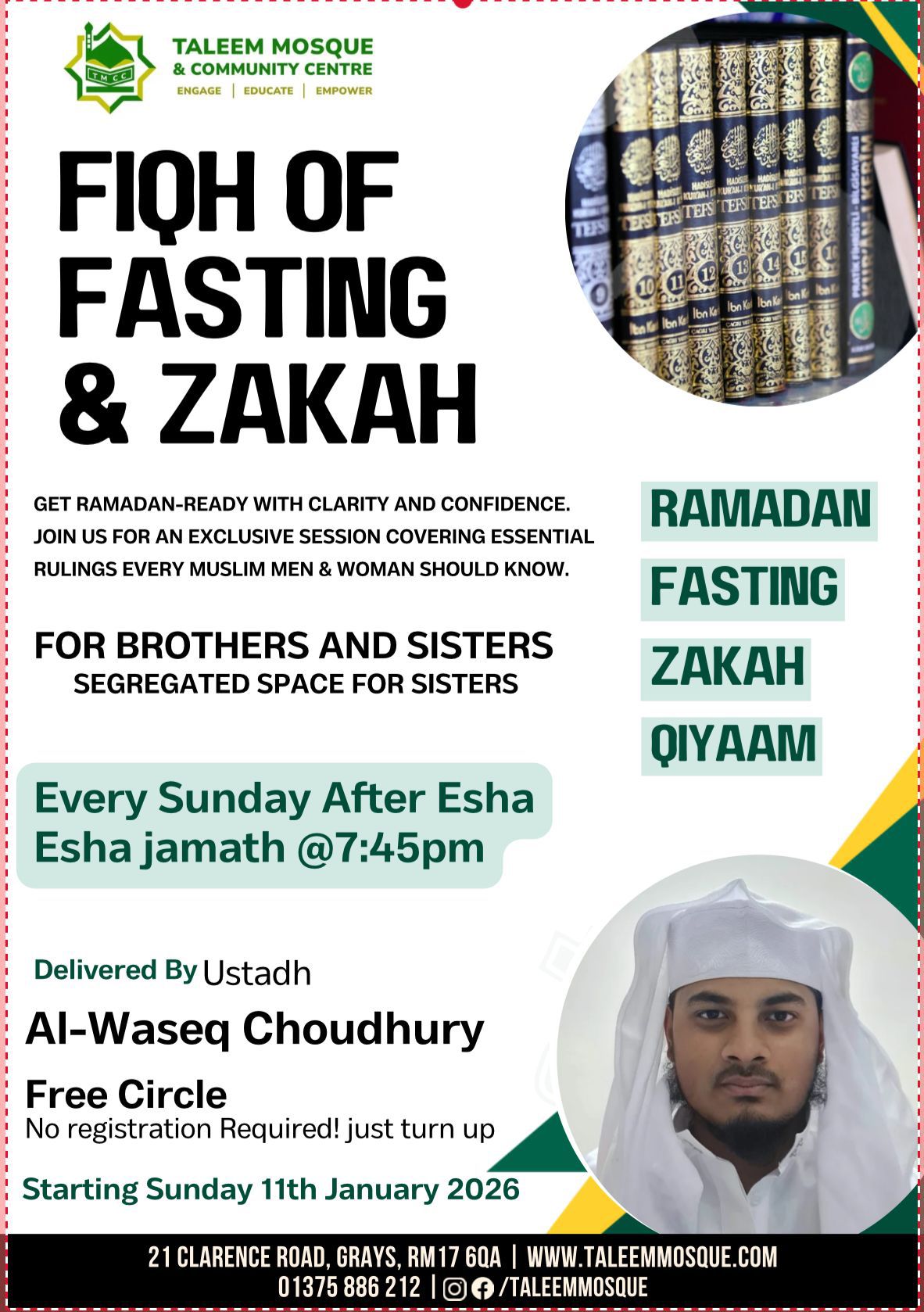
Taleem Masjid will be starting a *new course* in preparation to Ramadan. We will be running *weekly free classes* covering the Fiqh of Fasting & Zakah.

*Date:* Every Sundays

*Time:* After Esha (7:45pm)

*Instructor:* Ustadh Al-Waseq (Madinah University Graduate & Khateeb at Taleem Mosque)

_Open for Men & Women_

Class poster attached above 👆 

*Taleem Mosque Management*

GET READY FOR RAMADAN! Thurrock Muslims -Ramadan preparatory reminders- Fiqh of fasting


GET READY FOR RAMADAN 1447AH

Ramadaan preparatory reminders- Fiqh of fasting


Share this vital information with others! https://wp.me/p4GU3D-Cz

Let’s get ready for Ramadan in obedience to our Most Merciful Rabb, Allah!

person holding blue ceramic teapot pouring tea on clear drinking glass
Photo by Tima Miroshnichenko

It is hoped this will inform us of the primary reasons we fast, what is required of us and what to hope for.

May Allah, The Supreme Creator, permit us to fast for none but Him alone, may He reward us for our endeavours, and may He permit us to strive to avoid that which nullifies the fast, and strive to adhere to what maintains and perfects it, in accordance with the teachings of His final prophet peace be upon him.  Ameen.

DISCLAIMER: This is for educational purposes and serves as an introduction to the issues pertaining to fasting. Parents/guardians are advised to supervise the following read as some issues which pertain to married adults have been mentioned. Please consult a knowledgeable Islamic scholar (and trustworthy medical professional) for details, particularly for questions and advice related to individual circumstances. We are not scholars and thus cannot issue fatwa, however we endeavour relate to you the words of the scholars who have studied the authentic teachings of Islam from the Qur’an and the Sunnah of prophet Muhammad upon him be peace. And ultimately, Allah knows best.

blue squares banner

Fiqh of Fasting – Part 7  (adapted mainly from Sh. Yahya Adel Ibrahim with notes from others)

Summary of Siyam (Fasting) Essentials

What is the meaning of “Siyam?”

The word “siyam” comes from the root word “sowm,” which means “to abstain from.”

Did Muslims fast before 2 A.H.?

Yes, in fact the Prophet sala Allahu alihi wasSalaam and his companions (may Allah be pleased with them) used to fast on various days, including:

1. Day of Ashura (the exodus) when Allah delivered Musa sala Allahu alihi wasSalaam and the Muslims of that time from the evil of Pharaoh. The Prophet (upon him be peace) taught us to fast two days—either the day before or after plus the actual day of Ashura.

2. On the day of Arafat, if not making Hajj

3. The first 9 Days of dhul-Hijjah

4. Mondays & Thursdays through out the year

5. The middle three days of each lunar month (13th, 14th & 15th) when he moon is at its brightest

6. There are some proofs by way of Khadija (May Allah be pleased with her) who reports that the Prophet (peace be upon him) used to fast before the prophethood—but we do not know the exact days.

Why was Siyam ordered?

The answer to this question lies only with Allah. However, we can find that there are many benefits and bits of wisdom behind this pious and sincere act.

1. Increases one’s Taqwa (remembrance of Allah in daily affairs), as is stated in the Quran: Surah Baqara verse 183.

2. Trains the body, mind and spirit to bear hardships while remaining patient.

3. Trains the body, mind and spirit to hold back from the natural desires of the human: food, drink, anger, lust, etc.

4. To help one understand what the impoverished go though.

What is the importance of the month of Ramadan?

This is the month in which the gates of heaven are opened and the gates of hell are closed. This is the month where every dua’ reaches Allah. This is the month where the Muslims are protected from the evil whisperings of the shayateen. This is the month where one plants the seeds of worship, the seeds of taqwa in the earth and harvests the good deeds for sustenance throughout the year. And most importantly, this is the month in which the Quran was revealed—more specifically, on the night of Lailat-ul-Qadr.

Who must fast?

1. One who is Muslim
2. One who has Aql (mental faculties are sound and understands the responsibility of fasting)
3. One who has reached the age of puberty (signs include: growth of pubic hair or nocturnal emissions, emitting maniy, or reaching 15 years of age, occurrence of menses)
4. One who is Kaadir (able to maintain the fast)

What is the requirement for the fast?

Very simply, the fast begins with the niya (intention-this need not be verbal, rather intention resides in the heart)—this is a pre Requisite/ Shart—and then refraining from food, drink and things that break the fast, until the time for Maghrib has arrived.

It must be noted by the reader that one cannot just wake up in the morning and proclaim his fast for that day. This was only allowed for the Prophet sala Allahu alihi wasSalaam. Rather, for the followers, there needs to be mental recognition of the fast BEFORE FAJR in other than the month of Ramadan.

What breaks the fast?

1. Eating

2. Drinking

3. Sexual relations/intimate acts of any type that leads to male or female sexual discharge,

4. Haid (menstrual bleeding)

5. Nifas (post natal bleeding)

6. Intentional vomiting

7. Needles that give you nourishment

For further clarification on some issues:

a. Blood testing is okay

b. If one needs to take Insulin then that person cannot fast

c. Using the puffer for asthma patients is okay—the respiratory type only.

(in sha Allah, see more detailed article on things which nullify the fast)
What happens if a couple has intimate relations during the fast?

• If the couple have intercourse intentionally then they have to make up that day and they have to fast 60 days consecutively, or if unable feed 60 people or Kafarah

What is Kafarah?

This is given only as expiation for sexual infractions during the fast. There are three methods of expiation:

1. Freeing of a slave

2. Fast for 60 consecutive days. If one day is missed then you would start from the beginning again

3. If you are unable to fast, for a legitimate reason (sick, old,etc.) then you may feed 60 miskeen (poor) people. They have to be Muslim people and it can happen on one day as a feast. Also, one can just give the money to feed 60 people. This is considered a debt for that person and they should fulfil it before their death. If they do die then the relatives can either fast for them or feed the miskeen.

What about those that cannot fast, but are of age?

Of those who are excused from the fast are those who have a long-term sickness, the pregnant woman, the woman who is breast-feeding and the traveller. For the traveller, the fast is to be made up. But for the others, they are to pay the Fidya (please note, there is a scholarly difference of opinion regarding who can pay fidyah instead of making up fasts- please consult a scholar for your own case, see the links below). Fidya is to pay for a meal for one miskeen person for everyday that is missed. Like the Kafarah, one can arrange to give 30 days worth of money at one time, or arrange a feast for 30 miskeen people on one day.

PLEASE NOTE however, regarding pregnant and nursing mothers and sickness, please ask a highly knowledge Islamic scholar for individual cases. see this and this-is fidyah enough for pregnant women/sick people or not & should they make up the fast?) . Regarding pregnant and nursing mothers and sick people whose illness goes away and making up missed fasts, see these (who is exempt) and (how to make up fasts for ladies/mothers) and (how to make up missed fasts- sickness and all else)

Confused about your case? Contact a knowledgabe Mufti (try calling up on the Ask the Sheikh programmes on Eman Channel, or similar.)

The Sunnan of Fasting

1. The sahoor and iftaar should be done with the family. If the family is not available then one should make an effort to never break the fast alone.

2. To hurry up with breaking the iftaar—not to delay it. But the sahoor can be delayed right up until the time for Fajr enters.

3. To break the fast with dates, or at least 3 sips of water.

4. To make dua’ of breaking the fast. (“Dhahaba al-zamau’a, wa abtallat al-‘urooq wa thabata al-ajr insha Allah (Thirst has gone, the veins are moist, and the reward is assured, if Allaah wills).” see Arabic below )

break the fasting dua

5. To increase in acts of ibada (recitation of the Quran) and this should continue after the month of Ramadan has passed.

6. To give more sadaqa (charity).

7. To offer the tahajud prayers and the tarrawih prayers (in congregation).

8. To feed other Muslims, even if they are not needy—meaning to invite people to your house for the iftaar. In fact, when you invite people the host receives the reward that his guest earned on that day (while the guest retains his own reward). This is true even for the one who finances an iftaar, or one who prepares the food.

The Makrooh (hated things) of Fasting

1. To be excessive in rinsing with water, during wudu or other times. Having too much water in the mouth might cause a person to swallow some.

2. To unnecessarily taste food. There cannot be any swallowing and the tongue should be cleaned of any residual taste.

3. Kissing your spouse.

4. To sexually excite/touch your spouse.

5. To lie, to make ghiba (back biting), to do nameema (telling lies to cause two parties to fight). In fact, those who practice nameema do not enter paradise with the first set of Muslims.

6. To not pray the tarrawih or tahajjud in the last 10 days.

What are some the Voluntary Fasts that one may do?

1. The fast of the Prophet Dawood (peace be upon him) was mentioned by Prophet Muhammad (sallallahu alaihi wasallam) as the best. It includes one day of fasting and one day of resting, continuously.
2. The best months for fasting include: Sha’ban, Muharram, Ramadan,Dhul Hijja.
3. The 13th, 14th & 15th of every Islamic month. The reward of fasting these three days is like having fasted an entire year.
4. Mondays and Thursdays—for these are the two days that the angels rise and descend with your deeds; i.e. the gates of heaven are open.(This refers to Maghrib time)

5. The 9th day of Dhul Hijja (for the ones not performing the hajj).This is the day of Arafat and fasting on this day ensures that the minor sins for the previous year and the coming year are forgiven.

Allah knows best!

purple stripes banner

May Allah make this benefit us, and this advice is to us before it is to you our beloved readers.

May Allah allow us to succeed this Ramadan and may He forgive us for He is the Oft-Forgiving, The Forbearing! May Allah forgive us for any errors in this and grant us correctness. Wasallallahu alaa nabiyina Muhammad.Amin

ThurrockMuslims.com

Be generous, like, share and teach others for the sake of Allahhttps://wp.me/p4GU3D-Cz

support our work

Disclaimer:

Continue reading

What Breaks the FAST? Ramadan Reminders Fiqh of Fasting- The nullifiers

What Breaks the FAST? Ramadan Fiqh of Fasting- The Nullifiers


Asalamu alaykum,

Dear brothers and sisters, with Ramadan just round the corner, lets brush up our knowledge on the dos and donts of fasting, for the sake of Allah.

Here follows the fiqh of fasting regarding the nullifiers. May Allah help us to do that which He loves and is pleased with. May Allah help us to worship Him alone always and may He make us experience many Ramadans to come, in His obedience. ameen.

(Please  do see the previous post for a summary on matters related to fasting, the wisdom behind it and much more, in sha Allah!)

DISCLAIMER: This is for educational purposes and serves as an introduction to the issues pertaining to fasting. Parents/guardians are advised to supervise the following read as some issues which pertain to married adults have been mentioned. Please consult a knowledgeable Islamic scholar (and trustworthy physician if needed) for details, particularly for questions and advice related to individual circumstances. We are not scholars and thus cannot issue fatwa, however we endeavour to relate to you the words of the scholars who have studied the authentic teachings of Islam from the Qur’an and the Sunnah of prophet Muhammad upon him be peace. And ultimately, Allah knows best.

pattern pentagons

In the name of Allah

Fiqh of Fasting Part 3
by Sh. Yahya Adel Ibrahim (with external annotations)

What breaks the fast? Can I have a blood test? How about other medical procedures? Am I allowed to apply moisturizers that penetrate the skin? What about eye drops or nasal spray or asthma puffer?

Imam Ibn Qudamah says in al Umdah: (Arabic omitted)

Things that Invalidate Fasting

[The Invalidators of Fasting] Whoever:- eats or drinks (1) or takes anything into his stomach through his nostrils (2)- or through any other route (3)- or intentionally vomit (4)– or masturbates (5)– or kissed or touched [the opposite sex] and subsequently ejaculated semen or had madh-ey (pre ejaculation) (6)– or had hijamah (cupping with bloodletting) (7)-or did it to someone else intentionally and while remembering [that he is fasting] his fast is nullified.

End words of Imam Ibn Qudamah——-NOTES

See also: things that invalidate the fast

1) Both these and sexual intercourse break one’s fast by consensus, for Allah the Almighty says: “…so now be in contact with them [your wives] and seek what Allah has ordained for you, and eat and drink until the whiteness of the day becomes distinct from the blackness of the night at dawn, then complete the fast till night…” (al-Baqarah 2:187)Eating (by mouth) non-food items invalidates fasting by consensus.

2) Due to the statement of the Prophet sala Allahu alihi wasSalaam “Sniff water far into your nostrils unless you are fasting.” abu Dawud Authentic

3) Medical Care and Fasting (Taken from Judgements of Senior Scholars at the Fiqh Assembly of the OIC Organisation of Islamic Conference):

-Injections (with the exception of nutritious ones), many contemporary scholars believe they do not invalidate the fast. That is the position of the Fiqh Assembly of the OIC (Organization of Islamic Conference).

-Nutritious injections: controversial, but the vast majority considers them to invalidate the fast. That is the position of the Fiqh Assembly.

– Enemas, many contemporary scholars allow them while fasting, because even though they reach the hollow interior of the body (al-Jawf), they do so from a route that is not natural for food or drink; it is not even close to this natural route.- Vaginal suppositories do not break the fast according to (Malikis & Hanbalis) and modern medicine supports that position because there is no connection between the vagina and the stomach. The same applies to the male and female urethra. That is the position of the Fiqh Assembly of the OIC.- Sublingual tablets: many allow them because they are completely absorbed by the mucous membranes of the mouth and do not reach the hollow interior of the body (al-Jawf).

The Fiqh Assembly of the OIC maintains that as long as the patient avoids swallowing it, there should be no harm.- Inhalers and nasal sprays were regarded by the Permanent Fatwa Committee in Saudi Arabia as non-invalidators of the fast.- Nasal drops: controversial, and the scholars who say it invalidates the fast support their view with the previous hadeeth about istinshaq.

The scholars who argue that they do not break the fast maintain that even if a minute amount made it to the stomach, it would still be negligible. The Fiqh Assembly of the OIC maintains that as long as the patient avoids swallowing it, there should be no harm.- Eye drops and eardrops do not invalidate one’s fasting according to many scholars, particularly eardrops because there is no connection between the external ear and the interior of the body except in the case of perforation of the eardrum, and then what may reach the hollow interior of the body (al-Jawf) would be extremely negligible. That is the position of the Fiqh Assembly of the OIC.- Endoscopes, even if they enter from the mouth, they would not break the fast according to many (including the Fiqh Assembly of the OIC) because, they are not nutritious and according to (Hanafis), they do not remain in the abdomen.

The majority of the earlier scholars would consider them invalidators because they enter the hollow interior of the body (al-Jawf). But that seems to not be the correct position.- Skin preparations that are absorbed into the body do not invalidate the fast according to the Fiqh Assembly of the OIC and the vast majority of contemporary scholars and that was the opinion of Imam Ibn Taymiyah.

4) The Prophet sala Allahu alihi wasSalaam said: “He who is overwhelmed by vomiting does not have to make up, but he who intentionally vomits must make up.” (Tirmithi, and authenticated by Ibn Khuzaimah and Ibn Hibban and others)The one who intentionally vomits is the one who brings it on, not the one who vomits because he feels very nauseous.

5)That is the position of the four schools of Fiqh, for in the Divine hadeeth, Allah the Almighty in the hadith QUDSI says about the fasting person:“…he gives up his (sexual) desire, food and drink for Me…”(Agreed upon)And the one who masturbates does not give up his sexual desire. This sinful habit must be given up, here’s how to break the addiction and how to keep away from it.

6)  Kissing one’s spouse while fasting with subsequent discharge
The position here above is the agreement of the four schools of Fiqh in the case of the ejaculation of semen, but it is controversial in the case of madhey (pre ejaculation). Many (Shafi’ee scholars and minority of hanbali) argue that it would not break the fast since the Prophet sala Allahu alihi wasSalaam allowed touching and kissing and that is not infrequently associated with madhey.

7) Bloodletting, Blood donation, and Blood tests

That is the correct position of the Hanbali school of thought. The majority (Shafiee,Malik, Abu Hanifa) does not consider hijamah to break one’s fast. The disagreement is because the Prophet sala Allahu alihi wasSalaam said: “Both the one doing bloodletting and the one having it done to him break their fast.” (abi Dawud; Authentic)Yet, many of the sahabah considered this to be abrogated and allowed bloodletting while fasting, and they include Anas Ibn Malik who indicated that it was initially forbidden out of fear that they may become weak.

(Bukhari reports that Ibn ‘Abbaas (may Allah be pleased with him) that he said:”The Prophet had hijamah done to him while he was between Makkah and al-Madeenah while he was fasting and in the state of Ihram.”

Blood donation and tests therefore are acceptable, if they weaken you they are Makrooh but the fast is valid and not broken.

And Allah knows best.

 pencil banner

May Allah, Al-Ghaffaar (The Perpetual Forgiver) forgive all our sins, and may He erase them completely, for He is Al-‘Afuww, Ar-Raheem, (The Oft-Pardoning, The Most Merciful). Ameen

Share: http://wp.me/p4GU3D-se

Disclaimer:

Continue reading

Countdown to RAMADAN- reminder to make up missed fasts before Ramadan 1447

Asalamu alaykum

Bismillah

We are nearly a month away from Ramadan and those of us who owe missed fasts from previous Ramadan, we really must make them up now in sha Allah!

Take advantage of the short days. Let us put our trust in Allah, and it will be alright. (Alhamdulillah) Remember Allah is Al-Qadeer (capable of all things) and He will surely help us and make it possible.

fruits agriculture

Trust Allah, that we can do it! And it’s good preparation for Ramadan in sha Allah!

Be inspired by those who have genuine difficulty/lack of resources and food, but soldier on for the sake of Allah.

Remember Allah gave us a lot more than others, so let’s drop the excuses and start showing Allah more gratitude by obeying Him as we owe Him everything, because He owns everything!!!

Allahumma barik lana fi Rajab wa fi Sha’ban, wa balignaa Ramadan!

May Allah grant us the ability. May Allah make us sincere and make our fasting easy, rewarded and accepted and may He grant us many Ramadans in His obedience, Ya Rabb al aalameen! Allahumma Salli alaa Rasoolillah Muhammad sallallahu alayhi wasallam!

Ameen.

Peace and love.

wasalam.

ThurrockMuslims.com

Rajab 1447

THE SACRED MONTHS-Ramadan in under 2 Months! Rajab


THE SACRED MONTHS – RAJAB 1447AH


Asalamu alaykum dear readers.

We are now in the sacred month of Rajab walhamdulillah and  we would like to remind ourselves about the importance of the four sacred months in Islam. Rajab is the 7th month of the Islamic calendar. The sacred months are are Rajab, Dhul Qad’ah, Dhul Hijjah and Muharram, the 7th, 11th, 12th and 1st month of the Islamic Hijri calander respectively. (see Surah Tawbah, Qur’an chapter 9 verse 36).

Watch this video on what to do in Rajab and other sacred months, Sheikh Assim Al Hakim explains:

(We should be extra careful not to sin, all the time, but particularly in the sacred months, and avoid aggression…also a word on Isra’ wal Miraaj and religious innovations/bid’ah…and the importance of holding on to the Sunnah of Rasoolullah peace be upon him)

May Allah forgive us, be merciful to us and guide us, for He is the Most Gracious the Most Merciful, The Ever-Relenting. May Allah enable us to witness and observe many Ramadans in His obedience, with sincerity and strength. May Allah unite us in jannat al firdaus. Allah bless His final messenger Muhammad ibn Abdillah in abundance. Amin

Please keep us in duas and support our work. Help us keep this going in sha Allah.

ThurrockMuslims.com

Rajab 1447ah

share https://wp.me/p4GU3D-vW

About us/Disclaimer

Taleem Masjid Women’s Halaqah/Social- review Nov2025

Taleem Masjid Women’s Halaqah/Social- review Nov2025

Taleem Masjid hosted a woman’s event in November2025.

It was fun-packed, educational and full of laughs with the quiz at the end.

Congratulations to the winning team!

The Talk

Ustadah Nawal kindly taught us the 5 pillars of Islam and 6 pillars of Iman and aqidah.

The most important matter is the Shahadah.

Islam Explained

She also reminded us to learn Arabic so we can understand Qur’an and recite it with focus in our salah.

Editor note (NS): Here’s some Alimiyyah notes on the Conditions, Pillars, Wajibaat of Salah

SUMMARY 10

Conditions of validity of prayer are 9.

CONDITIONS/SHURUT: PRE-REQUISITES BEFORE SALAH

1-be Muslim, Believer. Intention.

2-Sane. Sound mind. Not intoxicated.

3-Discernment. Able to tell good from bad.Understanding. Ability to judge well.judge right from wrong.

4-Be free of ritual impurity

Ritual impurity means anything that would nullify acts of worship. 

So purify self from things that break wudu, anything that breaks ghusl.

See previous lesson summaries.

5- removing tangible impurity .Any impurity you can physically remove.

Either from clothes or surroundings.

6-covering the awrah (privacy in body)

Islam defines this for male and female.

Cover censored part of body.

Scholar agree if person can cover awrah but don’t then his prayer invalid.

Awrah, see Surah Araf v31

Man: Minimum awrah. Male 7-10yrs age .2 privates regions. pre-pubescent child doesn’t have to pray but they can copy. 

Moderate awra from 10+ years:

 From navel to knee, outside prayer in general.

If man exposes navel to knee that would invalidate prayer.

Maximum awrah-this is one you need for prayer. Men, cover from navel to knees region, and top half cover too.

Men be careful cover your lower back and rear. If it was uncovered significant time, invalidates prayer.

So tell them to cover n repeat prayer. Just wear a longer garment that covers the backside. Have shame.

Best for man if wears shirt in prayer, upper garment, for prayer to be valid. Be respectful.

Woman:

Awrah of female- All of woman awrah except hands and face.

In prayer all body cover except face and hands, but scholars differ regarding feet.

Ustadh Abu Khaled’s opinion..in public..woman better cover feet.if praying at home, fine if feet show..safest opinion he thinks.

7- entry of the time

Salah on prescribed time.. Rasoolullah Muhammad peace be upon him mentioned.

Dukhul waqt. Time for prayer should have began.

Combining n shortening discussion nxt week inshaAllah

8-facing Qibla.. ka’bah

Makkah.. SE frm LDN

He said go see which way Satellite dish facing.

Subhanallah special force that way, direction energy go to middle of earth Makkah.

9-niyyah. Forming right intention  

Is in heart, mind.

Intend to pray the right salah.

Need be cognizant of what you praying 

Asr hadith- if u miss is, lose it all

Allah’s Messenger (peace be upon him) said, “Whoever misses the `Asr prayer (intentionally) then it is as if he lost his family and property.

https://sunnah.com/bukhari:552

SUMMARY 13

Pillars and mandatory/obligatory parts of Salah 

Pillars Of salah. (arkaan)

Without the pillars of prayer, the prayer is not valid

1-Takbir Al ihram/opening takbir. 

2- standing (provided able)

3-reciting surah al fatihah. Without fatiha, prayer invalid.

4- rukoo, bowing position, be at ease 

5-rising from rukoo, 

6-Be comfortable in the position after rukoo, don’t haste. 5 sec min

7-prostration, sajdah/suju. be at ease, following limbs to touch ground:

Forehead,Nose, Palms, Knees ,Toes, Firmly on floor.

8-rising from prostration

9-sitting between 2 prostrations

10- at ease of each physical pillars steps. No rush.

11-final tashahud

12-sitting to recite final tashahud .

13-tasleem, the 2 Salams to end prayer

14-pillars in order.

Obligations/mandatory parts of prayer (wajibaat):

1-all other takbir with exclusion of takbir ihram (which is a pillar)

2-saying “sami Allahu liman Hamidah”

3-saying “rabbana wa lakal Hamd”

4-saying “subhana rabbiyal azeem”

5-saying “subhana rabbiyal a’laa” 

6-say “rabbigh fir lee” between 2 sajdah

7-saying tashahud, First one (2nd rakah)

8-sitting in the first tashahud.

If you miss a pillar in prayer:

If you miss a pillar in the prayer, you have to go back and repeat that pillar and continue in sequence. See hadiths

How to do prostration of forgetfulness: sajdah sahw

This extra prostrations make up for any wajibaat/obligatory parts of the prayer missed out. It does not account for missed pillars.

How to sajdah sahw:

Ustadh Abu Khaled takes this opinion:

Read all tashahud and durood/ duas. Don’t say salam to right or left yet.

Then do an extra sajdah x 2, with sitting between them saying rabbigh fir lee. Then rise from sajdah to seated position, then do the Salam/tasleem to right and left and exit prayer.

Stronger option. 

Don’t do sahjdah sahw incase you forget, or for every prayer, as this is bid’ah. Enemy satan wants us to go either extreme, must fight it. Allah help us all.

Witr prayer- odd numbered, after isha

Witr- 3 rakah, no sitting in 2nd rakah. (different to magrib). Then last rakah you sit. Qunut duas..after rukoo in 3rd rakah

May Allah forgive all our errors and guide us to the truth, and cure us, protect us, unite us in jannah. Allahumma salli ala rasoolillah Muhammad.

NS

End notes.

ThurrockMuslims.com

About/disclaimer

SPECIAL EVENT- JESUS IN ISLAM- TALEEM MOSQUE- XMAS HOLIDAYS

SPECIAL EVENT- JESUS SON OF MARY (ALAYHISALAM) IN ISLAM- TALEEM MOSQUE- XMAS HOLIDAYS

SPECIAL EVENT -JESUS IN ISLAM- TALEEM MOSQUE

*Winter Event – This Friday Evening- Story of Prophet Isa (AS)*

AssalamuAlaikum Everyone,

We invite *families* to come and learn about the Story of Jesus [Isa (AS)] from an *Islamic perspective* during this half-term holiday.

*Date:* Friday 19th Dec (7pm)

*Guest Speaker*: Ustadh Anhar Khan, Head of Sanatayn Programme and Secondary School Teacher.

📍Location: Taleem Mosque, 21-23 Clarence Road, Grays, RM17 6QA

_Brothers/Sisters/Children All Welcome_

*Food will be provided after the event.*

Taleem Mosque Management

ThurrockMuslims.com

about/disclaimer

VIRGIN MARY AND HER SON JESUS (upon them be peace)- thurrockmuslims.com

:’ )

Thurrock Muslim Community

Thurrockmuslims.com

Contact us

About us/disclaimer

Get involved/join

Muslims and Christmas- Thurrock Muslim Community

Muslims and Christmas


In the name of Allah, The Most Gracious The Most Merciful.

Peace! Let’s talk about the holidays.

In Britain  it has traditionally been known as a Christian country, Christmas day, i.e. 25 December is considered a national holiday.

christmas lights on christmas tree
Photo by Vladislav Murashko on Pexels.com

Let’s have a look at the history of Christmas:

According to Britannica Encyclopaedia, Christmas has become a Christian festival where Christians believe they are celebrating the birth of Christ, or Jesus. Historically, however, the date coincides with pagan Roman festivals which celebrated the winter solstice. It is believed that early Christians wanted to celebrate the 25th to coincide with the pagan festival. There is no clear statement in the New testament supporting the celebration of Jesus’ birth on the 25th. Nevertheless, it is still widely celebrated in that manner.

So basically in a nutshell, Christmas day has pagan origins!

And did you know, there are many groups and sections of society who do not celebrate Christmas, such as Jewish people, some atheists, and even some Christians.

So do Muslims celebrate Christmas? In Islam, the MOST IMPORTANT belief is that of Islamic monotheism. That is, we are commanded to submit to and believe in Allah (The One True God), and attribute complete Oneness to Allah as He deserves in His Lordship, Names and Attributes and right to be worshipped alone.

Consequently, as a Muslim, i.e. one who submits to Allah (The One True God), we believe that we must abandon and turn away from anything that contradicts the principles of Islamic monotheism. Polytheism, idolatry and ascribing partners to Allah are MAJOR SINS! The biggest sin which Allah will not forgive, is ascribing partners to Him !

‘Verily, Allah forgives not that partners should be set up with Him (in worship), but He forgives except that (anything else) to whom He wills; and whoever sets up partners with Allah in worship, he has indeed invented a tremendous sin.’

[Qur’an, chapter 4, verse 48- English interpretation]

Allah is so self-sufficient, it does not befit His Majesty to take a son or wife, or to beget or be begotten. He does not resemble His creation, for He is the uncreated Creator, and there is no similitude to Him.

In fact, a remarkably concise description of Allah can be found in chapter 112 of The Noble Qur’an, which is the verbatim words of Allah, and Allah’s final revealed book to mankind.

Have a listen to this chapter here:

Regarding Jesus (peace be upon him), in Islam we believe he was a mighty messenger of Allah. Jesus, or Isa in Arabic, was born a miraculous birth, from the virgin Mary. We refer to Jesus as ‘Isa ibnu Maryam, which means Jesus son of Mary. Jesus did not have a father, and he is not the son of God/Allah, because as we mentioned earlier, it does not befit the majesty of Allah to beget. Allah decreed that Jesus would be born miraculously without a father from the pure chaste virgin Mary. We respect them very much and we know that Jesus never claimed divinity, rather Jesus called his people to worship Allah alone, the same message each prophet and messenger of Allah called to. Jesus’ (peace be upon him) story can be found in the Qur’an in numerous places. (for more information, please see the upcoming post on chapter 19 of the Qur’an entitled Maryam!)

And ˹on Judgment Day˺ Allah will say, “O Jesus, son of Mary! Did you ever ask the people to worship you and your mother as gods besides Allah?” He will answer, “Glory be to You! How could I ever say what I had no right to say? If I had said such a thing, you would have certainly known it. You know what is ˹hidden˺ within me, but I do not know what is within You. Indeed, You ˹alone˺ are the Knower of all unseen.

Qur’an chapter 5, verse 116

View= Story of Jesus In Islam

Incidentally, Paganism supports polytheism. Polytheism means worshipping multiple deities. Therefore, the Christian Trinity is essentially polytheism. And as previously mentioned in this blog, Islam means submission to the One True God, Allah, and our purpose in life is to acknowledge Allah’s complete Oneness, to uphold Islamic monotheism, and to attribute absolute Oneness to Allah in His Lordship, names and attributes and right to be worshipped alone.

handshak

In honesty, Muslims don’t really party on Christmas. But despite that, we still spread peace and justice the best we can with everyone, regardless of our differences.

Because the truth is, as Muslims, the most important One to us is Allah, and the only reason we are alive is for Allah, to serve Him, to worship Him, because we need to worship Him and He doesn’t need us to do that. Whether or not we worship Him, it does not detract or add to His majesty at all. Rather He is The Self-Sufficient, The Majestic, The Rich, Free of all needs. The Lord of all that exists, He is Allah.

Besides, our kind behaviour and gifts to you is not supposed to be limited to a certain day of the year, as Muslims we are required to deal with everyone in a just manner at all times, exhibiting the best character.  If we have fallen short in fulfilling our rights towards you as our neighbours, please do forgive us. We make mistakes, after all we are human. Although, we endeavour to follow the best example of excellent moral conduct, as taught to us by Allah’s final prophet and messenger, Muhammad peace be upon him.

I’ll leave you with a verse from the Qur’an to get you thinking.

‘Say (O Muhammad صلى الله عليه وسلم): “I am only a man like you. It has been revealed to me that your Ilah (God) is One Ilah (God – i.e. Allah). So whoever hopes for the Meeting with his Lord, let him work righteousness and associate none as a partner in the worship of his Lord.” ‘

[Qur’an, chapter 18: v110, english interpretation]

Thanks for reading.

Peace.

ThurrockMuslims.com

LOCAL EVENTS NOV25- THURROCK MUSLIM COMMUNITY- TALEEM MOSQUE FAMILY BBQ

LOCAL EVENTS NOV25- THURROCK MUSLIM COMMUNITY- TALEEM MOSQUE FAMILY BBQ

Salam!

Check out the scheduled events from Taleem Masjid & Community Centre.

TALEEM MOSQUE FAMILY BBQ- OPEN TO ALL! COME ALONG, ALL WELCOME

Taleem Mosque Winter BBQ – Grays, Essex- Community Event 🍔

Eat! And Enjoy! We invite everyone to come to the Taleem Winter BBQ community event.

All funds will go towards building refurbishment 🕌

🗓️ Sunday 16th November 2025
⏰ Start 12:30pm till 4:30pm
📍 Taleem Mosque, Grays. 21-23 Clarence Road, Grays, RM17 6QA

Men, women & children are welcome.

To sponsor the event, businesses and individuals are welcome: Submit your support at the Link👇

Acc Name – Taleem Foundation
Account Number – 1044 3584
Acc Sort Code – 60 02 63

More events for November 2025

This month, there’s lots to do at your local Masjid. Take part in inspirational get-togethers, socialise and make friends and enjoy great food. TMCC is hosting youth club activities, women’s night, men’s evening and breakfast after Fajr prayers.

Contact the organiser:

TMCC

Thurrock Muslim Community

ThurrockMuslims.com

About us/disclaimer