WALK WITH US! Taleem Masjid Community Walking/Fitness programme

WALK WITH US! Taleem Masjid Community Walking/Fitness programme

WOMEN’S WALKING GROUP:

Walking Group – Taleem Sisters

Introducting a new initiative from Taleem Mosque to promote wellness, good health and social connection during the summer holidays (in August 2025)

Walk around the local Grays beach area with your fellow sisters on Thurs 28th Aug (10:30am – 11:30am).

Meeting point at Taleem Mosque with refreshments and snacks provided upon return.

Suitable for all fitness levels as well as children (save the date)

Taleem Mosque Management

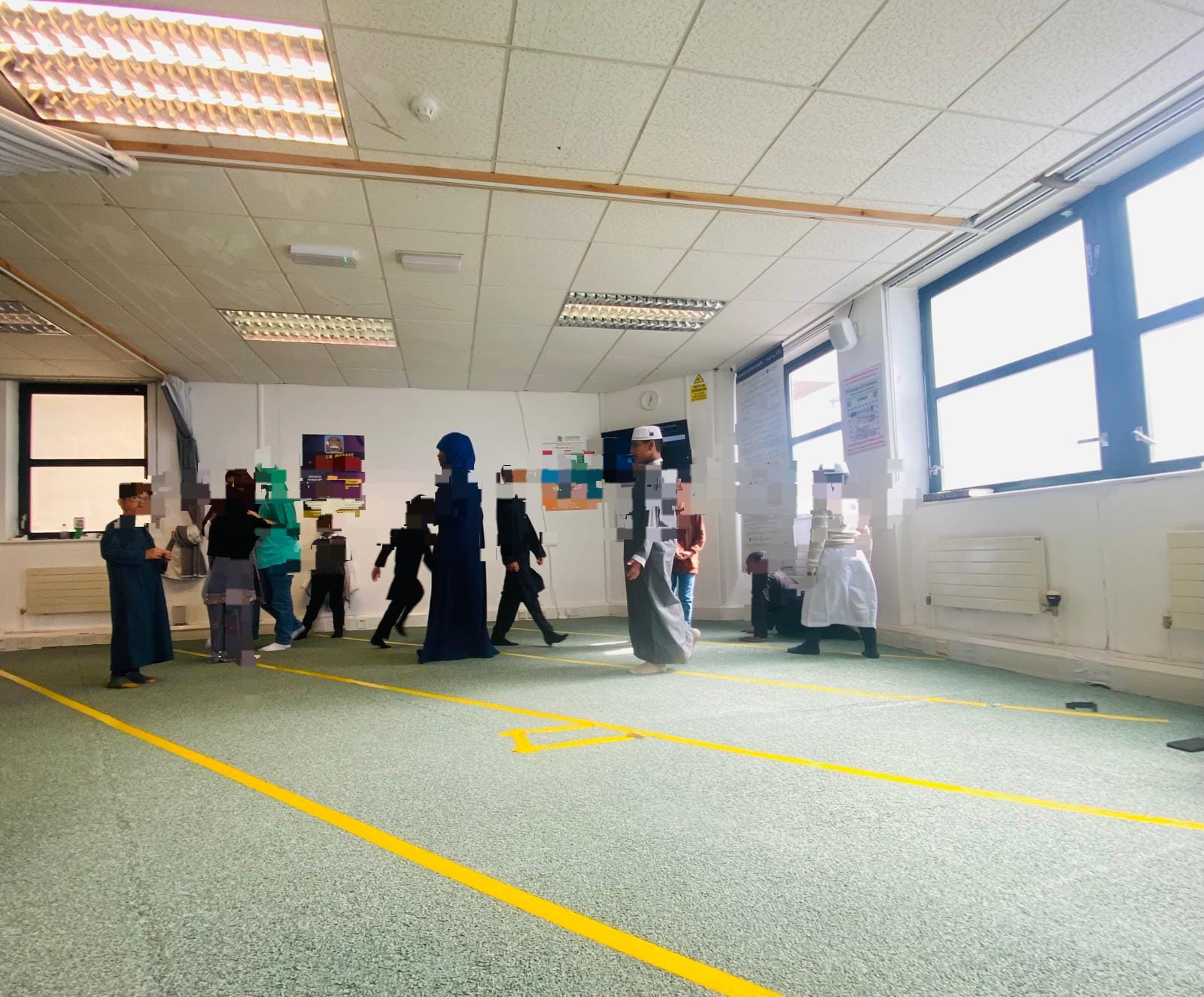
MEN’S WALKING GROUP

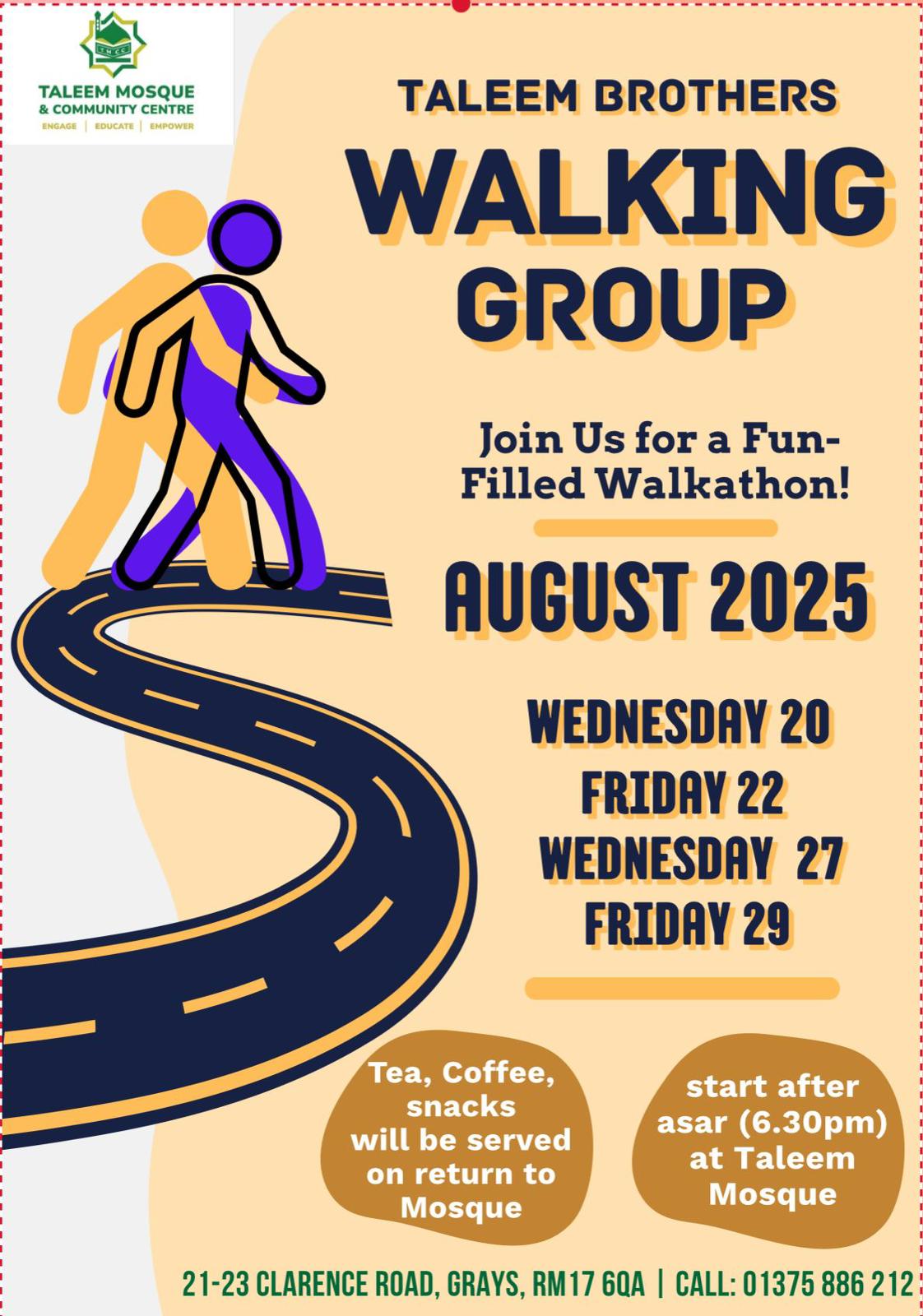
Walking Group – Taleem Brothers

Introducting a new initiative from Taleem Mosque to promote wellness, good health and social connection during the summer holidays (in August 2025)

Walk around the local area (such Grays beach area) with your fellow brothers after Asr (6:30pm):

  • Wednesday 20th Aug
  • Friday 22nd Aug
  • Wednesday 27th Aug
  • Friday 29th Aug

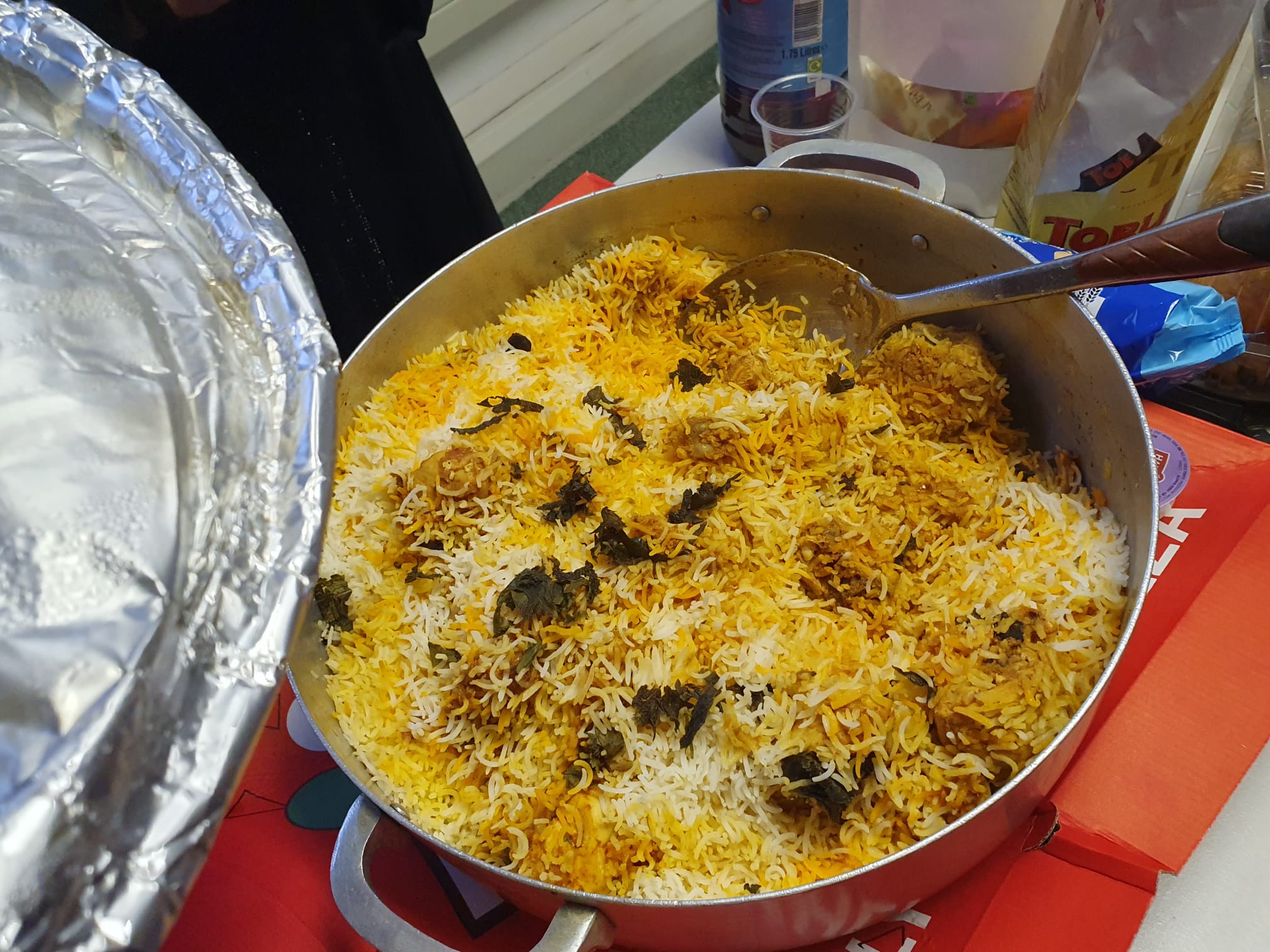
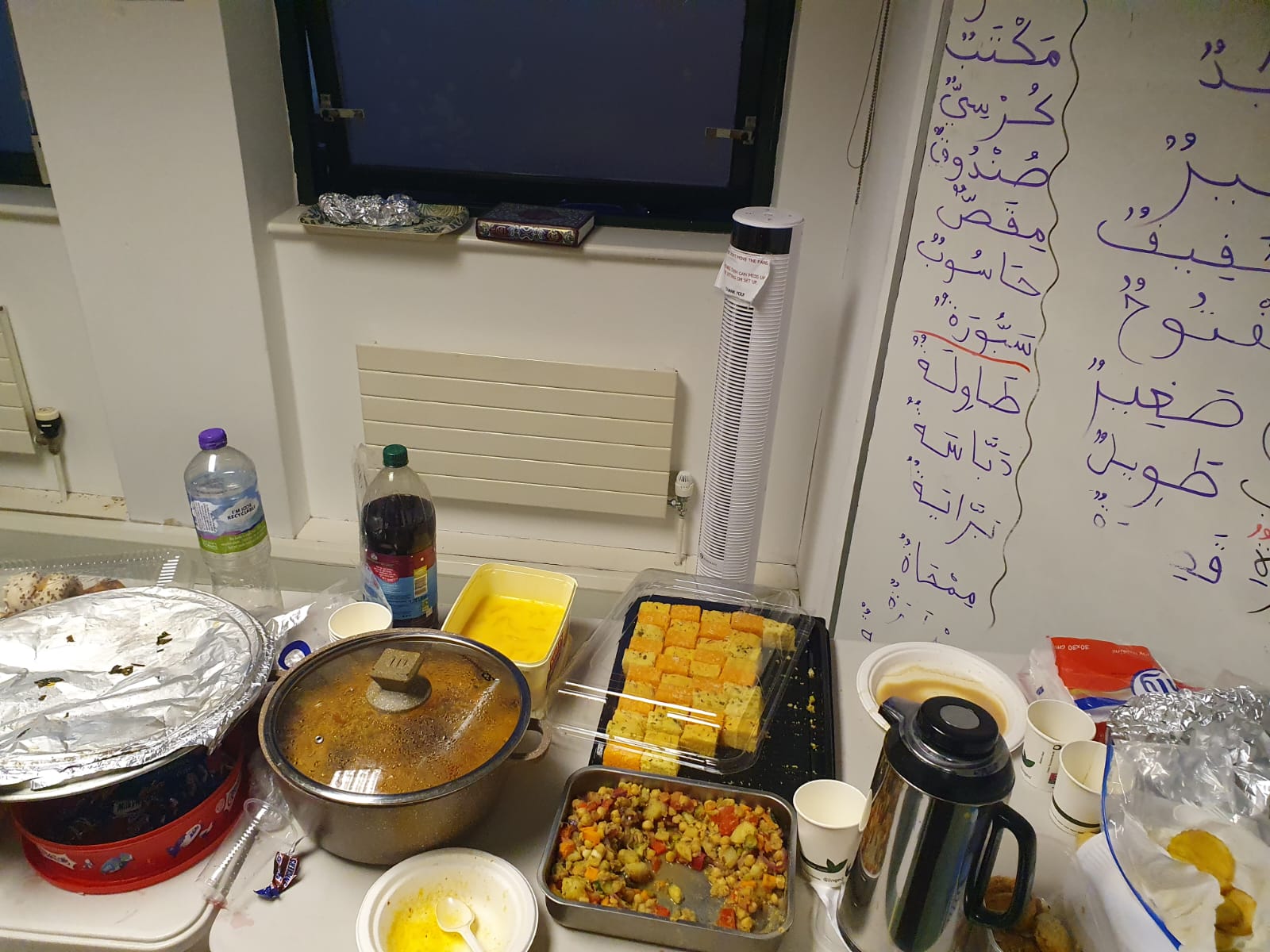
Refreshments will be provided at the Mosque upon return for all participants inshaAllah

Suitable for all fitness levels.

Taleem Mosque Management

ThurrockMuslims.com

About us/disclaimer

=

Supported by

=

Walk organisers website: https://taleemmosque.com/

TALEEM MASJID KIDS EID PARTY OVERVIEW AND QUIZ WINNERS

TALEEM MASJID KIDS EID PARTY- QUIZ WINNERS

TALEEM MASJID held a KIDS EID PARTY to inspire, connect and educate the local Muslim children during spring break. It was a morning of games, fun, quizzes, food, snacks and sports.

The event highlight included Qur’an recitation by some young students of Taleem Masjid Madrasa

Check out the gallery!

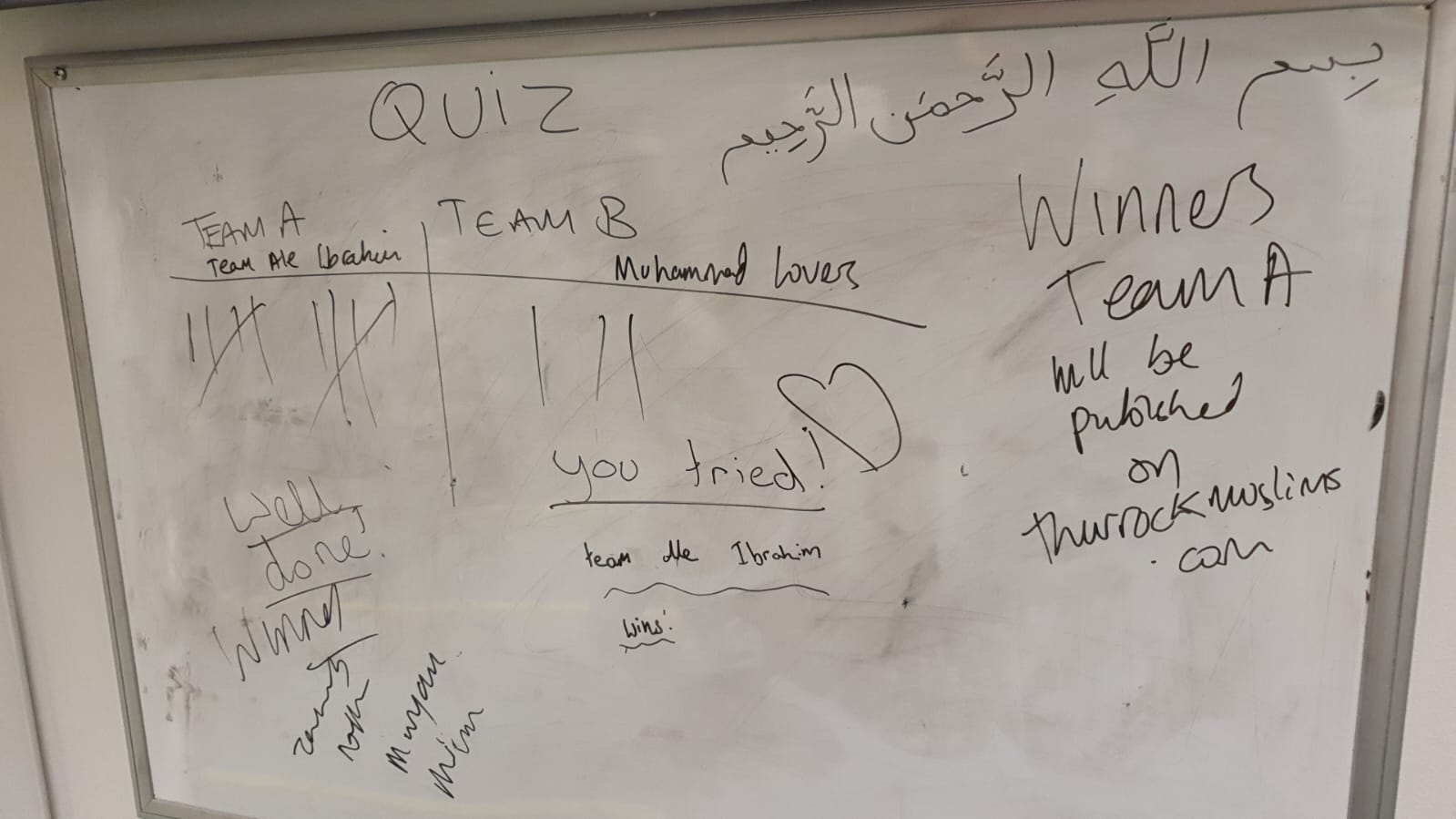
Quiz winners: TEAM B Ahmed, Abdul, Fahima, Nafiah, Amir, Zaid. Well done!

Team A runner up, thanks for playing!

Thanks for turning up and may Allah allow it to benefit us.

ThurrockMuslims.com

about/disclaimer

TALEEM MASJID WOMEN’S EVENT- EVENT OVERVIEW AND QUIZ WINNERS

TALEEM MASJID WOMEN’S EVENT- QUIZ WINNERS

TALEEM MASJID held a women’s gathering, to inspire, connect and educate the local Muslim women. It was a night of socials, chill, pizza, biryani, cakes, tea, laughter, quizzes, and of course naseeha, dua, dhikr, salah in jamat and lots of smiles!

Check out the gallery!

Quiz winners: Zainab, Nafiah, Jidatu Nafi, auntie Maryam. Well done!

Thanks for turning up and may Allah allow it to benefit us.

ThurrockMuslims.com

about/disclaimer

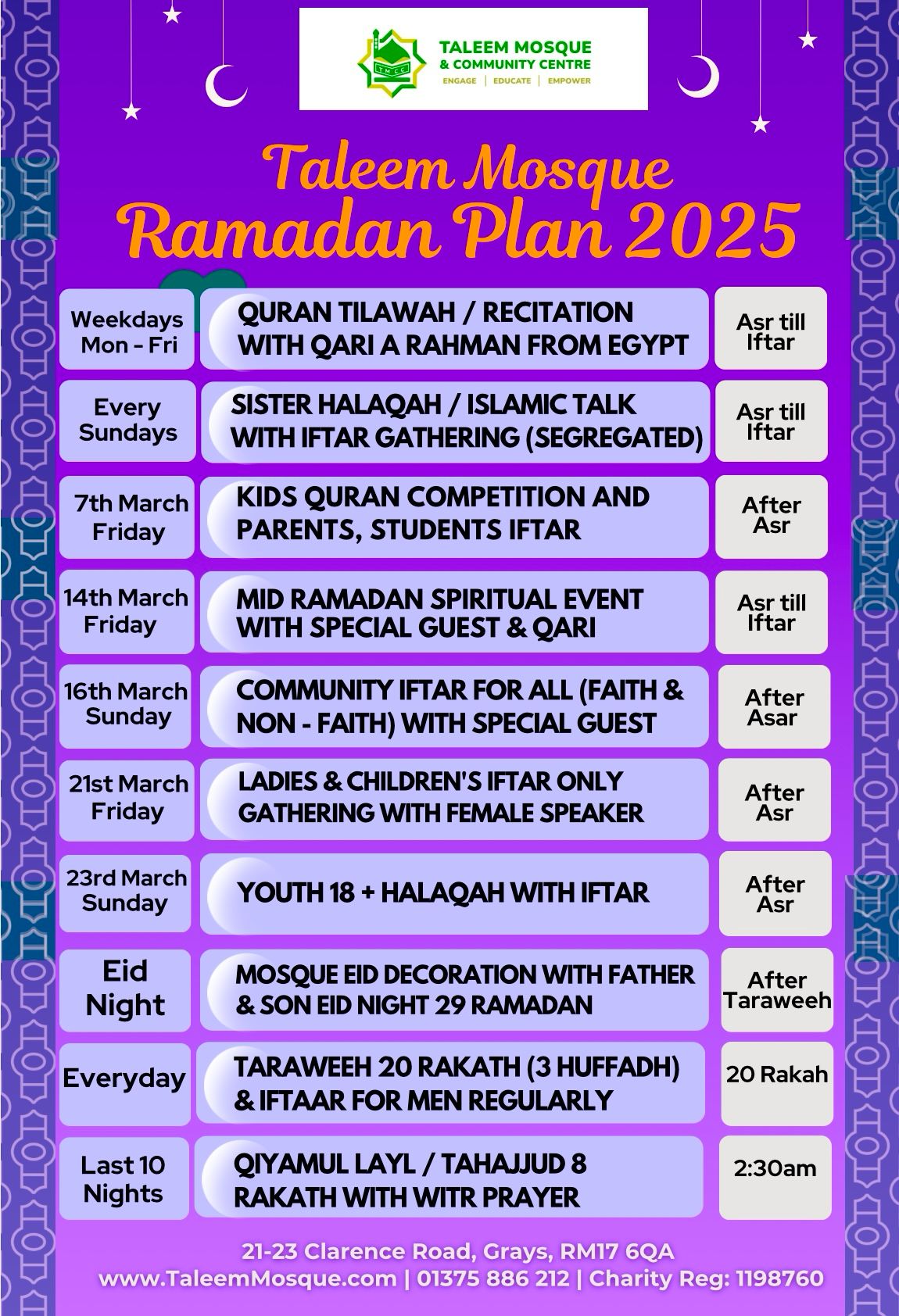
TALEEM MASJID RAMADAN EVENTS, GRAYS, ESSEX UK

TALEEM MASJID RAMADAN EVENTS

about/ disclaimer

GET READY FOR RAMADAN! Thurrock Muslims -Ramadan preparatory reminders- Fiqh of fasting


GET READY FOR RAMADAN 1445AH

Ramadaan preparatory reminders- Fiqh of fasting


Share this vital information with others! https://wp.me/p4GU3D-Cz

Let’s get ready for Ramadan in obedience to our Most Merciful Rabb, Allah!

person holding blue ceramic teapot pouring tea on clear drinking glass
Photo by Tima Miroshnichenko

It is hoped this will inform us of the primary reasons we fast, what is required of us and what to hope for.

May Allah, The Supreme Creator, permit us to fast for none but Him alone, may He reward us for our endeavours, and may He permit us to strive to avoid that which nullifies the fast, and strive to adhere to what maintains and perfects it, in accordance with the teachings of His final prophet peace be upon him.  Ameen.

DISCLAIMER: This is for educational purposes and serves as an introduction to the issues pertaining to fasting. Parents/guardians are advised to supervise the following read as some issues which pertain to married adults have been mentioned. Please consult a knowledgeable Islamic scholar (and trustworthy medical professional) for details, particularly for questions and advice related to individual circumstances. We are not scholars and thus cannot issue fatwa, however we endeavour relate to you the words of the scholars who have studied the authentic teachings of Islam from the Qur’an and the Sunnah of prophet Muhammad upon him be peace. And ultimately, Allah knows best.

blue squares banner

Fiqh of Fasting – Part 7  (adapted mainly from Sh. Yahya Adel Ibrahim with notes from others)

Summary of Siyam (Fasting) Essentials

What is the meaning of “Siyam?”

The word “siyam” comes from the root word “sowm,” which means “to abstain from.”

Did Muslims fast before 2 A.H.?

Yes, in fact the Prophet sala Allahu alihi wasSalaam and his companions (may Allah be pleased with them) used to fast on various days, including:

1. Day of Ashura (the exodus) when Allah delivered Musa sala Allahu alihi wasSalaam and the Muslims of that time from the evil of Pharaoh. The Prophet (upon him be peace) taught us to fast two days—either the day before or after plus the actual day of Ashura.

2. On the day of Arafat, if not making Hajj

3. The first 9 Days of dhul-Hijjah

4. Mondays & Thursdays through out the year

5. The middle three days of each lunar month (13th, 14th & 15th) when he moon is at its brightest

6. There are some proofs by way of Khadija (May Allah be pleased with her) who reports that the Prophet (peace be upon him) used to fast before the prophethood—but we do not know the exact days.

Why was Siyam ordered?

The answer to this question lies only with Allah. However, we can find that there are many benefits and bits of wisdom behind this pious and sincere act.

1. Increases one’s Taqwa (remembrance of Allah in daily affairs), as is stated in the Quran: Surah Baqara verse 183.

2. Trains the body, mind and spirit to bear hardships while remaining patient.

3. Trains the body, mind and spirit to hold back from the natural desires of the human: food, drink, anger, lust, etc.

4. To help one understand what the impoverished go though.

What is the importance of the month of Ramadan?

This is the month in which the gates of heaven are opened and the gates of hell are closed. This is the month where every dua’ reaches Allah. This is the month where the Muslims are protected from the evil whisperings of the shayateen. This is the month where one plants the seeds of worship, the seeds of taqwa in the earth and harvests the good deeds for sustenance throughout the year. And most importantly, this is the month in which the Quran was revealed—more specifically, on the night of Lailat-ul-Qadr.

Who must fast?

1. One who is Muslim
2. One who has Aql (mental faculties are sound and understands the responsibility of fasting)
3. One who has reached the age of puberty (signs include: growth of pubic hair or nocturnal emissions, emitting maniy, or reaching 15 years of age, occurrence of menses)
4. One who is Kaadir (able to maintain the fast)

What is the requirement for the fast?

Very simply, the fast begins with the niya (intention-this need not be verbal, rather intention resides in the heart)—this is a pre Requisite/ Shart—and then refraining from food, drink and things that break the fast, until the time for Maghrib has arrived.

It must be noted by the reader that one cannot just wake up in the morning and proclaim his fast for that day. This was only allowed for the Prophet sala Allahu alihi wasSalaam. Rather, for the followers, there needs to be mental recognition of the fast BEFORE FAJR in other than the month of Ramadan.

What breaks the fast?

1. Eating

2. Drinking

3. Sexual relations/intimate acts of any type that leads to male or female sexual discharge,

4. Haid (menstrual bleeding)

5. Nifas (post natal bleeding)

6. Intentional vomiting

7. Needles that give you nourishment

For further clarification on some issues:

a. Blood testing is okay

b. If one needs to take Insulin then that person cannot fast

c. Using the puffer for asthma patients is okay—the respiratory type only.

(in sha Allah, see more detailed article on things which nullify the fast)
What happens if a couple has intimate relations during the fast?

• If the couple have intercourse intentionally then they have to make up that day and they have to fast 60 days consecutively, or if unable feed 60 people or Kafarah

What is Kafarah?

This is given only as expiation for sexual infractions during the fast. There are three methods of expiation:

1. Freeing of a slave

2. Fast for 60 consecutive days. If one day is missed then you would start from the beginning again

3. If you are unable to fast, for a legitimate reason (sick, old,etc.) then you may feed 60 miskeen (poor) people. They have to be Muslim people and it can happen on one day as a feast. Also, one can just give the money to feed 60 people. This is considered a debt for that person and they should fulfil it before their death. If they do die then the relatives can either fast for them or feed the miskeen.

What about those that cannot fast, but are of age?

Of those who are excused from the fast are those who have a long-term sickness, the pregnant woman, the woman who is breast-feeding and the traveller. For the traveller, the fast is to be made up. But for the others, they are to pay the Fidya (please note, there is a scholarly difference of opinion regarding who can pay fidyah instead of making up fasts- please consult a scholar for your own case, see the links below). Fidya is to pay for a meal for one miskeen person for everyday that is missed. Like the Kafarah, one can arrange to give 30 days worth of money at one time, or arrange a feast for 30 miskeen people on one day.

PLEASE NOTE however, regarding pregnant and nursing mothers and sickness, please ask a highly knowledge Islamic scholar for individual cases. see this and this-is fidyah enough for pregnant women/sick people or not & should they make up the fast?) . Regarding pregnant and nursing mothers and sick people whose illness goes away and making up missed fasts, see these (who is exempt) and (how to make up fasts for ladies/mothers) and (how to make up missed fasts- sickness and all else)

Confused about your case? Contact a knowledgabe Mufti (try calling up on the Ask the Sheikh programmes on Eman Channel, or similar.)

The Sunnan of Fasting

1. The sahoor and iftaar should be done with the family. If the family is not available then one should make an effort to never break the fast alone.

2. To hurry up with breaking the iftaar—not to delay it. But the sahoor can be delayed right up until the time for Fajr enters.

3. To break the fast with dates, or at least 3 sips of water.

4. To make dua’ of breaking the fast. (“Dhahaba al-zamau’a, wa abtallat al-‘urooq wa thabata al-ajr insha Allah (Thirst has gone, the veins are moist, and the reward is assured, if Allaah wills).” see Arabic below )

break the fasting dua

5. To increase in acts of ibada (recitation of the Quran) and this should continue after the month of Ramadan has passed.

6. To give more sadaqa (charity).

7. To offer the tahajud prayers and the tarrawih prayers (in congregation).

8. To feed other Muslims, even if they are not needy—meaning to invite people to your house for the iftaar. In fact, when you invite people the host receives the reward that his guest earned on that day (while the guest retains his own reward). This is true even for the one who finances an iftaar, or one who prepares the food.

The Makrooh (hated things) of Fasting

1. To be excessive in rinsing with water, during wudu or other times. Having too much water in the mouth might cause a person to swallow some.

2. To unnecessarily taste food. There cannot be any swallowing and the tongue should be cleaned of any residual taste.

3. Kissing your spouse.

4. To sexually excite/touch your spouse.

5. To lie, to make ghiba (back biting), to do nameema (telling lies to cause two parties to fight). In fact, those who practice nameema do not enter paradise with the first set of Muslims.

6. To not pray the tarrawih or tahajjud in the last 10 days.

What are some the Voluntary Fasts that one may do?

1. The fast of the Prophet Dawood (peace be upon him) was mentioned by Prophet Muhammad (sallallahu alaihi wasallam) as the best. It includes one day of fasting and one day of resting, continuously.
2. The best months for fasting include: Sha’ban, Muharram, Ramadan,Dhul Hijja.
3. The 13th, 14th & 15th of every Islamic month. The reward of fasting these three days is like having fasted an entire year.
4. Mondays and Thursdays—for these are the two days that the angels rise and descend with your deeds; i.e. the gates of heaven are open.(This refers to Maghrib time)

5. The 9th day of Dhul Hijja (for the ones not performing the hajj).This is the day of Arafat and fasting on this day ensures that the minor sins for the previous year and the coming year are forgiven.

Allah knows best!

purple stripes banner

May Allah make this benefit us, and this advice is to us before it is to you our beloved readers.

May Allah allow us to succeed this Ramadan and may He forgive us for He is the Oft-Forgiving, The Forbearing! May Allah forgive us for any errors in this and grant us correctness. Wasallallahu alaa nabiyina Muhammad.Amin

ThurrockMuslims.com

Be generous, like, share and teach others for the sake of Allahhttps://wp.me/p4GU3D-Cz

support our work

Disclaimer:

Continue reading

I believe… 6 pillars of Iman song

I believe… 6 pillars of Iman song-

Amantu billahi…

wa malaaikatihi

wa kutubihi

warusulihi

walyawmilakhiri

walqadri

khayrihi washarihi

minal Allah

wal ba’thi ba’dal mawt.

la ilaha illAllah!

I believe in Allah

and His angels

and His books

and His messengers (peace be upon them)

and the last day,

and the divine decree/destiny, all of it the good and the bad,

it is from Allah,

and the resurrection after death.

There is no true God but Allah!

Artist-Talib Habib

Thurrockmuslims.com

about/disclaimer

GET READY FOR RAMADAN! Thurrock Muslims -Ramadan preparatory reminders- Fiqh of fasting


GET READY FOR RAMADAN 1445AH

Ramadaan preparatory reminders- Fiqh of fasting


Share this vital information with others! https://wp.me/p4GU3D-Cz

Let’s get ready for Ramadan in obedience to our Most Merciful Rabb, Allah!

person holding blue ceramic teapot pouring tea on clear drinking glass
Photo by Tima Miroshnichenko

It is hoped this will inform us of the primary reasons we fast, what is required of us and what to hope for.

May Allah, The Supreme Creator, permit us to fast for none but Him alone, may He reward us for our endeavours, and may He permit us to strive to avoid that which nullifies the fast, and strive to adhere to what maintains and perfects it, in accordance with the teachings of His final prophet peace be upon him.  Ameen.

DISCLAIMER: This is for educational purposes and serves as an introduction to the issues pertaining to fasting. Parents/guardians are advised to supervise the following read as some issues which pertain to married adults have been mentioned. Please consult a knowledgeable Islamic scholar (and trustworthy medical professional) for details, particularly for questions and advice related to individual circumstances. We are not scholars and thus cannot issue fatwa, however we endeavour relate to you the words of the scholars who have studied the authentic teachings of Islam from the Qur’an and the Sunnah of prophet Muhammad upon him be peace. And ultimately, Allah knows best.

blue squares banner

Fiqh of Fasting – Part 7  (adapted mainly from Sh. Yahya Adel Ibrahim with notes from others)

Summary of Siyam (Fasting) Essentials

What is the meaning of “Siyam?”

The word “siyam” comes from the root word “sowm,” which means “to abstain from.”

Did Muslims fast before 2 A.H.?

Yes, in fact the Prophet sala Allahu alihi wasSalaam and his companions (may Allah be pleased with them) used to fast on various days, including:

1. Day of Ashura (the exodus) when Allah delivered Musa sala Allahu alihi wasSalaam and the Muslims of that time from the evil of Pharaoh. The Prophet (upon him be peace) taught us to fast two days—either the day before or after plus the actual day of Ashura.

2. On the day of Arafat, if not making Hajj

3. The first 9 Days of dhul-Hijjah

4. Mondays & Thursdays through out the year

5. The middle three days of each lunar month (13th, 14th & 15th) when he moon is at its brightest

6. There are some proofs by way of Khadija (May Allah be pleased with her) who reports that the Prophet (peace be upon him) used to fast before the prophethood—but we do not know the exact days.

Why was Siyam ordered?

The answer to this question lies only with Allah. However, we can find that there are many benefits and bits of wisdom behind this pious and sincere act.

1. Increases one’s Taqwa (remembrance of Allah in daily affairs), as is stated in the Quran: Surah Baqara verse 183.

2. Trains the body, mind and spirit to bear hardships while remaining patient.

3. Trains the body, mind and spirit to hold back from the natural desires of the human: food, drink, anger, lust, etc.

4. To help one understand what the impoverished go though.

What is the importance of the month of Ramadan?

This is the month in which the gates of heaven are opened and the gates of hell are closed. This is the month where every dua’ reaches Allah. This is the month where the Muslims are protected from the evil whisperings of the shayateen. This is the month where one plants the seeds of worship, the seeds of taqwa in the earth and harvests the good deeds for sustenance throughout the year. And most importantly, this is the month in which the Quran was revealed—more specifically, on the night of Lailat-ul-Qadr.

Who must fast?

1. One who is Muslim
2. One who has Aql (mental faculties are sound and understands the responsibility of fasting)
3. One who has reached the age of puberty (signs include: growth of pubic hair or nocturnal emissions, emitting maniy, or reaching 15 years of age, occurrence of menses)
4. One who is Kaadir (able to maintain the fast)

What is the requirement for the fast?

Very simply, the fast begins with the niya (intention-this need not be verbal, rather intention resides in the heart)—this is a pre Requisite/ Shart—and then refraining from food, drink and things that break the fast, until the time for Maghrib has arrived.

It must be noted by the reader that one cannot just wake up in the morning and proclaim his fast for that day. This was only allowed for the Prophet sala Allahu alihi wasSalaam. Rather, for the followers, there needs to be mental recognition of the fast BEFORE FAJR in other than the month of Ramadan.

What breaks the fast?

1. Eating

2. Drinking

3. Sexual relations/intimate acts of any type that leads to male or female sexual discharge,

4. Haid (menstrual bleeding)

5. Nifas (post natal bleeding)

6. Intentional vomiting

7. Needles that give you nourishment

For further clarification on some issues:

a. Blood testing is okay

b. If one needs to take Insulin then that person cannot fast

c. Using the puffer for asthma patients is okay—the respiratory type only.

(in sha Allah, see more detailed article on things which nullify the fast)
What happens if a couple has intimate relations during the fast?

• If the couple have intercourse intentionally then they have to make up that day and they have to fast 60 days consecutively, or if unable feed 60 people or Kafarah

What is Kafarah?

This is given only as expiation for sexual infractions during the fast. There are three methods of expiation:

1. Freeing of a slave

2. Fast for 60 consecutive days. If one day is missed then you would start from the beginning again

3. If you are unable to fast, for a legitimate reason (sick, old,etc.) then you may feed 60 miskeen (poor) people. They have to be Muslim people and it can happen on one day as a feast. Also, one can just give the money to feed 60 people. This is considered a debt for that person and they should fulfil it before their death. If they do die then the relatives can either fast for them or feed the miskeen.

What about those that cannot fast, but are of age?

Of those who are excused from the fast are those who have a long-term sickness, the pregnant woman, the woman who is breast-feeding and the traveller. For the traveller, the fast is to be made up. But for the others, they are to pay the Fidya (please note, there is a scholarly difference of opinion regarding who can pay fidyah instead of making up fasts- please consult a scholar for your own case, see the links below). Fidya is to pay for a meal for one miskeen person for everyday that is missed. Like the Kafarah, one can arrange to give 30 days worth of money at one time, or arrange a feast for 30 miskeen people on one day.

PLEASE NOTE however, regarding pregnant and nursing mothers and sickness, please ask a highly knowledge Islamic scholar for individual cases. see this and this-is fidyah enough for pregnant women/sick people or not & should they make up the fast?) . Regarding pregnant and nursing mothers and sick people whose illness goes away and making up missed fasts, see these (who is exempt) and (how to make up fasts for ladies/mothers) and (how to make up missed fasts- sickness and all else)

Confused about your case? Contact a knowledgabe Mufti (try calling up on the Ask the Sheikh programmes on Eman Channel, or similar.)

The Sunnan of Fasting

1. The sahoor and iftaar should be done with the family. If the family is not available then one should make an effort to never break the fast alone.

2. To hurry up with breaking the iftaar—not to delay it. But the sahoor can be delayed right up until the time for Fajr enters.

3. To break the fast with dates, or at least 3 sips of water.

4. To make dua’ of breaking the fast. (“Dhahaba al-zamau’a, wa abtallat al-‘urooq wa thabata al-ajr insha Allah (Thirst has gone, the veins are moist, and the reward is assured, if Allaah wills).” see Arabic below )

break the fasting dua

5. To increase in acts of ibada (recitation of the Quran) and this should continue after the month of Ramadan has passed.

6. To give more sadaqa (charity).

7. To offer the tahajud prayers and the tarrawih prayers (in congregation).

8. To feed other Muslims, even if they are not needy—meaning to invite people to your house for the iftaar. In fact, when you invite people the host receives the reward that his guest earned on that day (while the guest retains his own reward). This is true even for the one who finances an iftaar, or one who prepares the food.

The Makrooh (hated things) of Fasting

1. To be excessive in rinsing with water, during wudu or other times. Having too much water in the mouth might cause a person to swallow some.

2. To unnecessarily taste food. There cannot be any swallowing and the tongue should be cleaned of any residual taste.

3. Kissing your spouse.

4. To sexually excite/touch your spouse.

5. To lie, to make ghiba (back biting), to do nameema (telling lies to cause two parties to fight). In fact, those who practice nameema do not enter paradise with the first set of Muslims.

6. To not pray the tarrawih or tahajjud in the last 10 days.

What are some the Voluntary Fasts that one may do?

1. The fast of the Prophet Dawood (peace be upon him) was mentioned by Prophet Muhammad (sallallahu alaihi wasallam) as the best. It includes one day of fasting and one day of resting, continuously.
2. The best months for fasting include: Sha’ban, Muharram, Ramadan,Dhul Hijja.
3. The 13th, 14th & 15th of every Islamic month. The reward of fasting these three days is like having fasted an entire year.
4. Mondays and Thursdays—for these are the two days that the angels rise and descend with your deeds; i.e. the gates of heaven are open.(This refers to Maghrib time)

5. The 9th day of Dhul Hijja (for the ones not performing the hajj).This is the day of Arafat and fasting on this day ensures that the minor sins for the previous year and the coming year are forgiven.

Allah knows best!

purple stripes banner

May Allah make this benefit us, and this advice is to us before it is to you our beloved readers.

May Allah allow us to succeed this Ramadan and may He forgive us for He is the Oft-Forgiving, The Forbearing! May Allah forgive us for any errors in this and grant us correctness. Wasallallahu alaa nabiyina Muhammad.Amin

ThurrockMuslims.com

Be generous, like, share and teach others for the sake of Allahhttps://wp.me/p4GU3D-Cz

support our work

Disclaimer:

Continue reading

How to Perform Wudu (Ablution)-Fiqh of Taharah

How to Perform Wudu (Ablution)-Fiqh of Taharah

Let’s learn together 🙂

How to perform wudu/ablution

Thurrock Muslim Community

Thurrockmuslims.com

About/disclaimer

Learn Islam

RAMADAN FAMILY DINNER EVENT 18 MARCH 2023 IN GRAYS/THURROCK/ESSEX- TALEEM FOUNDATION

RAMADAN FAMILY EVENT 18 MARCH 2023 IN GRAYS/THURROCK/ESSEX- TALEEM FOUNDATION

Don’t be deprived! Come along with family and friends.

(Contact organiseer, for tickets : https://www.eventbrite.co.uk/e/ramadan-family-dinner-event-tickets-543620853607 

Come and join a gathering where Allah is mentioned. Let’s win this Ramadan in sha Allah.

*RAMADAN FAMILY EVENT*

Taleem would like to invite you to a special family dinner Ramadan event. Join us for a beneficial convention exploring tips on how to prepare for Ramadan.

*Saturday 18th March 2023*

*Door Open 5.30 P.M*

Venue: *Lighthouse Hall, Grays, RM17 5BT*

*NASEEHA FROM RENOWNED SCHOLARS AND NASHEED*

– Yusuf Chambers

– Shaikh Saeed ibn Jalal

– Sheikh Ashiqur Rahman

– Mikhaael Mala

– Tariq Shaikh 

– Marayam Jazeem

* Delicious 3-Course Meal

* Sponsors Recognition Awards

* Islamic Nasheeds

To *book tickets* click here 

https://taleem.eventbrite.co.uk

Please *Share* the poster

Thurrock Muslim Community

Thurrockmuslims.com

About/disclaimer

Read more: RAMADAN FAMILY DINNER EVENT 18 MARCH 2023 IN GRAYS/THURROCK/ESSEX- TALEEM FOUNDATION

Supported by Travel Link, ATOL and IATA accredited professional travel services, flights, holidays and umrah.

GET READY FOR RAMADAN! Thurrock Muslims -Ramadan preparatory reminders- Fiqh of fasting


GET READY FOR RAMADAN 1444AH

Ramadaan preparatory reminders- Fiqh of fasting


Share this vital information with others! https://wp.me/p4GU3D-Cz

Let’s get ready for Ramadan in obedience to our Most Merciful Rabb, Allah!

person holding blue ceramic teapot pouring tea on clear drinking glass
Photo by Tima Miroshnichenko

It is hoped this will inform us of the primary reasons we fast, what is required of us and what to hope for.

May Allah, The Supreme Creator, permit us to fast for none but Him alone, may He reward us for our endeavours, and may He permit us to strive to avoid that which nullifies the fast, and strive to adhere to what maintains and perfects it, in accordance with the teachings of His final prophet peace be upon him.  Ameen.

DISCLAIMER: This is for educational purposes and serves as an introduction to the issues pertaining to fasting. Parents/guardians are advised to supervise the following read as some issues which pertain to married adults have been mentioned. Please consult a knowledgeable Islamic scholar (and trustworthy medical professional) for details, particularly for questions and advice related to individual circumstances. We are not scholars and thus cannot issue fatwa, however we endeavour relate to you the words of the scholars who have studied the authentic teachings of Islam from the Qur’an and the Sunnah of prophet Muhammad upon him be peace. And ultimately, Allah knows best.

blue squares banner

Fiqh of Fasting – Part 7  (adapted mainly from Sh. Yahya Adel Ibrahim with notes from others)

Summary of Siyam (Fasting) Essentials

What is the meaning of “Siyam?”

The word “siyam” comes from the root word “sowm,” which means “to abstain from.”

Did Muslims fast before 2 A.H.?

Yes, in fact the Prophet sala Allahu alihi wasSalaam and his companions (may Allah be pleased with them) used to fast on various days, including:

1. Day of Ashura (the exodus) when Allah delivered Musa sala Allahu alihi wasSalaam and the Muslims of that time from the evil of Pharaoh. The Prophet (upon him be peace) taught us to fast two days—either the day before or after plus the actual day of Ashura.

2. On the day of Arafat, if not making Hajj

3. The first 9 Days of dhul-Hijjah

4. Mondays & Thursdays through out the year

5. The middle three days of each lunar month (13th, 14th & 15th) when he moon is at its brightest

6. There are some proofs by way of Khadija (May Allah be pleased with her) who reports that the Prophet (peace be upon him) used to fast before the prophethood—but we do not know the exact days.

Why was Siyam ordered?

The answer to this question lies only with Allah. However, we can find that there are many benefits and bits of wisdom behind this pious and sincere act.

1. Increases one’s Taqwa (remembrance of Allah in daily affairs), as is stated in the Quran: Surah Baqara verse 183.

2. Trains the body, mind and spirit to bear hardships while remaining patient.

3. Trains the body, mind and spirit to hold back from the natural desires of the human: food, drink, anger, lust, etc.

4. To help one understand what the impoverished go though.

What is the importance of the month of Ramadan?

This is the month in which the gates of heaven are opened and the gates of hell are closed. This is the month where every dua’ reaches Allah. This is the month where the Muslims are protected from the evil whisperings of the shayateen. This is the month where one plants the seeds of worship, the seeds of taqwa in the earth and harvests the good deeds for sustenance throughout the year. And most importantly, this is the month in which the Quran was revealed—more specifically, on the night of Lailat-ul-Qadr.

Who must fast?

1. One who is Muslim
2. One who has Aql (mental faculties are sound and understands the responsibility of fasting)
3. One who has reached the age of puberty (signs include: growth of pubic hair or nocturnal emissions, emitting maniy, or reaching 15 years of age, occurrence of menses)
4. One who is Kaadir (able to maintain the fast)

What is the requirement for the fast?

Very simply, the fast begins with the niya (intention-this need not be verbal, rather intention resides in the heart)—this is a pre Requisite/ Shart—and then refraining from food, drink and things that break the fast, until the time for Maghrib has arrived.

It must be noted by the reader that one cannot just wake up in the morning and proclaim his fast for that day. This was only allowed for the Prophet sala Allahu alihi wasSalaam. Rather, for the followers, there needs to be mental recognition of the fast BEFORE FAJR in other than the month of Ramadan.

What breaks the fast?

1. Eating

2. Drinking

3. Sexual relations/intimate acts of any type that leads to male or female sexual discharge,

4. Haid (menstrual bleeding)

5. Nifas (post natal bleeding)

6. Intentional vomiting

7. Needles that give you nourishment

For further clarification on some issues:

a. Blood testing is okay

b. If one needs to take Insulin then that person cannot fast

c. Using the puffer for asthma patients is okay—the respiratory type only.

(in sha Allah, see more detailed article on things which nullify the fast)
What happens if a couple has intimate relations during the fast?

• If the couple have intercourse intentionally then they have to make up that day and they have to fast 60 days consecutively, or if unable feed 60 people or Kafarah

What is Kafarah?

This is given only as expiation for sexual infractions during the fast. There are three methods of expiation:

1. Freeing of a slave

2. Fast for 60 consecutive days. If one day is missed then you would start from the beginning again

3. If you are unable to fast, for a legitimate reason (sick, old,etc.) then you may feed 60 miskeen (poor) people. They have to be Muslim people and it can happen on one day as a feast. Also, one can just give the money to feed 60 people. This is considered a debt for that person and they should fulfil it before their death. If they do die then the relatives can either fast for them or feed the miskeen.

What about those that cannot fast, but are of age?

Of those who are excused from the fast are those who have a long-term sickness, the pregnant woman, the woman who is breast-feeding and the traveller. For the traveller, the fast is to be made up. But for the others, they are to pay the Fidya (please note, there is a scholarly difference of opinion regarding who can pay fidyah instead of making up fasts- please consult a scholar for your own case, see the links below). Fidya is to pay for a meal for one miskeen person for everyday that is missed. Like the Kafarah, one can arrange to give 30 days worth of money at one time, or arrange a feast for 30 miskeen people on one day.

PLEASE NOTE however, regarding pregnant and nursing mothers and sickness, please ask a highly knowledge Islamic scholar for individual cases. see this and this-is fidyah enough for pregnant women/sick people or not & should they make up the fast?) . Regarding pregnant and nursing mothers and sick people whose illness goes away and making up missed fasts, see these (who is exempt) and (how to make up fasts for ladies/mothers) and (how to make up missed fasts- sickness and all else)

Confused about your case? Contact a knowledgabe Mufti (try calling up on the Ask the Sheikh programmes on Eman Channel, or similar.)

The Sunnan of Fasting

1. The sahoor and iftaar should be done with the family. If the family is not available then one should make an effort to never break the fast alone.

2. To hurry up with breaking the iftaar—not to delay it. But the sahoor can be delayed right up until the time for Fajr enters.

3. To break the fast with dates, or at least 3 sips of water.

4. To make dua’ of breaking the fast. (“Dhahaba al-zamau’a, wa abtallat al-‘urooq wa thabata al-ajr insha Allah (Thirst has gone, the veins are moist, and the reward is assured, if Allaah wills).” see Arabic below )

break the fasting dua

5. To increase in acts of ibada (recitation of the Quran) and this should continue after the month of Ramadan has passed.

6. To give more sadaqa (charity).

7. To offer the tahajud prayers and the tarrawih prayers (in congregation).

8. To feed other Muslims, even if they are not needy—meaning to invite people to your house for the iftaar. In fact, when you invite people the host receives the reward that his guest earned on that day (while the guest retains his own reward). This is true even for the one who finances an iftaar, or one who prepares the food.

The Makrooh (hated things) of Fasting

1. To be excessive in rinsing with water, during wudu or other times. Having too much water in the mouth might cause a person to swallow some.

2. To unnecessarily taste food. There cannot be any swallowing and the tongue should be cleaned of any residual taste.

3. Kissing your spouse.

4. To sexually excite/touch your spouse.

5. To lie, to make ghiba (back biting), to do nameema (telling lies to cause two parties to fight). In fact, those who practice nameema do not enter paradise with the first set of Muslims.

6. To not pray the tarrawih or tahajjud in the last 10 days.

What are some the Voluntary Fasts that one may do?

1. The fast of the Prophet Dawood (peace be upon him) was mentioned by Prophet Muhammad (sallallahu alaihi wasallam) as the best. It includes one day of fasting and one day of resting, continuously.
2. The best months for fasting include: Sha’ban, Muharram, Ramadan,Dhul Hijja.
3. The 13th, 14th & 15th of every Islamic month. The reward of fasting these three days is like having fasted an entire year.
4. Mondays and Thursdays—for these are the two days that the angels rise and descend with your deeds; i.e. the gates of heaven are open.(This refers to Maghrib time)

5. The 9th day of Dhul Hijja (for the ones not performing the hajj).This is the day of Arafat and fasting on this day ensures that the minor sins for the previous year and the coming year are forgiven.

Allah knows best!

purple stripes banner

May Allah make this benefit us, and this advice is to us before it is to you our beloved readers.

May Allah allow us to succeed this Ramadan and may He forgive us for He is the Oft-Forgiving, The Forbearing! May Allah forgive us for any errors in this and grant us correctness. Wasallallahu alaa nabiyina Muhammad.Amin

ThurrockMuslims.com

Be generous, like, share and teach others for the sake of Allahhttps://wp.me/p4GU3D-Cz

support our work

Disclaimer:

Continue reading