In the name of Allah, the Beneficent, the Merciful
Verily, We have sent it (this Qur’ân) down in the night of Al-Qadr (Decree)[] (1) And what will make you know what the night of Al-Qadr (Decree) is? (2) The night of Al-Qadr (Decree) is better than a thousand months (i.e. worshipping Allâh in that night is better than worshipping Him a thousand months, i.e. 83 years and 4 months) (3) Therein descend the angels and the Rûh [Jibril (Gabriel)] by Allâh’s Permission with all Decrees, (4) (All that night), there is Peace (and Goodness from Allâh to His believing slaves) until the appearance of dawn.[] (5)
And if you are a lady on your menses, you can ibadah other than prayer: see this
Some reminders from our respected lecturers in the Ramadan Revival, this night, increase in Qiyam (standing in prayer at night), reading Qur’an, making dua- lots of it, pour our hearts out to Allah! We can also give zakah if one lunar year passed on the wealth which reached the nisaab, and do other good deeds, like istighfar (seeking forgiveness from Allah –click to see amazing this dua) sadaqah, reminding each other of Allah, dhikr- remembering Allah, salat and salam on rasoolullah sallallahu alayhi wasallam!
It was narrated from Abu Hurayrah (may Allaah be pleased with him) that the Prophet (peace and blessings of Allaah be upon him) said: “Whoever stays up and prays on Laylat al-Qadr out of faith and in the hope of reward, his previous sins will be forgiven.” Agreed upon.
Rasoolullah sallallahu alayhi wasallam taught ‘Aisha radi Allahu anhaa what to say on laylat-ul-qadr:
Let’s revive the sunnah and flee to Allah! please remember us in your duas, and like and share this in sha Allah!
NOTE: Congregational prayers are being held around Thurrock and Grays, don’t miss out!
Isha and taraweeh prayers:
Taleem Masjid has facilities for men, women and children (families welcome). Special guest Sheikh Qari Mohammad Ibrahim from Egypt, and Hafiz Mamun (UK) and Hafiz Ammar, and other guest Quraa , including qiyam layl at 230am.
(21 Clarence Road, next to Job Centre, Grays, RM17 6QA)
(Wudu/ablution facilities available at Taleem Masjid, and parking in secure car park, arrive earlier)
Grays mosque has facilities for men and boys, women (in Grays Park, Grays)
Basildon has prayer facilities for families: organised by South Essex Islamic Trust
Stanford le-Hope and Tilbury masjids also have jamaat.
Arrive with wudu (facilities available) and make sure you park responsibly 🙂 (let’s be better neighbours in sha Allah).
Special note: Taleem Masjid is offering daily prayers, jumuah, taraweeh with dedicated local Huffaz/Qari and Hafiz from Egypt , daily iftar for brothers, weekly sister’s iftars and special community iftar, programmes for women throughout this blessed month, plus tons of Islamic seminars and community events year round. This Masjid is truly fulfilling its purpose of uniting the community in Allah’s cause, and the growing congregation testifies to its benefit.
Prominent shuyukh countrywide are supporting this excellent effort and proudly advocate for Taleem Masjid.
Here’s a message from respected Shaikh Kazi Ashiqur Rahman.
Please donate generously for Taleem Masjid urgent appeal! Let’s build Masjids upon Tawhid and Qur’an and Sunnah in our town and beyond. May Allah help us spend sincerely in His cause and help us purchase Taleem Masjid swiftly and make it our sadaqah jariyah for generations to come.
May Allah grant us sincerity, and success and jannat al firdaus, May Allah guide and have mercy on us, forgive all of us who believe and admit us to paradise, by His mercy. Allah abundantly bless rasoollullah. Ameen
Dear readers, it is with great joy that we announce that TUESDAY 17TH FEBRUARY 2026 marks the first night of Ramadan 1447AH and the first day of Ramadan 1447AH will be WEDNESDAY 18TH FEBRUARY 2026.
Allah’s Messenger (ﷺ) said, “When the month of Ramadan comes, the gates of Paradise are opened and the gates of the (Hell) Fire are closed, and the devils are chained.”[Sahih Bukhari]
Indeed, sincere devotion is due ˹only˺ to Allah. As for those who take other lords besides Him, ˹saying,˺ “We worship them only so they may bring us closer to Allah,” surely Allah will judge between all1 regarding what they differed about. Allah certainly does not guide whoever persists in lying and disbelief. Qur’an 39:3
2- Make a plan- The sahabah Radi Allahu anhum prepared for Ramadan months in advance. DON’T LOSE HOPE, you can renew your intention now and start an action plan. Maybe set yourself to read 5 verses a day of Qur’an and gradually increase. Be positive and be proactive! If you want to complete Qur’an in Ramadan, read 20 pages a day. And try to read the translation of Qur’an in your language.
Narrated Abu Huraira:
The Prophet (ﷺ) said, “(Allah said), ‘Every good deed of Adam’s son is for him except fasting; it is for Me. and I shall reward (the fasting person) for it.’ Verily, the smell of the mouth of a fasting person is better to Allah than the smell of musk.” [Sahih Bukhari]
2- Cut back on the greasy foods and unhealthy diet. Eat healthy, and balance your meals, with carbohydrates, fibre and protein. Add some healthy fats and dairy too. Moderation is key. Stick to the sunnah regarding food!
3-Practice self-restraint. Guard our tongues and limbs from wrongdoing.
Narrated Abu Huraira:
Allah’s Messenger (ﷺ) said, “Whoever believes in Allah and the Last Day should talk what is good or keep quiet, and whoever believes in Allah and the Last Day should not hurt (or insult) his neighbor; and whoever believes in Allah and the Last Day, should entertain his guest generously.”Bukhari
4-Be strong and grateful for Islam and the favour of witnessing Ramadan to get closer to Allah. We will have struggles, jobs, school, exams, tasks that we have to face with strength. Fasting will not hinder us, fasting sincerely for Allah will help us attain success in this life and the next.
5- Muslims are diverse, Allah created us in different colours and backgrounds, with different languages, so we may know one another. The honourable harbour Taqwa (God-conciousness/ awareness of Allah). We are from Adam and Eve (upon them be peace) at the end of the day, so let’s try to get together in Ramadan and revive the idea of community in Islam, which does not discriminate by race or other factors. Let us try to reunite our families too, for the sake of Allah.
6-Increase your prayers, not just quantity, but quality, learn about the Salah and the meanings of what you recite.
Narrated Abu Huraira:
I heard Allah’s Messenger (ﷺ) saying regarding Ramadan, “Whoever prayed at night in it (the month of Ramadan) out of sincere Faith and hoping for a reward from Allah, then all his previous sins will be forgiven.” [Sahih Bukhari]
7-Calculate your Zakaah (Zakat- obligatory poor-due charity, 2.5% of your wealth given each lunar year) and pay it in a timely manner, as best as you can. Zakaah is a primary pillar in Islam, which we must not neglect. For more on Zakaah, take a lookCheck out our ZAKAT GUIDE PAGE ZAKAT 101
10- Ease in, burn into your routine, don’t burn out. So start small, maybe five pages a day to begin with of Qur’an and build up, if you haven’t read in a long time.
12-Be productive, set realistic goals for yourself, based on your habits. So if you want to start giving more charity, first make sure you have done the obligatory Zakat, and then try to make little and often payments of sadaqah, or whatever you like, but measure it so you know when you are slacking.
13-Make a strategy/schedule for yourself. Please be kind to each other, ladies help your husbands to make time with the family, men help your women around the home. If men are working, ladies advise the children to be considerate. If mum needs a break, husbands spend some time with the kids.
14-Set a time where the family sit and learn Islam, BALANCE is key.
15-Be optimistic, like our prophet Muhammad peace be upon him. Alhamdulillah that the Masajid and world has opened up now, in our post Covid-19 world. The worst has passed in sha Allah. Take advantage and attend the mosques and pray jamah as much as possible.
We remind ourselves before we remind you, our beloved, dearest readers. Jazakumallahu khairan.
May Allah, The Most Gracious Lord of all creation shower upon us His blessings, may He make us successful in this month and beyond, may He keep us sincere for Him alone, and may He help us adhere to the sunnah of His final prophet muhammad peace be upon him. And may Allah forgive all our sins, and grant us firmness on the guidance, may He reward us, and may He make us true believers, and those who truly worship and serve none but Him alone, The One, The Irresistable Creator, for He is The All-Powerful. May Allah grant us taqwa and nearness to Him and a high place in Jannat al firdaus with the prophets alayhimusalam. May Allah abundantly bless His final prophet Muhammad peace be upon him. Ameen
Masjid timetables also available, Taleem Mosque, Grays, Basildon and others. Please contact Masajid/ Whatsapp groups for salah times, park responsibly, arrive with wudu and face masks. Barakallahu feekum
Featured, local and guest imams, and community programmes and Iftar at TMCC masjid
‼️TALEEM MASJID ISHA AND TARAWEEH STARTS 8PM (come earlier for spaces inside main building)‼️
EXTRA CAPACITY AVAILABLE (JAZAKALLAH KHAIR KIND TRUSTEES AND VOLUNTEERS WHO BUILT THE TEMPORARY EXTENTION) PLEASE KEEP US ALL IN YOUR KIND DUAS : )
LIMITED PARKING ON SITE. FIRST COME FIRST SERVED.
PARKING ON LOCAL ROADS/MORRISON SHOPPING CENTRE
Welcome to Ramadan 2026 | 1447
Taleem Mosque (Grays, Essex) is pleased to announce the blessed month of Ramadan will commence from sunset (maghrib time) on Tuesday 17th February 2026.
Therefore, Taraweeh prayers will take place TONIGHT at 8:00pm after Isha prayer.
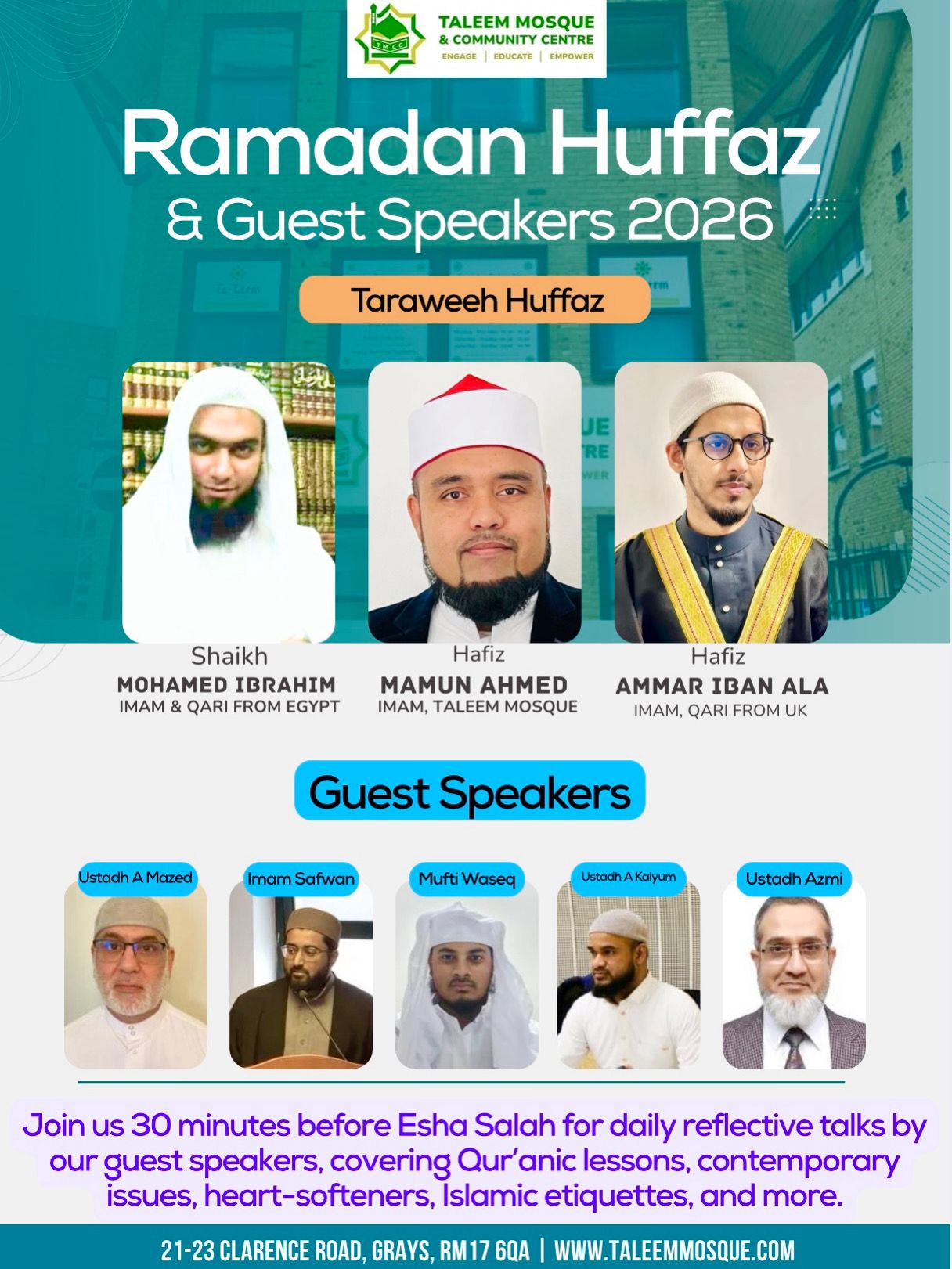
🎙️ Our Tarawih Imams:
🔸 Shaykh Mohamed Ibrahim (Egypt) 🔸 Imam Mamun Ahmed (UK) 🔸 Hafiz Ammar Iban Ala (UK)
🗣️Daily Talks: Please join us from 7:30pm (30mins before Esha) for our daily reflective talks and reminders by our guest speakers.
Parking facilities are available at Morrisons Carpark (3 mins walk).
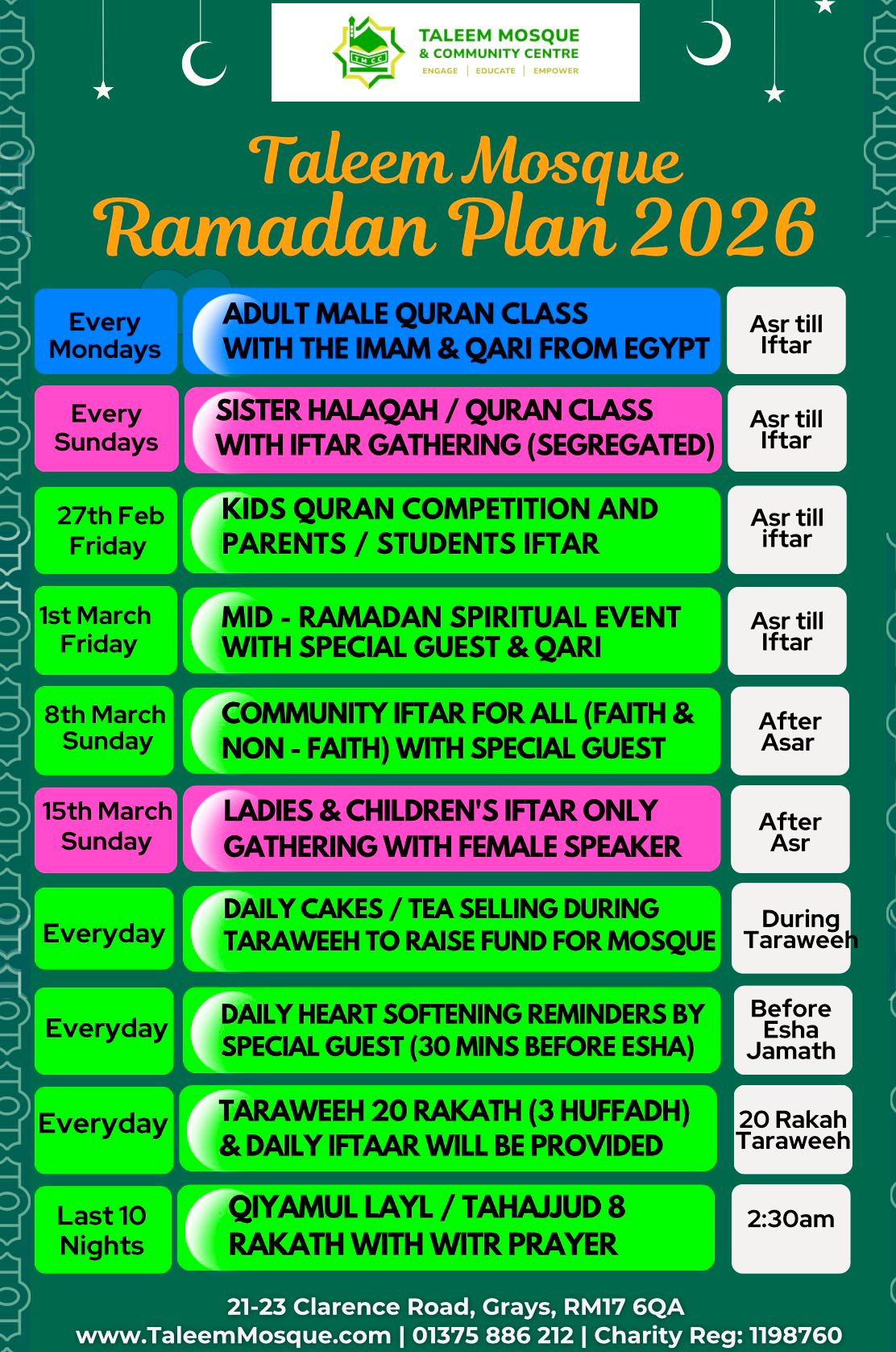
‼️ Ramadan Events Schedule: Please see the timetable (attached) outlining all our upcoming Ramadan programmes. The events have been colour-coded for clarity: blue for men, pink for ladies, and green for programmes open to both.
We are pleased to announce that we have confirmed our Taraweeh Huffadh for this year.
Our Taraweeh Imams:
🔹 Shaykh Mohamad Ibrahim (Egypt) 🔹 Imam Mamun Ahmed (UK) 🔹 Hafiz Ammar Iban Ala (UK)
Esha Jam’aat Times:
8pm (first 20 days)
8:15pm (last 10 days)
🗣️ Daily Taraweeh Reminders:
We will be joined by guest speakers for daily reflective reminders and talks on Quranic lessons, contemporary issues, Islamic etiquettes and more.
Talks will take place 30 minutes before Esha prayers. We highly encourage attending especially with your children and benefit from this additional provision and service during Ramadan.
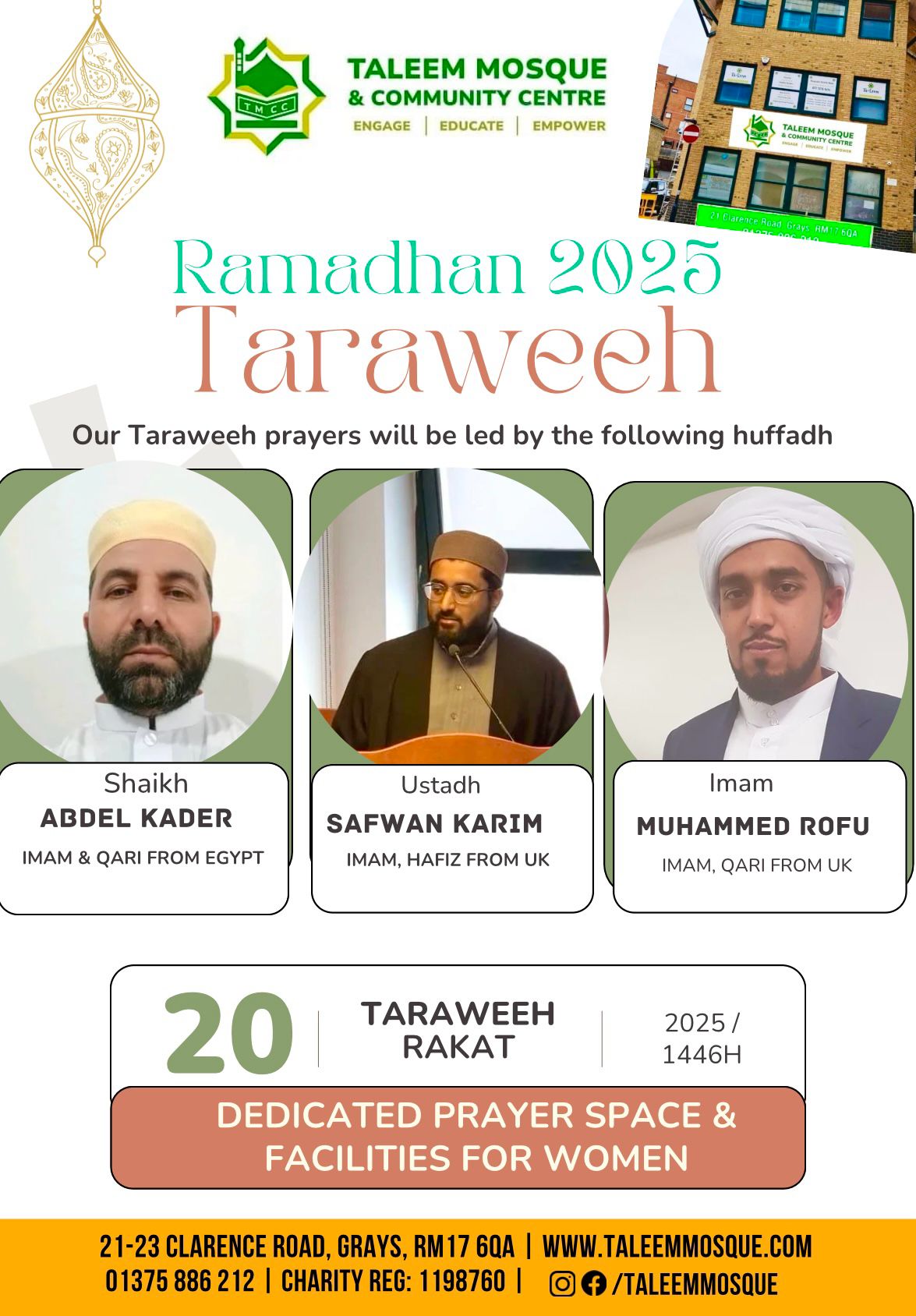
Please note our Taraweeh prayers will consist of 20 Rakah
Let’s get ready for Ramadan in obedience to our Most Merciful Rabb, Allah!
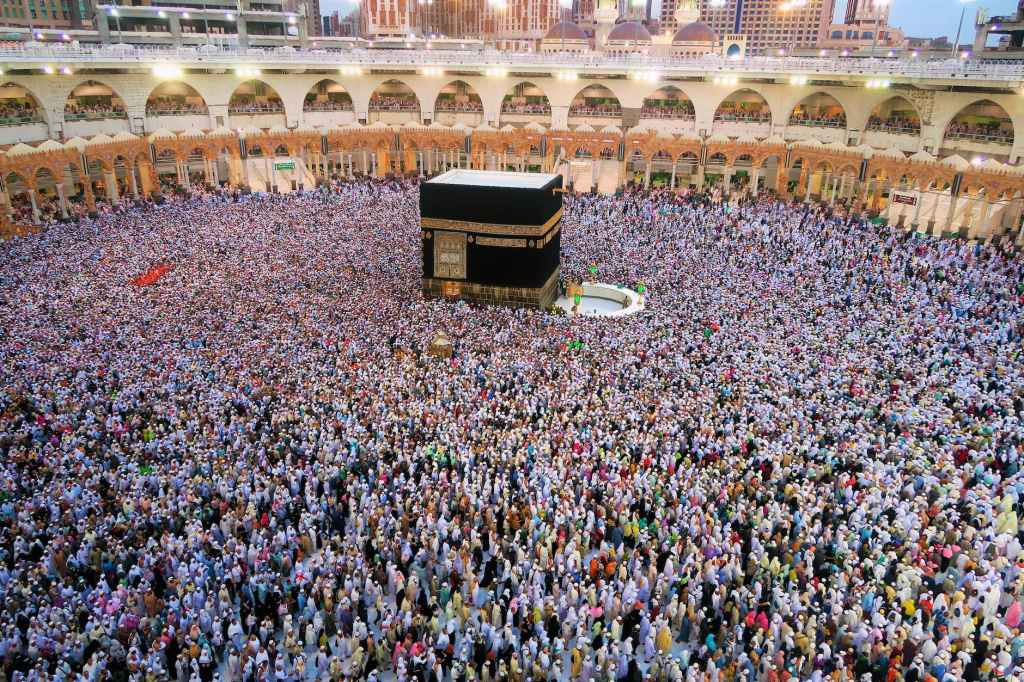
Photo by Tima Miroshnichenko
It is hoped this will inform us of the primary reasons we fast, what is required of us and what to hope for.
May Allah, The Supreme Creator, permit us to fast for none but Him alone, may He reward us for our endeavours, and may He permit us to strive to avoid that which nullifies the fast, and strive to adhere to what maintains and perfects it, in accordance with the teachings of His final prophet peace be upon him. Ameen.
DISCLAIMER: This is for educational purposes and serves as an introduction to the issues pertaining to fasting. Parents/guardians are advised to supervise the following read as some issues which pertain to married adults have been mentioned. Please consult a knowledgeable Islamic scholar (and trustworthy medical professional) for details, particularly for questions and advice related to individual circumstances. We are not scholars and thus cannot issue fatwa, however we endeavour relate to you the words of the scholars who have studied the authentic teachings of Islam from the Qur’an and the Sunnah of prophet Muhammad upon him be peace. And ultimately, Allah knows best.
Fiqh of Fasting – Part 7 (adapted mainly from Sh. Yahya Adel Ibrahim with notes from others)
Summary of Siyam (Fasting) Essentials
What is the meaning of “Siyam?”
The word “siyam” comes from the root word “sowm,” which means “to abstain from.”
Did Muslims fast before 2 A.H.?
Yes, in fact the Prophet sala Allahu alihi wasSalaam and his companions (may Allah be pleased with them) used to fast on various days, including:
1. Day of Ashura (the exodus) when Allah delivered Musa sala Allahu alihi wasSalaam and the Muslims of that time from the evil of Pharaoh. The Prophet (upon him be peace) taught us to fast two days—either the day before or after plus the actual day of Ashura.
2. On the day of Arafat, if not making Hajj
3. The first 9 Days of dhul-Hijjah
4. Mondays & Thursdays through out the year
5. The middle three days of each lunar month (13th, 14th & 15th) when he moon is at its brightest
6. There are some proofs by way of Khadija (May Allah be pleased with her) who reports that the Prophet (peace be upon him) used to fast before the prophethood—but we do not know the exact days.
Why was Siyam ordered?
The answer to this question lies only with Allah. However, we can find that there are many benefits and bits of wisdom behind this pious and sincere act.
1. Increases one’s Taqwa (remembrance of Allah in daily affairs), as is stated in the Quran: Surah Baqara verse 183.
2. Trains the body, mind and spirit to bear hardships while remaining patient.
3. Trains the body, mind and spirit to hold back from the natural desires of the human: food, drink, anger, lust, etc.
4. To help one understand what the impoverished go though.
What is the importance of the month of Ramadan?
This is the month in which the gates of heaven are opened and the gates of hell are closed. This is the month where every dua’ reaches Allah. This is the month where the Muslims are protected from the evil whisperings of the shayateen. This is the month where one plants the seeds of worship, the seeds of taqwa in the earth and harvests the good deeds for sustenance throughout the year. And most importantly, this is the month in which the Quran was revealed—more specifically, on the night of Lailat-ul-Qadr.
Who must fast?
1. One who is Muslim
2. One who has Aql (mental faculties are sound and understands the responsibility of fasting)
3. One who has reached the age of puberty (signs include: growth of pubic hair or nocturnal emissions, emitting maniy, or reaching 15 years of age, occurrence of menses)
4. One who is Kaadir (able to maintain the fast)
What is the requirement for the fast?
Very simply, the fast begins with the niya (intention-this need not be verbal, rather intention resides in the heart)—this is a pre Requisite/ Shart—and then refraining from food, drink and things that break the fast, until the time for Maghrib has arrived.
It must be noted by the reader that one cannot just wake up in the morning and proclaim his fast for that day. This was only allowed for the Prophet sala Allahu alihi wasSalaam. Rather, for the followers, there needs to be mental recognition of the fast BEFORE FAJR in other than the month of Ramadan.
What breaks the fast?
1. Eating
2. Drinking
3. Sexual relations/intimate acts of any type that leads to male or female sexual discharge,
4. Haid (menstrual bleeding)
5. Nifas (post natal bleeding)
6. Intentional vomiting
7. Needles that give you nourishment
For further clarification on some issues:
a. Blood testing is okay
b. If one needs to take Insulin then that person cannot fast
c. Using the puffer for asthma patients is okay—the respiratory type only.
• If the couple have intercourse intentionally then they have to make up that day and they have to fast 60 days consecutively, or if unable feed 60 people or Kafarah
What is Kafarah?
This is given only as expiation for sexual infractions during the fast. There are three methods of expiation:
1. Freeing of a slave
2. Fast for 60 consecutive days. If one day is missed then you would start from the beginning again
3. If you are unable to fast, for a legitimate reason (sick, old,etc.) then you may feed 60 miskeen (poor) people. They have to be Muslim people and it can happen on one day as a feast. Also, one can just give the money to feed 60 people. This is considered a debt for that person and they should fulfil it before their death. If they do die then the relatives can either fast for them or feed the miskeen.
What about those that cannot fast, but are of age?
Of those who are excused from the fast are those who have a long-term sickness, the pregnant woman, the woman who is breast-feeding and the traveller. For the traveller, the fast is to be made up. But for the others, they are to pay the Fidya (please note, there is a scholarly difference of opinion regarding who can pay fidyah instead of making up fasts- please consult a scholar for your own case, see the links below). Fidya is to pay for a meal for one miskeen person for everyday that is missed. Like the Kafarah, one can arrange to give 30 days worth of money at one time, or arrange a feast for 30 miskeen people on one day.
Confused about your case? Contact a knowledgabe Mufti (try calling up on the Ask the Sheikh programmes on Eman Channel, or similar.)
The Sunnan of Fasting
1. The sahoor and iftaar should be done with the family. If the family is not available then one should make an effort to never break the fast alone.
2. To hurry up with breaking the iftaar—not to delay it. But the sahoor can be delayed right up until the time for Fajr enters.
3. To break the fast with dates, or at least 3 sips of water.
4. To make dua’ of breaking the fast. (“Dhahaba al-zamau’a, wa abtallat al-‘urooq wa thabata al-ajr insha Allah (Thirst has gone, the veins are moist, and the reward is assured, if Allaah wills).” see Arabic below )
5. To increase in acts of ibada (recitation of the Quran) and this should continue after the month of Ramadan has passed.
6. To give more sadaqa (charity).
7. To offer the tahajud prayers and the tarrawih prayers (in congregation).
8. To feed other Muslims, even if they are not needy—meaning to invite people to your house for the iftaar. In fact, when you invite people the host receives the reward that his guest earned on that day (while the guest retains his own reward). This is true even for the one who finances an iftaar, or one who prepares the food.
The Makrooh (hated things) of Fasting
1. To be excessive in rinsing with water, during wudu or other times. Having too much water in the mouth might cause a person to swallow some.
2. To unnecessarily taste food. There cannot be any swallowing and the tongue should be cleaned of any residual taste.
3. Kissing your spouse.
4. To sexually excite/touch your spouse.
5. To lie, to make ghiba (back biting), to do nameema (telling lies to cause two parties to fight). In fact, those who practice nameema do not enter paradise with the first set of Muslims.
6. To not pray the tarrawih or tahajjud in the last 10 days.
What are some the Voluntary Fasts that one may do?
1. The fast of the Prophet Dawood (peace be upon him) was mentioned by Prophet Muhammad (sallallahu alaihi wasallam) as the best. It includes one day of fasting and one day of resting, continuously.
2. The best months for fasting include: Sha’ban, Muharram, Ramadan,Dhul Hijja.
3. The 13th, 14th & 15th of every Islamic month. The reward of fasting these three days is like having fasted an entire year.
4. Mondays and Thursdays—for these are the two days that the angels rise and descend with your deeds; i.e. the gates of heaven are open.(This refers to Maghrib time)
5. The 9th day of Dhul Hijja (for the ones not performing the hajj).This is the day of Arafat and fasting on this day ensures that the minor sins for the previous year and the coming year are forgiven.
Allah knows best!
May Allah make this benefit us, and this advice is to us before it is to you our beloved readers.
May Allah allow us to succeed this Ramadan and may He forgive us for He is the Oft-Forgiving, The Forbearing! May Allah forgive us for any errors in this and grant us correctness. Wasallallahu alaa nabiyina Muhammad.Amin
Without the pillars of prayer, the prayer is not valid
1-Takbir Al ihram/opening takbir.
2- standing (provided able)
3-reciting surah al fatihah. Without fatiha, prayer invalid.
4- rukoo, bowing position, be at ease
5-rising from rukoo,
6-Be comfortable in the position after rukoo, don’t haste. 5 sec min
7-prostration, sajdah/suju. be at ease, following limbs to touch ground:
Forehead,Nose, Palms, Knees ,Toes, Firmly on floor.
8-rising from prostration
9-sitting between 2 prostrations
10- at ease of each physical pillars steps. No rush.
11-final tashahud
12-sitting to recite final tashahud .
13-tasleem, the 2 Salams to end prayer
14-pillars in order.
Obligations/mandatory parts of prayer (wajibaat):
1-all other takbir with exclusion of takbir ihram (which is a pillar)
2-saying “sami Allahu liman Hamidah”
3-saying “rabbana wa lakal Hamd”
4-saying “subhana rabbiyal azeem”
5-saying “subhana rabbiyal a’laa”
6-say “rabbigh fir lee” between 2 sajdah
7-saying tashahud, First one (2nd rakah)
8-sitting in the first tashahud.
If you miss a pillar in prayer:
If you miss a pillar in the prayer, you have to go back and repeat that pillar and continue in sequence. See hadiths
How to do prostration of forgetfulness: sajdah sahw
This extra prostrations make up for any wajibaat/obligatory parts of the prayer missed out. It does not account for missed pillars.
How to sajdah sahw:
Ustadh Abu Khaled takes this opinion:
Read all tashahud and durood/ duas. Don’t say salam to right or left yet.
Then do an extra sajdah x 2, with sitting between them saying rabbigh fir lee. Then rise from sajdah to seated position, then do the Salam/tasleem to right and left and exit prayer.
Stronger option.
Don’t do sahjdah sahw incase you forget, or for every prayer, as this is bid’ah. Enemy satan wants us to go either extreme, must fight it. Allah help us all.
Witr prayer- odd numbered, after isha
Witr- 3 rakah, no sitting in 2nd rakah. (different to magrib). Then last rakah you sit. Qunut duas..after rukoo in 3rd rakah
May Allah forgive all our errors and guide us to the truth, and cure us, protect us, unite us in jannah. Allahumma salli ala rasoolillah Muhammad.
In the name of Allah, The Most Gracious The Most Merciful.
‘And We have sent you (O Muhammad صلى الله عليه وسلم): not but as a mercy for the ‘Alamin (mankind, jinn and all that exists).'[Qur’an 21: 107]
The final messenger of Allah, Muhammad ibn Abdillah, peace be upon him, the best man who ever lived and walked on the face of this earth. With no comparison, he is known as the most successful man in history and beyond, the best leader, the best warrior, the best businessman, the best husband, the best father, the best companion, the trustworthy, the dignified, the chaste, the modest, the courageous, the morally upright, the epitome of exemplary character…The prophet of Allah, Muhammad, upon him be peace.
Say (O Muhammad صلى الله عليه وسلم to mankind): “If you (really) love Allâh then follow me (i.e. accept Islâmic Monotheism, follow the Qur’ân and the Sunnah), Allâh will love you and forgive you your sins. And Allâh is Oft-Forgiving, Most Merciful.” Qur’an 3:31
Allah says in the Qur’an, (English interpretation) :
‘And Verily, you (O Muhammad صلى الله عليه وسلم) are on an exalted (standard of) character.’ (Qur’an, 68:4)
Muhammad, peace be upon him, had great concern for his nation- he was swift to help those in need, he was gentle and mild tempered, patient and forbearing.
He was ready… ready to listen to the unheard, ready to defend the weak and oppressed, ready to advise sincerely those seeking advice… ready to convey the truth.
He strove through periods of great difficulty to convey the lofty message- a message conveyed by all prophets and messengers, upon them be peace- a message which resonates with the natural disposition of mankind, the message ‘laa ilaha ilallah ‘ – There is no true god worthy of worship except Allah alone.
The final messenger of Allah, Muhammad peace be upon him, did not fail in his task in the least bit. He succeeded. Far and wide, the mesage is known, and the message is followed.
I bear witness that there is no true god worthy of worship except Allah who is alone without partners or associates, and I bear witness that Muhammad peace be upon him is the servant and messenger of Allah.
His teachings, actions, descriptions, sayings and instructions are revered and adhered to, cherished and conveyed. Muhammad peace be upon him taught us to have high moral character and good manners with The Creator (Allah) and the creation. He taught us how to conduct ourselves in the best and most decent manner. He, upon him be peace, said (English interpretation): I have only been sent (by Allah) to complete the good manners [Al-Hakim].
He was a mercy for mankind. He peace be upon him taught us (English interpretation): The merciful ones are granted mercy by the Most Merciful . Show mercy to those who are on earth, and the One above the heavens will show mercy to you. [Ahmad]
Muhammad peace be upon him conveyed the message which would lead to our peace and salvation in this world and for the life to come. Our purpose in life is clear, to worship exclusively The Supreme Self-Sufficient Creator, Allah, and this is the only way to attain peace and eternal bliss.
Only the fair-minded will emancipate themselves from bigotry and ignorance. Those who mock this mighty messenger, are full of hate today, but tomorrow, will be full of regret. This occurred at the time of the prophet Muhammad peace be upon him, he had enemies, mockers and haters among the disbelievers and hypocrites. They intended by their vicious, slanderous profanity and abuse to dissuade the messenger from conveying the message, whilst they knew that all they attributed to him were but fabrications. In the end, these haters failed. They were surely humilated, and what’s to come in the hereafter of humiliation is an unimaginable and inevitable reality. Haters will be haters, but they’ll also be in great loss. Drawing from the wisdom exhibited by the prophet Muhammad peace be upon him throughout his lifetime, we learn that we must deal with all people justly. These people, i.e. the mockers, need help and guidance. Let’s keep unsolicited violence out of the equation. Pity is little we can offer them, but education is far more powerful. May Allah guide us all, ameen.
Isn’t it time we educated ourselves about this remarkable man whose call to Islamic monotheism has been received and accepted by discerning people from all walks of life? Isn’t it time we searched for the real, unadultered truth? Isn’t it about time we learnt who he was, what he stood for, and Whom he called to…
Oh Allah may Your peace and blessings be upon Your final prophet muhammad peace be upon him in great abundance, upon his family and companions and those who follow them in righteousness! Ameen! May Allah make us of Muhammad’s followers, peace be upon him, for indeed Allah commanded us to obey and follow the messenger, and this is the only way to true success.
“Indeed in the Messenger of Allâh (Muhammad [sal-Allâhu ‘alayhi wa sallam]) you have a good example to follow for him who hopes for (the Meeting with) Allâh and the Last Day, and remembers Allâh much.” {Al Ahzaab: 21}
Want resources? Start to read the book entitled ‘The Sealed Nectar’ (Ar-Raheequl-Makhtum), a biography of the Final messenger of Allah, Prophet Muhammad peace be upon him, by Safiur-Rahman Al-Mubarakpuri.
Of the best ways to love the prophet Muhammad peace be upon him, is to follow his sunnah. May Allah grant us ability to follow the sunnah of the final messenger Muhammad peace be upon him.
Embark on this journey to discover #WhoIsMuhammad (peace be upon him), with the following series:
May Allah forgive us, for He is the Oft-Forgiving, The Most Merciful. And may the peace and blessings of Allah be upon Muhammad sallallahu alayhi wasallam. ameen
Muharram is a month of great virtue. It is of the four sacred months out of twelve months in the Islamic calendar.
Allaah says (interpretation of the meaning):
“Verily, the number of months with Allaah is twelve months (in a year), so was it ordained by Allaah on the Day when He created the heavens and the earth; of them four are Sacred (i.e. the 1st, the 7th, the 11th and the 12th months of the Islamic calendar). That is the right religion, so wrong not yourselves therein”
[al-Tawbah 9:36]
Allah, The Almighty, has made it a sacred month of great virtue. May He allow us to abstain from sins, to turn to Him in repentance, and to run back to Him with good deeds, for verily, the good deeds remove the evil deeds.
And Allah is The Most Generous. Oh Allah we ask for Your peace and blessings upon The final prophet Muhammad peace be upon him. Ameen ya Rabb al ‘aalameen.
It is encouraged to fast in Muharram, particularly the 10th (Ashoora’), and the preceding day with it (9th/ Tasooaa’). Let us take advantage of these beautiful days, in sha Allah.
It was proven from the Prophet (peace and blessings of Allaah be upon him) that the best fasting after Ramadaan is fasting in the month of Muharram.
It was narrated that Abu Hurayrah (may Allaah be pleased with him) said: The Messenger of Allaah (peace and blessings of Allaah be upon him) said: “The best fasting after Ramadaan is the month of Allaah Muharram, and the best prayer after the obligatory prayer is prayer at night.” Narrated by Muslim, 1163.
**Ashura dates and fasting reminders**
Regarding the significance of fasting on Ashoora’ :
The reason why the Prophet (peace and blessings of Allaah be upon him) fasted on the day of ‘Ashoora’ and urged the people to do likewise is mentioned in the hadeeth narrated by al-Bukhaari (1865) from Ibn ‘Abbaas (may Allaah be pleased with him), who said: The Prophet (peace and blessings of Allaah be upon him) came to Madeenah and saw the Jews fasting on the day of ‘Ashoora’. He said, “What is this?” They said, “This is a good day, this is the day when Allaah saved the Children of Israel from their enemy and Moosa fasted on this day.” He (peace and blessings of Allah be upon him) said, “We are closer to Moosa than you.” So he fasted on this day and told the people to fast.
Fasting the day of ‘Ashoora’ does expiate (minor sins) for the past year, because the Prophet (peace and blessings of Allaah be upon him) said: “Fasting the day of ‘Arafah I hope Allaah will expiate thereby for the year before it and the year after it, and fasting the day of ‘Ashoora’ I hope Allaah will expiate thereby for the year that came before it.” Narrated by Muslim, 1162.
‘Abd-Allaah ibn ‘Abbaas (may Allaah be pleased with him) said: When the Messenger of Allaah (peace and blessings of Allaah be upon him) fasted on the day of ‘Ashoora and told the people to fast, they said, “O Messenger of Allaah, this is a day that is venerated by the Jews and Christians.” The Messenger of Allaah (peace and blessings of Allaah be upon him) said, “Next year, if Allaah wills, we will fast on the ninth day.” But by the time the following year came, the Messenger of Allaah (peace and blessings of Allaah be upon him) had passed away.
Narrated by Muslim, 1916.
It is expected that 9th Muharram 1445 will coincide with 4th July 2025 and 5th Jul 2025 will be the 10th, or Ashoora’. May Allah grant us sincerity and the ability to seize the opportunity this Ashoora’ by fasting to gain His reward, love and forgiveness, through implementing the Sunnah of His final messenger Muhammad sallallahu alayhi wasallam. Ameen
Before Dhul Hijjah starts (in a few days), let’s get prepared. Find out about sacrifice/udhiyah/qurbani, Hajj, virtuous deeds, fasting and fasting on the day of Arafah, the takbeer, and much more!
Keep us in your duas, especially those going for Hajj 🙂
How do the first ten days of the Month of Dhul Hijjah differ from other days of the year?
Adapted from Sheikh Salih Al Munajjid, IslamQA.info
Praise be to Allaah Who has created Time and has made some times better than others, some months and days and nights better than others, when rewards are multiplied many times, as a mercy towards His slaves. This encourages them to do more righteous deeds and makes them more eager to worship Him, so that the Muslim renews his efforts to gain a greater share of reward, prepare himself for death and supply himself in readiness for the Day of Judgement
This season of worship brings many benefits, such as the opportunity to correct one’s faults and make up for any shortcomings or anything that one might have missed. Every one of these special occasions involves some kind of worship through which the slaves may draw closer to Allaah, and some kind of blessing though which Allaah bestows His favour and mercy upon whomsoever He will. The happy person is the one who makes the most of these special months, days and hours and draws nearer to his Lord during these times through acts of worship; he will most likely be touched by the blessing of Allaah and will feel the joy of knowing that he is safe from the flames of Hell. (Ibn Rajab, al-Lataa’if, p.8)
The Muslim must understand the value of his life, increase his worship of Allaah and persist in doing good deeds until the moment of death. Allaah says (interpretation of the meaning):
“And worship your Lord until there comes unto you the certainty.” [al-Hijr 15:99]
The mufassireen (commentators) said: “‘The certainty’ means death.”
Among the special seasons of worship are the first ten days of Dhu’l-Hijjah, which Allaah has preferred over all the other days of the year. Ibn ‘Abbaas (may Allaah be pleased with him and his father) reported that the Prophet (peace and blessings of Allaah be upon him) said: “There are no days in which righteous deeds are more beloved to Allaah than these ten days.” The people asked, “Not even jihaad for the sake of Allaah?” He said, “Not even jihaad for the sake of Allaah, except in the case of a man who went out to fight giving himself and his wealth up for the cause, and came back with nothing.” (Reported by al-Bukhaari, 2/457).
Ibn ‘Abbaas (may Allaah be pleased with him and his father) also reported that the Prophet (peace and blessings of Allaah be upon him) said: “There is no deed more precious in the sight of Allaah, nor greater in reward, than a good deed done during the ten days of Sacrifice.” He was asked, “Not even jihaad for the sake of Allaah?” He said, “Not even jihaad for the sake of Allaah, except in the case of a man who went out to fight giving himself and his wealth up for the cause, and came back with nothing.” (Reported by al-Daarimi, 1/357; itsisnaad is hasan as stated in al-Irwaa’, 3/398).
These texts and others indicate that these ten days are better than all the other days of the year, with no exceptions, not even the last ten days of Ramadaan. But the last ten nights of Ramadaan are better, because they include Laylat al-Qadr (“the Night of Power”), which is better than a thousand months. Thus the various reports may be reconciled. (See Tafseer Ibn Katheer, 5/412).
You should know, my brothers and sisters in Islaam, that the virtue of these ten days is based on many things:
Allaah swears an oath by them, and swearing an oath by something is indicative of its importance and great benefit. Allaah says (interpretation of the meaning): “By the dawn; by the ten nights” [al-Fajr 89:1-2]. Ibn ‘Abbaas, Ibn al-Zubayr, Mujaahid and others of the earlier and later generations said that this refers to the first ten days of Dhu’l-Hijjah. Ibn Katheer said: “This is the correct opinion.” (Tafseer Ibn Katheer, 8/413)
2. The Prophet (peace and blessings of Allaah be upon him) testified that these are the best days of this world, as we have already quoted above from saheeh ahaadeeth.
3.The Prophet (peace and blessings of Allaah be upon him) encouraged people to do righteous deeds because of the virtue of this season for people throughout the world, and also because of the virtue of the place – for the Hujjaaj (pilgrims) to the Sacred House of Allaah.
4.The Prophet (peace and blessings of Allaah be upon him) commanded us to recite a lot of Tasbeeh (“Subhan-Allaah“),Tahmeed (“Al-hamdu Lillaah“) and Takbeer (“Allaahu akbar“) during this time. ‘Abdullaah ibn ‘Umar (may Allaah be pleased with him and his father) reported that the Prophet (peace and blessings of Allaah be upon him) said: “There are no days greater in the sight of Allaah and in which righteous deeds are more beloved to Him than these ten days, so during this time recite a great deal of Tahleel (“La ilaaha ill-Allaah“), Takbeerand Tahmeed.” (Reported by Ahmad, 7/224; Ahmad Shaakir stated that it is saheeh).
5.These ten days include Yawm ‘Arafaah (the Day of ‘Arafaah), on which Allaah perfected His Religion. Fasting on this day will expiate for the sins of two years. These days also includeYawm al-Nahar (the Day of Sacrifice), the greatest day of the entire year and the greatest day of Hajj, which combines acts of worship in a way unlike any other day.
6.These ten days include the days of sacrifice and of Hajj.
Question: What must the Muslim avoid during these ten days if he wants to offer a sacrifice?
The Sunnah indicates that the one who wants to offer a sacrifice must stop cutting his hair and nails and removing anything from his skin, from the beginning of the ten days until after he has offered his sacrifice, because the Prophet (peace and blessings of Allaah be upon him) said: “When you see the new moon of Dhu’l-Hijjah, if any one of you wants to offer a sacrifice, then he should stop cutting his hair and nails until he has offered his sacrifice.” According to another report he said: “He should not remove (literally, touch) anything from his hair or skin.” (reported by Muslim with four isnaads, 13/146)
The Prophet’s instruction here makes one thing obligatory and his prohibition makes another haraam, according to the soundest opinion, because these commands and prohibitions are unconditional and unavoidable. However, if a person does any of these things deliberately, he must seek Allaah’s forgiveness but is not required to offer (an extra) sacrifice in expiation; his sacrifice will be acceptable. Whoever needs to remove some hair, nails, etc. because it is harming him, such as having a broken nail or a wound in a site where there is hair, should do so, and there is nothing wrong with that. The state of ihraam is so important that it is permitted to cut one’s hair if leaving it will cause harm. There is nothing wrong with men or women washing their heads during the first ten days of Dhu’l-Hijjah, because the Prophet (peace and blessings of Allaah be upon him) only forbade cutting the hair, not washing it.
The wisdom behind this prohibition of the one who wants to offer a sacrifice from cutting his hair etc., is so that he may resemble those in ihraam in some aspects of the rituals performed, and so that he may draw closer to Allaah by offering the sacrifice. So he leaves his hair and nails alone until the time when he has offered his sacrifice, in the hope that Allaah will save him in his entirety from the Fire. And Allaah knows best.
If a person has cut his hair or nails during the first ten days of Dhu’l-Hijjah because he was not planning to offer a sacrifice, then he decides later, during the ten days, to offer a sacrifice, then he must refrain from cutting his hair and nails from the moment he makes this decision.
Some women may delegate their brothers or sons to make the sacrifice on their behalf, then cut their hair during these ten days. This is not correct, because the ruling applies to the one who is offering the sacrifice, whether or not he (or she) delegates someone else to carry out the actual deed. The prohibition does not apply to the person delegated, only to the person who is making the sacrifice, as is indicated in the hadeeth. The person who is sacrificing on behalf of someone else, for whatever reason, does not have to adhere to this prohibition.
This prohibition appears to apply only to the one who is offering the sacrifice, not to his wife and children, unless any of them is offering a sacrifice in his or her own right, because the Prophet (peace and blessings of Allaah be upon him) used to sacrifice “on behalf of the family of Muhammad,” but there are no reports that say he forbade them to cut their hair or nails at that time.
If a person was planning to offer a sacrifice, then he decides to go and perform Hajj, he should not cut his hair or nails if he wants to enter ihraam, because the Sunnah is only to cut hair and nails when necessary. But if he is performing Tamattu’ [whereby he performs ‘Umrah, comes out of ihraam and enters ihraam anew for Hajj], he should trim his hair at the end of his ‘Umrah because this is part of the ritual.
The things that are described above as being prohibited for the person who is planning to offer a sacrifice are reported in the hadeeth quoted above; the person is not forbidden to wear perfume, have marital relations, wear sewn garments, etc.
Concerning the types of worship to be performed during these ten days: one must understand that these days are a great blessing from Allaah to His slave, which is appreciated properly by the actively righteous. It is the Muslim’s duty to appreciate this blessing and make the most of the opportunity, by devoting these ten days to paying more attention to striving hard in worship. Among His blessings to His slaves, Allaah has given us many ways in which to do good and worship Him, so that the Muslim may be constantly active and consistent in his worship of his Lord.
Among the good deeds which the Muslim should strive to do during the first ten days of Dhu’l-Hijjah are:
Fasting. It is Sunnah to fast on the ninth day of Dhu’l-Hijjah, because the Prophet (peace and blessings of Allaah be upon him) urged us to do good deeds during this time, and fasting is one of the best of deeds. Allaah has chosen fasting for Himself, as is stated in the hadeeth qudsi: “Allaah says: ‘All the deeds of the son of Adam are for him, except for fasting, which is for Me and I am the One Who will reward him for it.’” (Reported by al-Bukhaari, 1805). The Prophet (peace and blessings of Allaah be upon him)used to fast on the ninth of Dhu’l-Hijjah. Hunaydah ibn Khaalid reported from his wife that some of the wives of the Prophet(peace and blessings of Allaah be upon him) said: “The Prophet (peace and blessings of Allaah be upon him)used to fast on the ninth of Dhu’l-Hijjah, on the day of ‘Aashooraa’, on three days of each month, and on the first two Mondays and Thursdays of each month.” (Reported by al-Nisaa’i, 4/205 and by Abu Dawud; classified by al-Albaani as saheeh in Saheeh Abi Dawud, 2/462).
Takbeer. It is Sunnah to say Takbeer (“Allaahu akbar“),Tahmeed (“Al-hamdu Lillaah“), Tahleel (“La ilaha ill-Allaah“) and Tasbeeh (“Subhaan Allaah“) during the first ten days of Dhu’l-Hijjah, and to say it loudly in the mosque, the home, the street and every place where it is permitted to remember Allaah and mention His name out loud, as an act of worship and as a proclamation of the greatness of Allaah, may He be exalted.Men should recite these phrases out loud, and women should recite them quietly.
Allaah says (interpretation of the meaning): “That they might witness things that are of benefit to them (i.e., reward of Hajj in the Hereafter, and also some worldly gain from trade, etc.), and mention the name of Allaah on appointed days, over the beast of cattle that He has provided for them (for sacrifice)…” [al-Hajj 22:28]
The majority of scholars agree that the “appointed days” are the first ten days of Dhu’l-Hijjah, because of the words of Ibn ‘Abbaas (may Allaah be pleased with him and his father): “The ‘appointed days’ are the first ten days (of Dhu’l-Hijjah).” The Takbeer may include the words “Allaahu akbar, Allaahu akbar, la ilaaha ill-Allaah; wa Allaahu akbar wa Lillaahi’l-hamd(Allaah is Most Great, Allaah is Most Great, there is no god but Allaah; Allaah is Most Great and to Allaah be praise),” as well as other phrases. Takbeer at this time is an aspect of the Sunnah that has been forgotten, especially during the early part of this period, so much so that one hardly ever hears Takbeer, except from a few people. This Takbeer should be pronounced loudly, in order to revive the Sunnah and as a reminder to the negligent. There is sound evidence that Ibn ‘Umar and Abu Hurayrah (may Allaah be pleased with them) used to go out in the marketplace during the first ten days of Dhu’l-Hijjah, reciting Takbeer, and the people would recite Takbeer when they heard them. The idea behind reminding the people to recite Takbeer is that each one should recite it individually, not in unison, as there is no basis in Sharee’ah for doing this.
Reviving aspects of the Sunnah that have been virtually forgotten is a deed that will bring an immense reward, as is indicated by the words of the Prophet (peace and blessings of Allaah be upon him): “Whoever revives an aspect of my Sunnah that is forgotten after my death, he will have a reward equivalent to that of the people who follow him, without it detracting in the least from their reward.” (Reported by al-Tirmidhi, 7/443; this is a hasan hadeeth because of corroborating asaaneed).
3. Performing Hajj and ‘Umrah. One of the best deeds that one can do during these ten days is to perform Hajj to the Sacred House of Allaah. The one whom Allaah helps to go on Hajj to His House and to perform all the rituals properly is included in the words of the Prophet (peace and blessings of Allaah be upon him): “An accepted Hajj brings no less a reward than Paradise.
4.Doing more good deeds in general, because good deeds are beloved by Allaah and will bring a great reward from Him. Whoever is not able to go to Hajj should occupy himself at this blessed time by worshipping Allaah, praying (salaat), reading Qur’an, remembering Allaah, making supplication (du’aa’), giving charity, honouring his parents, upholding the ties of kinship, enjoining what is good and forbidding what is evil, and other good deeds and acts of worship.
5.Sacrifice. One of the good deeds that will bring a person closer to Allaah during these ten days is offering a sacrifice, by choosing a high-quality animal and fattening it, spending money for the sake of Allaah.
6. Sincere repentance. One of the most important things to do during these ten days is to repent sincerely to Allaah and to give up all kinds of disobedience and sin. Repentance means coming back to Allaah and foregoing all the deeds, open and secret, that He dislikes, out of regret for what has passed, giving it up immediately and being determined never to return to it, but to adhere firmly to the Truth by doing what Allaah loves.
If a Muslim commits a sin, he must hasten to repent at once, without delay, firstly because he does not know when he will die, and secondly because one evil deed leads to another.
Repentance at special times is very important because in most cases people’s thoughts turn towards worship at these times, and they are keen to do good, which leads to them recognizing their sins and feeling regret for the past. Repentance is obligatory at all times, but when the Muslim combines sincere repentance with good deeds during the days of most virtue, this is a sign of success, in sha Allaah. Allaah says (interpretation of the meaning): “But as for him who repented, believed and did righteous deeds, then he will be among those who are successful.” [al-Qasas 28:67]
The Muslim should make sure that he does not miss any of these important occasion, because time is passing quickly. Let him prepare himself by doing good deeds which will bring him reward when he is most in need of it, for no matter how much reward he earns, he will find it is less than he needs; the time of departure is at hand, the journey is frightening, delusions are widespread, and the road is long, but Allaah is ever watchful, and to Him will we return and render account. As the Qur’aan says (interpretation of the meaning):
“So whosoever does good equal to the weight of an atom, shall see it,
And whosoever does evil equal to the weight of an atom, shall see it.”
[Qur’an , al-Zalzalah 99:7-8]
There is much to be gained, so make the most of the opportunity afforded by these invaluable and irreplaceable ten days. Hasten to do good works, before death strikes, before one can regret one’s negligence and failure to act, before one is asked to return to a place where no prayers will be answered, before death intervenes between the hopeful one and the things he hopes for, before you are trapped with your deeds in the grave.
Expose yourself to the gentle breeze of your Lord’s mercy during these ten days, for Allaah will cause this breeze to touch whomever He wills, and whoever is touched by it will be happy on the Day of Judgement. May Allaah bless our Prophet Muhammad and all his Family and Companions.
May Allah the Most Merciful, The Real Bestower help us to implement beneficial knowledge for His pleasure alone. ameen.
In the name of Allah, the Beneficent, the Merciful
Verily, We have sent it (this Qur’ân) down in the night of Al-Qadr (Decree)[] (1) And what will make you know what the night of Al-Qadr (Decree) is? (2) The night of Al-Qadr (Decree) is better than a thousand months (i.e. worshipping Allâh in that night is better than worshipping Him a thousand months, i.e. 83 years and 4 months) (3) Therein descend the angels and the Rûh [Jibril (Gabriel)] by Allâh’s Permission with all Decrees, (4) (All that night), there is Peace (and Goodness from Allâh to His believing slaves) until the appearance of dawn.[] (5)
And if you are a lady on your menses, you can ibadah other than prayer: see this
Some reminders from our respected lecturers in the Ramadan Revival, this night, increase in Qiyam (standing in prayer at night), reading Qur’an, making dua- lots of it, pour our hearts out to Allah! We can also give zakah if one lunar year passed on the wealth which reached the nisaab, and do other good deeds, like istighfar (seeking forgiveness from Allah –click to see amazing this dua) sadaqah, reminding each other of Allah, dhikr- remembering Allah, salat and salam on rasoolullah sallallahu alayhi wasallam!
It was narrated from Abu Hurayrah (may Allaah be pleased with him) that the Prophet (peace and blessings of Allaah be upon him) said: “Whoever stays up and prays on Laylat al-Qadr out of faith and in the hope of reward, his previous sins will be forgiven.” Agreed upon.
Rasoolullah sallallahu alayhi wasallam taught ‘Aisha radi Allahu anhaa what to say on laylat-ul-qadr:
Let’s revive the sunnah and flee to Allah! please remember us in your duas, and like and share this in sha Allah!
NOTE: Congregational prayers are being held around Thurrock and Grays, don’t miss out!
Isha and taraweeh prayers:
Taleem Masjid has facilities for men, women and children (families welcome). Special guest Sheikh Qari Abdul Qadir from Algeria, and Ustadh Safwan (UK), and Imam Muhammed Rofu (UK). Sheikh Ayman of Egypt, every Thursday, and other guest Quraa through the week.
(21 Clarence Road, next to Job Centre, Grays, RM17 6QA)
(Wudu/ablution facilities available at Taleem Masjid, and parking in secure car park, arrive earlier)
Grays mosque has facilities for men and boys (in Grays Park, Grays)
Basildon has prayer facilities for families: organised by South Essex Islamic Trust
Stanford le-Hope and Tilbury masjids also have jamaat.
Arrive with wudu (facilities available) and make sure you park responsibly 🙂 (let’s be better neighbours in sha Allah).
Special note: Taleem Masjid is offering daily prayers, jumuah, taraweeh with Sheikh Qari Ayman of Egypt, daily iftar for brothers, weekly sister’s iftars and special community iftar, programmes for women throughout this blessed month, plus tons of Islamic seminars and community events year round. This Masjid is truly fulfilling its purpose of uniting the community in Allah’s cause, and the growing congregation testifies to its benefit.
Prominent shuyukh countrywide are supporting this excellent effort and proudly advocate for Taleem Masjid.
Here’s a message from East London Mosque respected Imam Muzzamil Ahmed.
Here’s a message from respected Shaikh Kazi Ashiqur Rahman.
Please donate generously for Taleem Masjid urgent appeal! Let’s build Masjids upon Tawhid and Qur’an and Sunnah in our town and beyond. May Allah help us spend sincerely in His cause and help us purchase Taleem Masjid swiftly and make it our sadaqah jariyah for generations to come.
May Allah grant us sincerity, and success and jannat al firdaus, May Allah guide and have mercy on us, forgive all of us who believe and admit us to paradise, by His mercy. Allah abundantly bless rasoollullah. Ameen
Dear readers, it is with great joy that we announce that FRIDAY 28TH FEBRUARY 2025 marks the first night of Ramadan 1446AH and the first day of Ramadan 1446AH will be SATURDAY 1ST March 2025.
Allah’s Messenger (ﷺ) said, “When the month of Ramadan comes, the gates of Paradise are opened and the gates of the (Hell) Fire are closed, and the devils are chained.”[Sahih Bukhari]
Top Tips: (including reminders from Sheikh Asim Khan, London and Sheikh Dr Sajid Umar, KSA)
1- Purify our intention for Allah alone.
2- Make a plan- The sahabah Radi Allahu anhum prepared for Ramadan months in advance. DON’T LOSE HOPE, you can renew your intention now and start an action plan. Maybe set yourself to read 5 verses a day of Qur’an and gradually increase. Be positive and be proactive! If you want to complete Qur’an in Ramadan, read 20 pages a day. And try to read the translation of Qur’an in your language.
Narrated Abu Huraira:
The Prophet (ﷺ) said, “(Allah said), ‘Every good deed of Adam’s son is for him except fasting; it is for Me. and I shall reward (the fasting person) for it.’ Verily, the smell of the mouth of a fasting person is better to Allah than the smell of musk.” [Sahih Bukhari]
2- Cut back on the greasy foods and unhealthy diet. Eat healthy, and balance your meals, with carbohydrates, fibre and protein. Add some healthy fats and dairy too. Moderation is key. Stick to the sunnah regarding food!
3-Practice self-restraint. Guard our tongues and limbs from wrongdoing.
Narrated Abu Huraira:
Allah’s Messenger (ﷺ) said, “Whoever believes in Allah and the Last Day should talk what is good or keep quiet, and whoever believes in Allah and the Last Day should not hurt (or insult) his neighbor; and whoever believes in Allah and the Last Day, should entertain his guest generously.”Bukhari
4-Be strong and grateful for Islam and the favour of witnessing Ramadan to get closer to Allah. We will have struggles, jobs, exams, tasks that we have to face with strength. Fasting will not hinder us, fasting sincerely for Allah will help us attain success in this life and the next.
5- Muslims are diverse, Allah created us in different colours and backgrounds, with different languages, so we may know one another. The honourable harbour Taqwa (God-conciousness/ awareness of Allah). We are from Adam and Eve (upon them be peace) at the end of the day, so let’s try to get together in Ramadan and revive the idea of community in Islam, which does not discriminate by race or other factors. Let us try to reunite our families too, for the sake of Allah.
6-Increase your prayers, not just quantity, but quality, learn about the Salah and the meanings of what you recite.
Narrated Abu Huraira:
I heard Allah’s Messenger (ﷺ) saying regarding Ramadan, “Whoever prayed at night in it (the month of Ramadan) out of sincere Faith and hoping for a reward from Allah, then all his previous sins will be forgiven.” [Sahih Bukhari]
7-Calculate your Zakaah (Zakat- obligatory poor-due charity, 2.5% of your wealth given each lunar year) and pay it in a timely manner, as best as you can. Zakaah is a primary pillar in Islam, which we must not neglect. For more on Zakaah, take a lookCheck out our ZAKAT GUIDE PAGE ZAKAT 101
10- Ease in, burn into your routine, don’t burn out. So start small, maybe five pages a day to begin with of Qur’an and build up, if you haven’t read in a long time.
12-Be productive, set realistic goals for yourself, based on your habits. So if you want to start giving more charity, first make sure you have done the obligatory Zakat, and then try to make little and often payments of sadaqah, or whatever you like, but measure it so you know when you are slacking.
13-Make a strategy/schedule for yourself. Please be kind to each other, ladies help your husbands to make time with the family, men help your women around the home. If men are working, ladies advise the children to be considerate. If mum needs a break, husbands spend some time with the kids.
14-Set a time where the family sit and learn Islam, BALANCE is key.
15-Be optimistic, like our prophet Muhammad peace be upon him. Alhamdulillah that the Masajid and world has opened up now, in our post Covid-19 world. The worst has passed in sha Allah. Take advantage and attend the mosques and pray jamah as much as possible.
We remind ourselves before we remind you, our beloved, dearest readers. Jazakumallahu khairan.
May Allah, The Most Gracious Lord of all creation shower upon us His blessings, may He make us successful in this month and beyond, may He keep us sincere for Him alone, and may He help us adhere to the sunnah of His final prophet muhammad peace be upon him. And may Allah forgive all our sins, and grant us firmness on the guidance, may He reward us, and may He make us true believers, and those who truly worship and serve none but Him alone, The One, The Irresistable Creator, for He is The All-Powerful. May Allah grant us taqwa and nearness to Him and a high place in Jannat al firdaus with the prophets alayhimusalam. May Allah abundantly bless His final prophet Muhammad peace be upon him. Ameen
Masjid timetables also available, Taleem Mosque, Grays, Basildon and others. Please contact Masajid/ Whatsapp groups for salah times, park responsibly, arrive with wudu and face masks. Barakallahu feekum
‼️TALEEM MASJID ISHA AND TARAWEEH STARTS 8PM (come earlier for spaces inside main building)‼️
EXTRA CAPACITY AVAILABLE (JAZAKALLAH KHAIR KIND TRUSTEES AND VOLUNTEERS WHO BUILT THE TEMPORARY EXTENTION) PLEASE KEEP US ALL IN YOUR KIND DUAS : )



















 Thurrock Muslim Community
Leave a comment