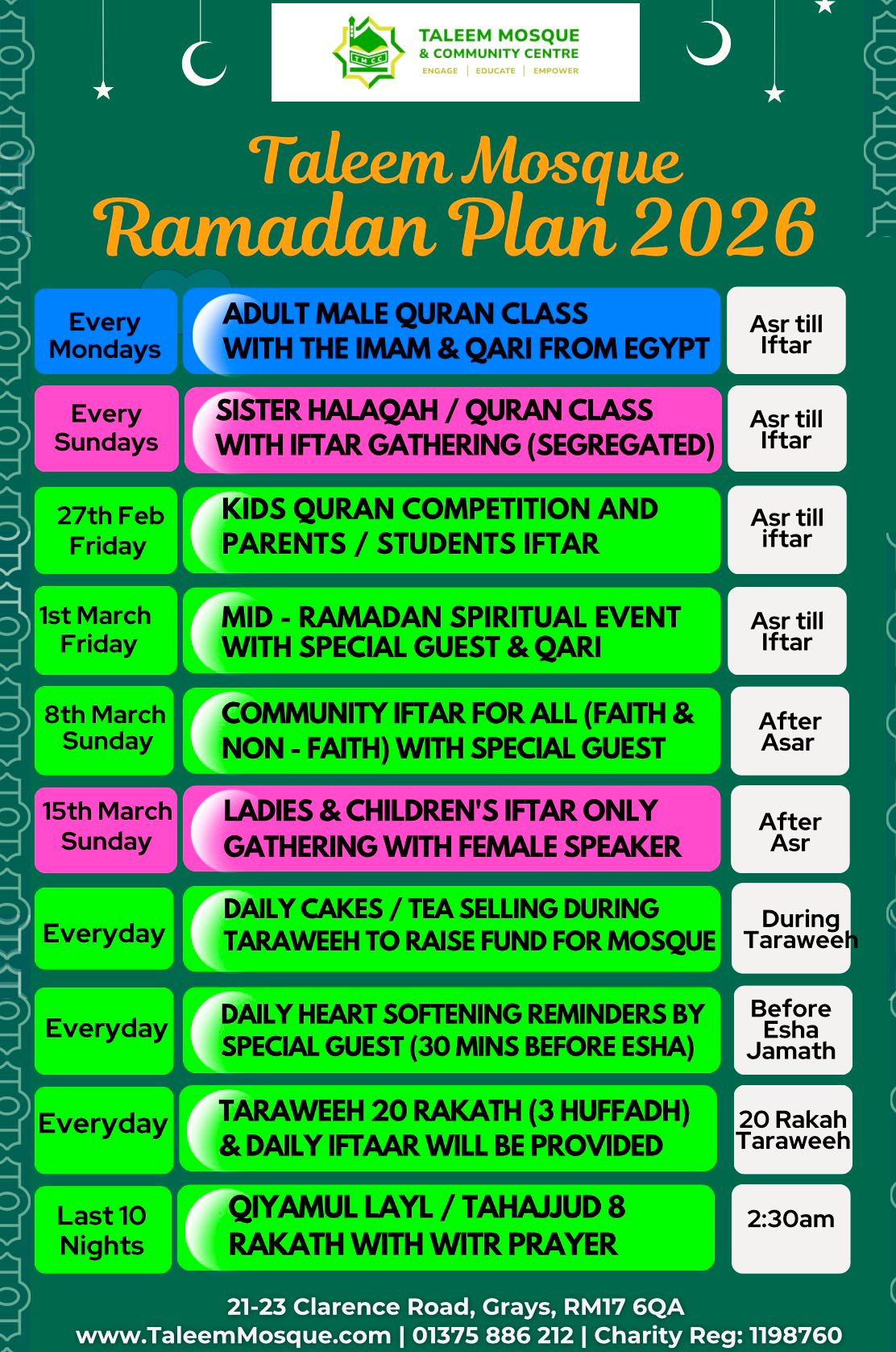
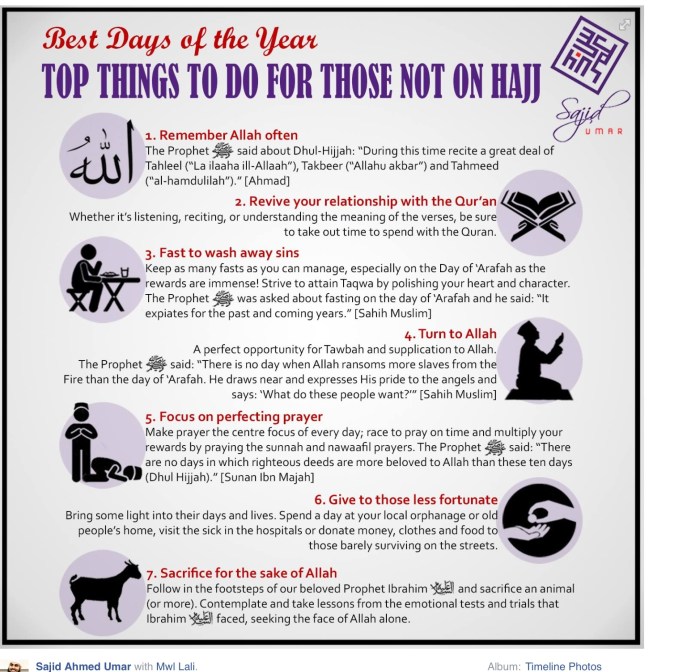
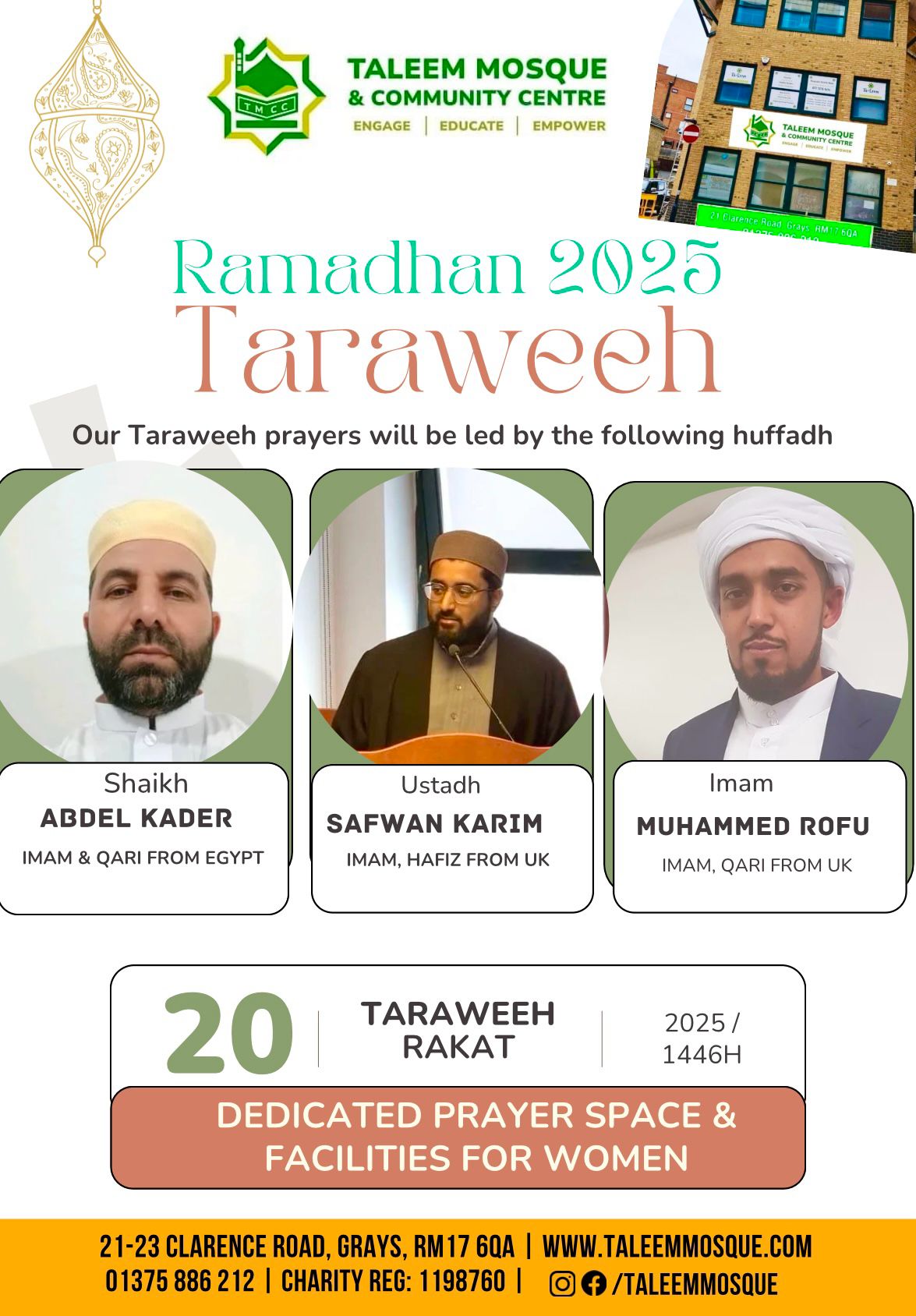
Reciting Takbeer: Let us not forget to make the Takbeer following the obligatory prayers, starting after Fajr on Arafat day, till when the sun sets on the 13th of Dhul Hijjah. (see below for details).
‘It is Sunnah to recite takbeer at any time during the first ten days of Dhu’l-Hijjah and all the days of Tashreeq, starting from the beginning of the month of Dhu’l-Hijjah (i.e., from sunset on the last day of Dhu’l-Qa’dah) until the end of the days of al-Tashreeq, which is when the sun sets on the thirteenth day of Dhu’l-Hijjah).
With regard to at certain times, it starts from Fajr on the day of ‘Arafah and lasts until the sun sets on the last day of the days of Tashreeq, in addition to the takbeer that may be recited at any time. So when a person says the tasleem at the end of the obligatory prayer, he should pray for forgiveness (by saying Astaghfir-Allaah) three times, and say, “Allaahumma anta al-salaam wa minka al-salaam, tabaarakta yaa dhaa’l-jalaali wa’l-ikraam (“O Allaah, You are al-Salaam [the One Who is free from all defects and deficiencies), and from You is all peace, blessed are You, O possessor of majesty and honour)”, then start the takbeer.
{Takbeer: Allaahu akbar, Allaahu akbar, laa ilaaha ill-Allaah, Allaahu akbar, Allaahu akbar, wa lillaahi’l-hamd(Allaah is Most Great, Allaah is Most Great, there is no god but Allaah, Allaah is Most Great, Allaah is Most Great, and to Allaah be praise). }
This is for those who are not on Hajj. The pilgrims should start the takbeer recited after prayer from Zuhr on the Day of Sacrifice (the 10th of Dhu’l-Hijjah).
And Allaah knows best.
See Majmoo’ Fataawa Ibn Baaz (may Allaah have mercy on him), 13/17; al-Sharh al-Mumti’ by Ibn ‘Uthaymeen (may Allaah have mercy on him), 5/220-224.’ [see http://islamqa.info/en/36627]
Alhamdulillah. May Allah have mercy on us all and forgive us,guide us and grant us jannat-al-firdaus, wasallallahu ala nabiyinaa Muhammad sallallahu alayhi wasallam! ameen.
Reciting Takbeer: Let us not forget to make the Takbeer following the obligatory prayers, starting after Fajr on Arafat day, till when the sun sets on the 13th of Dhul Hijjah. (see below for details).
‘It is Sunnah to recite takbeer at any time during the first ten days of Dhu’l-Hijjah and all the days of Tashreeq, starting from the beginning of the month of Dhu’l-Hijjah (i.e., from sunset on the last day of Dhu’l-Qa’dah) until the end of the days of al-Tashreeq, which is when the sun sets on the thirteenth day of Dhu’l-Hijjah).
With regard to at certain times, it starts from Fajr on the day of ‘Arafah and lasts until the sun sets on the last day of the days of Tashreeq, in addition to the takbeer that may be recited at any time. So when a person says the tasleem at the end of the obligatory prayer, he should pray for forgiveness (by saying Astaghfir-Allaah) three times, and say, “Allaahumma anta al-salaam wa minka al-salaam, tabaarakta yaa dhaa’l-jalaali wa’l-ikraam (“O Allaah, You are al-Salaam [the One Who is free from all defects and deficiencies), and from You is all peace, blessed are You, O possessor of majesty and honour)”, then start the takbeer.
{Takbeer: Allaahu akbar, Allaahu akbar, laa ilaaha ill-Allaah, Allaahu akbar, Allaahu akbar, wa lillaahi’l-hamd(Allaah is Most Great, Allaah is Most Great, there is no god but Allaah, Allaah is Most Great, Allaah is Most Great, and to Allaah be praise). }
This is for those who are not on Hajj. The pilgrims should start the takbeer recited after prayer from Zuhr on the Day of Sacrifice (the 10th of Dhu’l-Hijjah).
And Allaah knows best.
See Majmoo’ Fataawa Ibn Baaz (may Allaah have mercy on him), 13/17; al-Sharh al-Mumti’ by Ibn ‘Uthaymeen (may Allaah have mercy on him), 5/220-224.’ [see http://islamqa.info/en/36627]
Alhamdulillah. May Allah have mercy on us all and forgive us,guide us and grant us jannat-al-firdaus, wasallallahu ala nabiyinaa Muhammad sallallahu alayhi wasallam! ameen.
Dear readers, it is with great joy that we announce that FRIDAY 28TH FEBRUARY 2025 marks the first night of Ramadan 1446AH and the first day of Ramadan 1446AH will be SATURDAY 1ST March 2025.
Allah’s Messenger (ﷺ) said, “When the month of Ramadan comes, the gates of Paradise are opened and the gates of the (Hell) Fire are closed, and the devils are chained.”[Sahih Bukhari]
Top Tips: (including reminders from Sheikh Asim Khan, London and Sheikh Dr Sajid Umar, KSA)
1- Purify our intention for Allah alone.
2- Make a plan- The sahabah Radi Allahu anhum prepared for Ramadan months in advance. DON’T LOSE HOPE, you can renew your intention now and start an action plan. Maybe set yourself to read 5 verses a day of Qur’an and gradually increase. Be positive and be proactive! If you want to complete Qur’an in Ramadan, read 20 pages a day. And try to read the translation of Qur’an in your language.
Narrated Abu Huraira:
The Prophet (ﷺ) said, “(Allah said), ‘Every good deed of Adam’s son is for him except fasting; it is for Me. and I shall reward (the fasting person) for it.’ Verily, the smell of the mouth of a fasting person is better to Allah than the smell of musk.” [Sahih Bukhari]
2- Cut back on the greasy foods and unhealthy diet. Eat healthy, and balance your meals, with carbohydrates, fibre and protein. Add some healthy fats and dairy too. Moderation is key. Stick to the sunnah regarding food!
3-Practice self-restraint. Guard our tongues and limbs from wrongdoing.
Narrated Abu Huraira:
Allah’s Messenger (ﷺ) said, “Whoever believes in Allah and the Last Day should talk what is good or keep quiet, and whoever believes in Allah and the Last Day should not hurt (or insult) his neighbor; and whoever believes in Allah and the Last Day, should entertain his guest generously.”Bukhari
4-Be strong and grateful for Islam and the favour of witnessing Ramadan to get closer to Allah. We will have struggles, jobs, exams, tasks that we have to face with strength. Fasting will not hinder us, fasting sincerely for Allah will help us attain success in this life and the next.
5- Muslims are diverse, Allah created us in different colours and backgrounds, with different languages, so we may know one another. The honourable harbour Taqwa (God-conciousness/ awareness of Allah). We are from Adam and Eve (upon them be peace) at the end of the day, so let’s try to get together in Ramadan and revive the idea of community in Islam, which does not discriminate by race or other factors. Let us try to reunite our families too, for the sake of Allah.
6-Increase your prayers, not just quantity, but quality, learn about the Salah and the meanings of what you recite.
Narrated Abu Huraira:
I heard Allah’s Messenger (ﷺ) saying regarding Ramadan, “Whoever prayed at night in it (the month of Ramadan) out of sincere Faith and hoping for a reward from Allah, then all his previous sins will be forgiven.” [Sahih Bukhari]
7-Calculate your Zakaah (Zakat- obligatory poor-due charity, 2.5% of your wealth given each lunar year) and pay it in a timely manner, as best as you can. Zakaah is a primary pillar in Islam, which we must not neglect. For more on Zakaah, take a lookCheck out our ZAKAT GUIDE PAGE ZAKAT 101
10- Ease in, burn into your routine, don’t burn out. So start small, maybe five pages a day to begin with of Qur’an and build up, if you haven’t read in a long time.
12-Be productive, set realistic goals for yourself, based on your habits. So if you want to start giving more charity, first make sure you have done the obligatory Zakat, and then try to make little and often payments of sadaqah, or whatever you like, but measure it so you know when you are slacking.
13-Make a strategy/schedule for yourself. Please be kind to each other, ladies help your husbands to make time with the family, men help your women around the home. If men are working, ladies advise the children to be considerate. If mum needs a break, husbands spend some time with the kids.
14-Set a time where the family sit and learn Islam, BALANCE is key.
15-Be optimistic, like our prophet Muhammad peace be upon him. Alhamdulillah that the Masajid and world has opened up now, in our post Covid-19 world. The worst has passed in sha Allah. Take advantage and attend the mosques and pray jamah as much as possible.
We remind ourselves before we remind you, our beloved, dearest readers. Jazakumallahu khairan.
May Allah, The Most Gracious Lord of all creation shower upon us His blessings, may He make us successful in this month and beyond, may He keep us sincere for Him alone, and may He help us adhere to the sunnah of His final prophet muhammad peace be upon him. And may Allah forgive all our sins, and grant us firmness on the guidance, may He reward us, and may He make us true believers, and those who truly worship and serve none but Him alone, The One, The Irresistable Creator, for He is The All-Powerful. May Allah grant us taqwa and nearness to Him and a high place in Jannat al firdaus with the prophets alayhimusalam. May Allah abundantly bless His final prophet Muhammad peace be upon him. Ameen
Masjid timetables also available, Taleem Mosque, Grays, Basildon and others. Please contact Masajid/ Whatsapp groups for salah times, park responsibly, arrive with wudu and face masks. Barakallahu feekum
‼️TALEEM MASJID ISHA AND TARAWEEH STARTS 8PM (come earlier for spaces inside main building)‼️
EXTRA CAPACITY AVAILABLE (JAZAKALLAH KHAIR KIND TRUSTEES AND VOLUNTEERS WHO BUILT THE TEMPORARY EXTENTION) PLEASE KEEP US ALL IN YOUR KIND DUAS : )
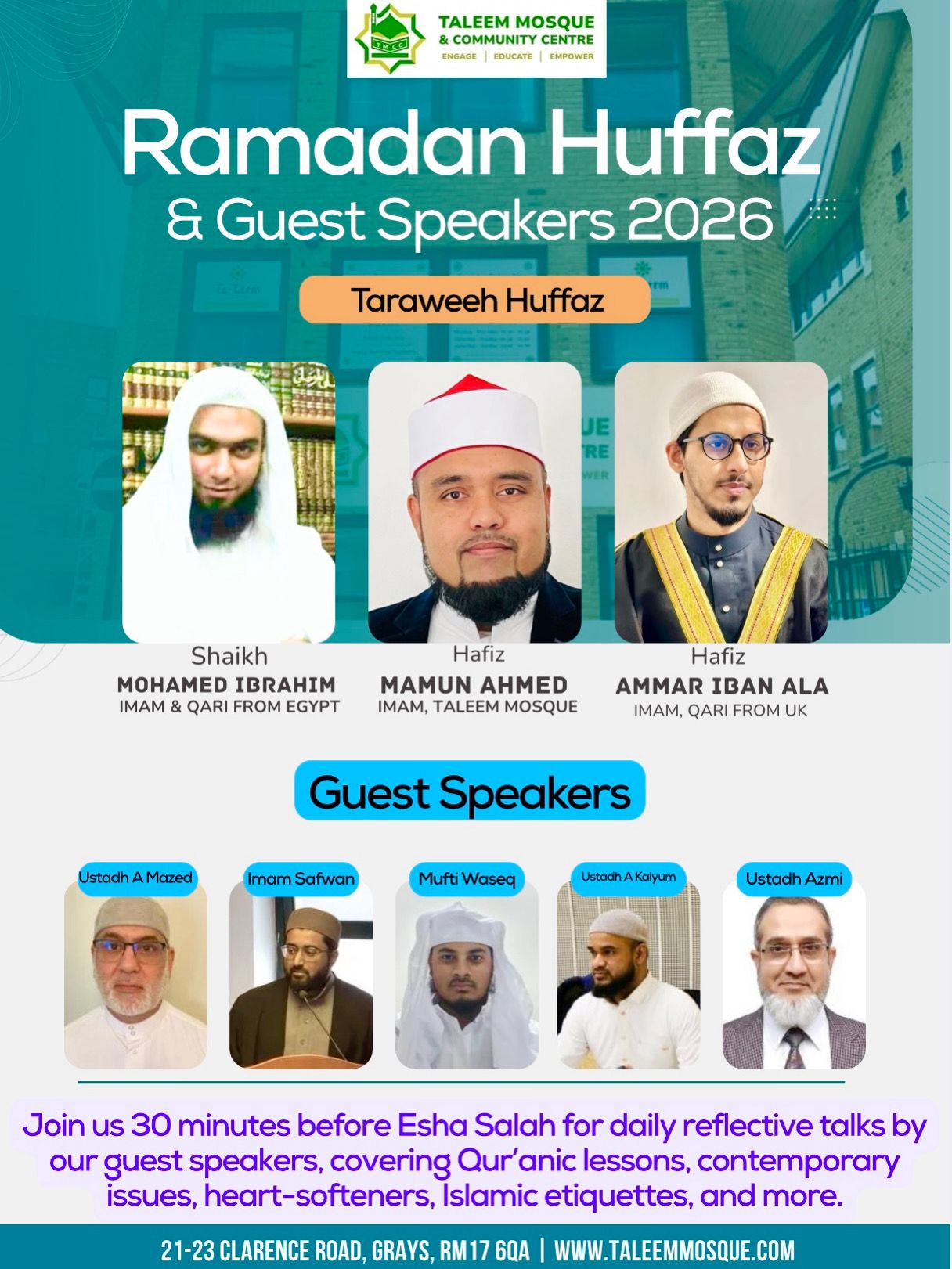
Let’s get ready for Ramadan in obedience to our Most Merciful Rabb, Allah!
Photo by Tima Miroshnichenko
It is hoped this will inform us of the primary reasons we fast, what is required of us and what to hope for.
May Allah, The Supreme Creator, permit us to fast for none but Him alone, may He reward us for our endeavours, and may He permit us to strive to avoid that which nullifies the fast, and strive to adhere to what maintains and perfects it, in accordance with the teachings of His final prophet peace be upon him. Ameen.
DISCLAIMER: This is for educational purposes and serves as an introduction to the issues pertaining to fasting. Parents/guardians are advised to supervise the following read as some issues which pertain to married adults have been mentioned. Please consult a knowledgeable Islamic scholar (and trustworthy medical professional) for details, particularly for questions and advice related to individual circumstances. We are not scholars and thus cannot issue fatwa, however we endeavour relate to you the words of the scholars who have studied the authentic teachings of Islam from the Qur’an and the Sunnah of prophet Muhammad upon him be peace. And ultimately, Allah knows best.
Fiqh of Fasting – Part 7 (adapted mainly from Sh. Yahya Adel Ibrahim with notes from others)
Summary of Siyam (Fasting) Essentials
What is the meaning of “Siyam?”
The word “siyam” comes from the root word “sowm,” which means “to abstain from.”
Did Muslims fast before 2 A.H.?
Yes, in fact the Prophet sala Allahu alihi wasSalaam and his companions (may Allah be pleased with them) used to fast on various days, including:
1. Day of Ashura (the exodus) when Allah delivered Musa sala Allahu alihi wasSalaam and the Muslims of that time from the evil of Pharaoh. The Prophet (upon him be peace) taught us to fast two days—either the day before or after plus the actual day of Ashura.
2. On the day of Arafat, if not making Hajj
3. The first 9 Days of dhul-Hijjah
4. Mondays & Thursdays through out the year
5. The middle three days of each lunar month (13th, 14th & 15th) when he moon is at its brightest
6. There are some proofs by way of Khadija (May Allah be pleased with her) who reports that the Prophet (peace be upon him) used to fast before the prophethood—but we do not know the exact days.
Why was Siyam ordered?
The answer to this question lies only with Allah. However, we can find that there are many benefits and bits of wisdom behind this pious and sincere act.
1. Increases one’s Taqwa (remembrance of Allah in daily affairs), as is stated in the Quran: Surah Baqara verse 183.
2. Trains the body, mind and spirit to bear hardships while remaining patient.
3. Trains the body, mind and spirit to hold back from the natural desires of the human: food, drink, anger, lust, etc.
4. To help one understand what the impoverished go though.
What is the importance of the month of Ramadan?
This is the month in which the gates of heaven are opened and the gates of hell are closed. This is the month where every dua’ reaches Allah. This is the month where the Muslims are protected from the evil whisperings of the shayateen. This is the month where one plants the seeds of worship, the seeds of taqwa in the earth and harvests the good deeds for sustenance throughout the year. And most importantly, this is the month in which the Quran was revealed—more specifically, on the night of Lailat-ul-Qadr.
Who must fast?
1. One who is Muslim
2. One who has Aql (mental faculties are sound and understands the responsibility of fasting)
3. One who has reached the age of puberty (signs include: growth of pubic hair or nocturnal emissions, emitting maniy, or reaching 15 years of age, occurrence of menses)
4. One who is Kaadir (able to maintain the fast)
What is the requirement for the fast?
Very simply, the fast begins with the niya (intention-this need not be verbal, rather intention resides in the heart)—this is a pre Requisite/ Shart—and then refraining from food, drink and things that break the fast, until the time for Maghrib has arrived.
It must be noted by the reader that one cannot just wake up in the morning and proclaim his fast for that day. This was only allowed for the Prophet sala Allahu alihi wasSalaam. Rather, for the followers, there needs to be mental recognition of the fast BEFORE FAJR in other than the month of Ramadan.
What breaks the fast?
1. Eating
2. Drinking
3. Sexual relations/intimate acts of any type that leads to male or female sexual discharge,
4. Haid (menstrual bleeding)
5. Nifas (post natal bleeding)
6. Intentional vomiting
7. Needles that give you nourishment
For further clarification on some issues:
a. Blood testing is okay
b. If one needs to take Insulin then that person cannot fast
c. Using the puffer for asthma patients is okay—the respiratory type only.
• If the couple have intercourse intentionally then they have to make up that day and they have to fast 60 days consecutively, or if unable feed 60 people or Kafarah
What is Kafarah?
This is given only as expiation for sexual infractions during the fast. There are three methods of expiation:
1. Freeing of a slave
2. Fast for 60 consecutive days. If one day is missed then you would start from the beginning again
3. If you are unable to fast, for a legitimate reason (sick, old,etc.) then you may feed 60 miskeen (poor) people. They have to be Muslim people and it can happen on one day as a feast. Also, one can just give the money to feed 60 people. This is considered a debt for that person and they should fulfil it before their death. If they do die then the relatives can either fast for them or feed the miskeen.
What about those that cannot fast, but are of age?
Of those who are excused from the fast are those who have a long-term sickness, the pregnant woman, the woman who is breast-feeding and the traveller. For the traveller, the fast is to be made up. But for the others, they are to pay the Fidya (please note, there is a scholarly difference of opinion regarding who can pay fidyah instead of making up fasts- please consult a scholar for your own case, see the links below). Fidya is to pay for a meal for one miskeen person for everyday that is missed. Like the Kafarah, one can arrange to give 30 days worth of money at one time, or arrange a feast for 30 miskeen people on one day.
Confused about your case? Contact a knowledgabe Mufti (try calling up on the Ask the Sheikh programmes on Eman Channel, or similar.)
The Sunnan of Fasting
1. The sahoor and iftaar should be done with the family. If the family is not available then one should make an effort to never break the fast alone.
2. To hurry up with breaking the iftaar—not to delay it. But the sahoor can be delayed right up until the time for Fajr enters.
3. To break the fast with dates, or at least 3 sips of water.
4. To make dua’ of breaking the fast. (“Dhahaba al-zamau’a, wa abtallat al-‘urooq wa thabata al-ajr insha Allah (Thirst has gone, the veins are moist, and the reward is assured, if Allaah wills).” see Arabic below )
5. To increase in acts of ibada (recitation of the Quran) and this should continue after the month of Ramadan has passed.
6. To give more sadaqa (charity).
7. To offer the tahajud prayers and the tarrawih prayers (in congregation).
8. To feed other Muslims, even if they are not needy—meaning to invite people to your house for the iftaar. In fact, when you invite people the host receives the reward that his guest earned on that day (while the guest retains his own reward). This is true even for the one who finances an iftaar, or one who prepares the food.
The Makrooh (hated things) of Fasting
1. To be excessive in rinsing with water, during wudu or other times. Having too much water in the mouth might cause a person to swallow some.
2. To unnecessarily taste food. There cannot be any swallowing and the tongue should be cleaned of any residual taste.
3. Kissing your spouse.
4. To sexually excite/touch your spouse.
5. To lie, to make ghiba (back biting), to do nameema (telling lies to cause two parties to fight). In fact, those who practice nameema do not enter paradise with the first set of Muslims.
6. To not pray the tarrawih or tahajjud in the last 10 days.
What are some the Voluntary Fasts that one may do?
1. The fast of the Prophet Dawood (peace be upon him) was mentioned by Prophet Muhammad (sallallahu alaihi wasallam) as the best. It includes one day of fasting and one day of resting, continuously.
2. The best months for fasting include: Sha’ban, Muharram, Ramadan,Dhul Hijja.
3. The 13th, 14th & 15th of every Islamic month. The reward of fasting these three days is like having fasted an entire year.
4. Mondays and Thursdays—for these are the two days that the angels rise and descend with your deeds; i.e. the gates of heaven are open.(This refers to Maghrib time)
5. The 9th day of Dhul Hijja (for the ones not performing the hajj).This is the day of Arafat and fasting on this day ensures that the minor sins for the previous year and the coming year are forgiven.
Allah knows best!
May Allah make this benefit us, and this advice is to us before it is to you our beloved readers.
May Allah allow us to succeed this Ramadan and may He forgive us for He is the Oft-Forgiving, The Forbearing! May Allah forgive us for any errors in this and grant us correctness. Wasallallahu alaa nabiyina Muhammad.Amin
Reciting Takbeer: Let us not forget to make the Takbeer following the obligatory prayers, starting after Fajr on Arafat day, till when the sun sets on the 13th of Dhul Hijjah. (see below for details).
‘It is Sunnah to recite takbeer at any time during the first ten days of Dhu’l-Hijjah and all the days of Tashreeq, starting from the beginning of the month of Dhu’l-Hijjah (i.e., from sunset on the last day of Dhu’l-Qa’dah) until the end of the days of al-Tashreeq, which is when the sun sets on the thirteenth day of Dhu’l-Hijjah).
With regard to at certain times, it starts from Fajr on the day of ‘Arafah and lasts until the sun sets on the last day of the days of Tashreeq, in addition to the takbeer that may be recited at any time. So when a person says the tasleem at the end of the obligatory prayer, he should pray for forgiveness (by saying Astaghfir-Allaah) three times, and say, “Allaahumma anta al-salaam wa minka al-salaam, tabaarakta yaa dhaa’l-jalaali wa’l-ikraam (“O Allaah, You are al-Salaam [the One Who is free from all defects and deficiencies), and from You is all peace, blessed are You, O possessor of majesty and honour)”, then start the takbeer.
{Takbeer: Allaahu akbar, Allaahu akbar, laa ilaaha ill-Allaah, Allaahu akbar, Allaahu akbar, wa lillaahi’l-hamd(Allaah is Most Great, Allaah is Most Great, there is no god but Allaah, Allaah is Most Great, Allaah is Most Great, and to Allaah be praise). }
This is for those who are not on Hajj. The pilgrims should start the takbeer recited after prayer from Zuhr on the Day of Sacrifice (the 10th of Dhu’l-Hijjah).
And Allaah knows best.
See Majmoo’ Fataawa Ibn Baaz (may Allaah have mercy on him), 13/17; al-Sharh al-Mumti’ by Ibn ‘Uthaymeen (may Allaah have mercy on him), 5/220-224.’ [see http://islamqa.info/en/36627]
Alhamdulillah. May Allah have mercy on us all and forgive us,guide us and grant us jannat-al-firdaus, wasallallahu ala nabiyinaa Muhammad sallallahu alayhi wasallam! ameen.
Dear readers, it is with great joy that we announce that SUNDAY 10TH MARCH 2024 marks the first night of Ramadan 1445AH and the first day of Ramadan 1444AH will be MONDAY 11TH March 2024.
Allah’s Messenger (ﷺ) said, “When the month of Ramadan comes, the gates of Paradise are opened and the gates of the (Hell) Fire are closed, and the devils are chained.”[Sahih Bukhari]
Top Tips: (including reminders from Sheikh Asim Khan, London and Dr Sajid Umar, KSA)
1- Purify our intention for Allah alone.
2- Make a plan- The sahabah Radi Allahu anhum prepared for Ramadan months in advance. DON’T LOSE HOPE, you can renew your intention now and start an action plan. Maybe set yourself to read 5 verses a day of Qur’an and gradually increase. Be positive and be proactive! If you want to complete Qur’an in Ramadan, read 20 pages a day. And try to read the translation of Qur’an in your language.
Narrated Abu Huraira:
The Prophet (ﷺ) said, “(Allah said), ‘Every good deed of Adam’s son is for him except fasting; it is for Me. and I shall reward (the fasting person) for it.’ Verily, the smell of the mouth of a fasting person is better to Allah than the smell of musk.” [Sahih Bukhari]
2- Cut back on the greasy foods and unhealthy diet. Eat healthy, and balance your meals, with carbohydrates, fibre and protein. Add some healthy fats and dairy too. Moderation is key. Stick to the sunnah regarding food!
3-Practice self-restraint. Guard our tongues and limbs from wrongdoing.
Narrated Abu Huraira:
Allah’s Messenger (ﷺ) said, “Whoever believes in Allah and the Last Day should talk what is good or keep quiet, and whoever believes in Allah and the Last Day should not hurt (or insult) his neighbor; and whoever believes in Allah and the Last Day, should entertain his guest generously.”Bukhari
4-Be strong and grateful for Islam and the favour of witnessing Ramadan to get closer to Allah. We will have struggles, jobs, exams, tasks that we have to face with strength. Fasting will not hinder us, fasting sincerely for Allah will help us attain success in this life and the next.
5- Muslims are diverse, Allah created us in different colours and backgrounds, with different languages, so we may know one another. The honourable harbour Taqwa (God-conciousness/ awareness of Allah). We are from Adam and Eve (upon them be peace) at the end of the day, so let’s try to get together in Ramadan and revive the idea of community in Islam, which does not discriminate by race or other factors. Let us try to reunite our families too, for the sake of Allah.
6-Increase your prayers, not just quantity, but quality, learn about the Salah and the meanings of what you recite.
Narrated Abu Huraira:
I heard Allah’s Messenger (ﷺ) saying regarding Ramadan, “Whoever prayed at night in it (the month of Ramadan) out of sincere Faith and hoping for a reward from Allah, then all his previous sins will be forgiven.” [Sahih Bukhari]
7-Calculate your Zakaah (Zakat- obligatory poor-due charity, 2.5% of your wealth given each lunar year) and pay it in a timely manner, as best as you can. Zakaah is a primary pillar in Islam, which we must not neglect. For more on Zakaah, take a lookCheck out our ZAKAT GUIDE PAGE ZAKAT 101
10- Ease in, burn into your routine, don’t burn out. So start small, maybe five pages a day to begin with of Qur’an and build up, if you haven’t read in a long time.
12-Be productive, set realistic goals for yourself, based on your habits. So if you want to start giving more charity, first make sure you have done the obligatory Zakat, and then try to make little and often payments of sadaqah, or whatever you like, but measure it so you know when you are slacking.
13-Make a strategy/schedule for yourself. Please be kind to each other, ladies help your husbands to make time with the family, men help your women around the home. If men are working, ladies advise the children to be considerate. If mum needs a break, husbands spend some time with the kids.
14-Set a time where the family sit and learn Islam, BALANCE is key.
15-Be optimistic, like our prophet Muhammad peace be upon him. Alhamdulillah that the Masajid and world has opened up now, in our post Covid-19 world. The worst has passed in sha Allah. Take advantage and attend the mosques and pray jamah as much as possible.
We remind ourselves before we remind you, our beloved, dearest readers. Jazakumallahu khairan.
May Allah, The Most Gracious Lord of all creation shower upon us His blessings, may He make us successful in this month and beyond, may He keep us sincere for Him alone, and may He help us adhere to the sunnah of His final prophet muhammad peace be upon him. And may Allah forgive all our sins, and grant us firmness on the guidance, may He reward us, and may He make us true believers, and those who truly worship and serve none but Him alone, The One, The Irresistable Creator, for He is The All-Powerful. May Allah grant us taqwa and nearness to Him and a high place in Jannat al firdaus with the prophets alayhimusalam. May Allah abundantly bless His final prophet Muhammad peace be upon him. Ameen
Masjid timetables also available, Taleem Mosque, Grays and others. Please contact Masajid/ Whatsapp groups for salah times, park responsibly, arrive with wudu and face masks. Barakallahu feekum
Let’s get ready for Ramadan in obedience to our Most Merciful Rabb, Allah!
Photo by Tima Miroshnichenko
It is hoped this will inform us of the primary reasons we fast, what is required of us and what to hope for.
May Allah, The Supreme Creator, permit us to fast for none but Him alone, may He reward us for our endeavours, and may He permit us to strive to avoid that which nullifies the fast, and strive to adhere to what maintains and perfects it, in accordance with the teachings of His final prophet peace be upon him. Ameen.
DISCLAIMER: This is for educational purposes and serves as an introduction to the issues pertaining to fasting. Parents/guardians are advised to supervise the following read as some issues which pertain to married adults have been mentioned. Please consult a knowledgeable Islamic scholar (and trustworthy medical professional) for details, particularly for questions and advice related to individual circumstances. We are not scholars and thus cannot issue fatwa, however we endeavour relate to you the words of the scholars who have studied the authentic teachings of Islam from the Qur’an and the Sunnah of prophet Muhammad upon him be peace. And ultimately, Allah knows best.
Fiqh of Fasting – Part 7 (adapted mainly from Sh. Yahya Adel Ibrahim with notes from others)
Summary of Siyam (Fasting) Essentials
What is the meaning of “Siyam?”
The word “siyam” comes from the root word “sowm,” which means “to abstain from.”
Did Muslims fast before 2 A.H.?
Yes, in fact the Prophet sala Allahu alihi wasSalaam and his companions (may Allah be pleased with them) used to fast on various days, including:
1. Day of Ashura (the exodus) when Allah delivered Musa sala Allahu alihi wasSalaam and the Muslims of that time from the evil of Pharaoh. The Prophet (upon him be peace) taught us to fast two days—either the day before or after plus the actual day of Ashura.
2. On the day of Arafat, if not making Hajj
3. The first 9 Days of dhul-Hijjah
4. Mondays & Thursdays through out the year
5. The middle three days of each lunar month (13th, 14th & 15th) when he moon is at its brightest
6. There are some proofs by way of Khadija (May Allah be pleased with her) who reports that the Prophet (peace be upon him) used to fast before the prophethood—but we do not know the exact days.
Why was Siyam ordered?
The answer to this question lies only with Allah. However, we can find that there are many benefits and bits of wisdom behind this pious and sincere act.
1. Increases one’s Taqwa (remembrance of Allah in daily affairs), as is stated in the Quran: Surah Baqara verse 183.
2. Trains the body, mind and spirit to bear hardships while remaining patient.
3. Trains the body, mind and spirit to hold back from the natural desires of the human: food, drink, anger, lust, etc.
4. To help one understand what the impoverished go though.
What is the importance of the month of Ramadan?
This is the month in which the gates of heaven are opened and the gates of hell are closed. This is the month where every dua’ reaches Allah. This is the month where the Muslims are protected from the evil whisperings of the shayateen. This is the month where one plants the seeds of worship, the seeds of taqwa in the earth and harvests the good deeds for sustenance throughout the year. And most importantly, this is the month in which the Quran was revealed—more specifically, on the night of Lailat-ul-Qadr.
Who must fast?
1. One who is Muslim
2. One who has Aql (mental faculties are sound and understands the responsibility of fasting)
3. One who has reached the age of puberty (signs include: growth of pubic hair or nocturnal emissions, emitting maniy, or reaching 15 years of age, occurrence of menses)
4. One who is Kaadir (able to maintain the fast)
What is the requirement for the fast?
Very simply, the fast begins with the niya (intention-this need not be verbal, rather intention resides in the heart)—this is a pre Requisite/ Shart—and then refraining from food, drink and things that break the fast, until the time for Maghrib has arrived.
It must be noted by the reader that one cannot just wake up in the morning and proclaim his fast for that day. This was only allowed for the Prophet sala Allahu alihi wasSalaam. Rather, for the followers, there needs to be mental recognition of the fast BEFORE FAJR in other than the month of Ramadan.
What breaks the fast?
1. Eating
2. Drinking
3. Sexual relations/intimate acts of any type that leads to male or female sexual discharge,
4. Haid (menstrual bleeding)
5. Nifas (post natal bleeding)
6. Intentional vomiting
7. Needles that give you nourishment
For further clarification on some issues:
a. Blood testing is okay
b. If one needs to take Insulin then that person cannot fast
c. Using the puffer for asthma patients is okay—the respiratory type only.
• If the couple have intercourse intentionally then they have to make up that day and they have to fast 60 days consecutively, or if unable feed 60 people or Kafarah
What is Kafarah?
This is given only as expiation for sexual infractions during the fast. There are three methods of expiation:
1. Freeing of a slave
2. Fast for 60 consecutive days. If one day is missed then you would start from the beginning again
3. If you are unable to fast, for a legitimate reason (sick, old,etc.) then you may feed 60 miskeen (poor) people. They have to be Muslim people and it can happen on one day as a feast. Also, one can just give the money to feed 60 people. This is considered a debt for that person and they should fulfil it before their death. If they do die then the relatives can either fast for them or feed the miskeen.
What about those that cannot fast, but are of age?
Of those who are excused from the fast are those who have a long-term sickness, the pregnant woman, the woman who is breast-feeding and the traveller. For the traveller, the fast is to be made up. But for the others, they are to pay the Fidya (please note, there is a scholarly difference of opinion regarding who can pay fidyah instead of making up fasts- please consult a scholar for your own case, see the links below). Fidya is to pay for a meal for one miskeen person for everyday that is missed. Like the Kafarah, one can arrange to give 30 days worth of money at one time, or arrange a feast for 30 miskeen people on one day.
Confused about your case? Contact a knowledgabe Mufti (try calling up on the Ask the Sheikh programmes on Eman Channel, or similar.)
The Sunnan of Fasting
1. The sahoor and iftaar should be done with the family. If the family is not available then one should make an effort to never break the fast alone.
2. To hurry up with breaking the iftaar—not to delay it. But the sahoor can be delayed right up until the time for Fajr enters.
3. To break the fast with dates, or at least 3 sips of water.
4. To make dua’ of breaking the fast. (“Dhahaba al-zamau’a, wa abtallat al-‘urooq wa thabata al-ajr insha Allah (Thirst has gone, the veins are moist, and the reward is assured, if Allaah wills).” see Arabic below )
5. To increase in acts of ibada (recitation of the Quran) and this should continue after the month of Ramadan has passed.
6. To give more sadaqa (charity).
7. To offer the tahajud prayers and the tarrawih prayers (in congregation).
8. To feed other Muslims, even if they are not needy—meaning to invite people to your house for the iftaar. In fact, when you invite people the host receives the reward that his guest earned on that day (while the guest retains his own reward). This is true even for the one who finances an iftaar, or one who prepares the food.
The Makrooh (hated things) of Fasting
1. To be excessive in rinsing with water, during wudu or other times. Having too much water in the mouth might cause a person to swallow some.
2. To unnecessarily taste food. There cannot be any swallowing and the tongue should be cleaned of any residual taste.
3. Kissing your spouse.
4. To sexually excite/touch your spouse.
5. To lie, to make ghiba (back biting), to do nameema (telling lies to cause two parties to fight). In fact, those who practice nameema do not enter paradise with the first set of Muslims.
6. To not pray the tarrawih or tahajjud in the last 10 days.
What are some the Voluntary Fasts that one may do?
1. The fast of the Prophet Dawood (peace be upon him) was mentioned by Prophet Muhammad (sallallahu alaihi wasallam) as the best. It includes one day of fasting and one day of resting, continuously.
2. The best months for fasting include: Sha’ban, Muharram, Ramadan,Dhul Hijja.
3. The 13th, 14th & 15th of every Islamic month. The reward of fasting these three days is like having fasted an entire year.
4. Mondays and Thursdays—for these are the two days that the angels rise and descend with your deeds; i.e. the gates of heaven are open.(This refers to Maghrib time)
5. The 9th day of Dhul Hijja (for the ones not performing the hajj).This is the day of Arafat and fasting on this day ensures that the minor sins for the previous year and the coming year are forgiven.
Allah knows best!
May Allah make this benefit us, and this advice is to us before it is to you our beloved readers.
May Allah allow us to succeed this Ramadan and may He forgive us for He is the Oft-Forgiving, The Forbearing! May Allah forgive us for any errors in this and grant us correctness. Wasallallahu alaa nabiyina Muhammad.Amin
Taqwa means to be concious and aware of Allah (The One True God), in all that we do. We fear and love and hope in Allah. It is the driving force behind living faith. The higher our level of taqwa, the higher our faith and rank.
We can’t claim piety or sainthood/wali for ourselves or others. Only Allah knows who is truly pious. The criterion for divine friendship/walaya (to be of the close friends of Allah) is having iman (faith) and Taqwa (God-conciousness). We cannot designate ourselves or others as such (i.e. wali), as this is decided by Allah, He knows the hearts and the true piety within.
No so-called saint, dead or alive, can give you anything, nor can they benefit or harm. Allah alone is the true Provider and He alone controls the universe.
Grave worship, that is visiting the graves of the desceased to ask them for something or similar, is a huge sin. If we ask, we should ask from Allah alone, for Allah is The Ever-Living, He never dies and He is the Provider, The Rich.
The practice of visiting graves of “saints”/”pirs” or “walis” and praying to them is a serious crime and a form of shirk (the biggest sin Allah won’t forgive).
May Allah protect us from all types of shirk! May Allah, The One, The Compeller, grant us perfect Tawheed for His sake alone forever! May Allah forgive us for any error. Allahumma salli alaa Muhammad Sallallahu alayhi wasallam. ameen!
Reciting Takbeer: Let us not forget to make the Takbeer following the obligatory prayers, starting after Fajr on Arafat day, till when the sun sets on the 13th of Dhul Hijjah. (see below for details).
‘It is Sunnah to recite takbeer at any time during the first ten days of Dhu’l-Hijjah and all the days of Tashreeq, starting from the beginning of the month of Dhu’l-Hijjah (i.e., from sunset on the last day of Dhu’l-Qa’dah) until the end of the days of al-Tashreeq, which is when the sun sets on the thirteenth day of Dhu’l-Hijjah).
With regard to at certain times, it starts from Fajr on the day of ‘Arafah and lasts until the sun sets on the last day of the days of Tashreeq, in addition to the takbeer that may be recited at any time. So when a person says the tasleem at the end of the obligatory prayer, he should pray for forgiveness (by saying Astaghfir-Allaah) three times, and say, “Allaahumma anta al-salaam wa minka al-salaam, tabaarakta yaa dhaa’l-jalaali wa’l-ikraam (“O Allaah, You are al-Salaam [the One Who is free from all defects and deficiencies), and from You is all peace, blessed are You, O possessor of majesty and honour)”, then start the takbeer.
{Takbeer: Allaahu akbar, Allaahu akbar, laa ilaaha ill-Allaah, Allaahu akbar, Allaahu akbar, wa lillaahi’l-hamd(Allaah is Most Great, Allaah is Most Great, there is no god but Allaah, Allaah is Most Great, Allaah is Most Great, and to Allaah be praise). }
This is for those who are not on Hajj. The pilgrims should start the takbeer recited after prayer from Zuhr on the Day of Sacrifice (the 10th of Dhu’l-Hijjah).
And Allaah knows best.
See Majmoo’ Fataawa Ibn Baaz (may Allaah have mercy on him), 13/17; al-Sharh al-Mumti’ by Ibn ‘Uthaymeen (may Allaah have mercy on him), 5/220-224.’ [see http://islamqa.info/en/36627]
Alhamdulillah. May Allah have mercy on us all and forgive us,guide us and grant us jannat-al-firdaus, wasallallahu ala nabiyinaa Muhammad sallallahu alayhi wasallam! ameen.
Leave a comment