Knowledge is light- lesson 1 part 5

A MUST READ

Thurrock Muslim Community- thurrockmuslims.com's avatarThurrock Muslim Community

Bismillah, walhamdulillah, wasalaatu wasalaam alaa rasoolillaah.

Asalamu alaykum.

Hey hey readers! Are you ready for the proofs of Tawhid, that is, the proof for Allah’s Oneness in His Lordship, names and attributes and right to be worshipped alone.

number 1

Bismillah  Here we go!


Categories of Tawhid & Islamic Monotheism evidences


1- Tawhid ar-rububiyyah- Oneness of Allah in His Lordship:

In the Qur’an, Allah the Lord of all creation, The Supreme Creator, says (English interpretation):

‘[All] praise is [due] to Allah, Lord of the worlds ‘ [Qur’an, chapter 1, verse 2]

and :

‘O mankind, worship your Lord, who created you and those before you,

that you may become righteous -‘ [Qu’ran chapter 2:v21]

also:

”Then, to Allah belongs [all] praise – Lord of the heavens and Lord of the earth, Lord of the worlds. (36)

And to Him belongs [all] grandeur within the heavens and the earth, and He is the…

View original post 848 more words

Fasting in SHAWWAL after Ramadan

Bismillah!

Asalamu ‘alaykum amazing individuals

We have a few days of Shawwal 1438ah, for those of you with good health, take advantage of this opportunity to gain extra rewards with the voluntary fasts. 


olives n breadPerhaps we’ve slacked a little on our Qur’an recitation regime…

Perhaps we’re not praying much optional prayers…

Perhaps we’ve fallen into the same bad habits pre-Ramadan…

Feeling regretful? That’s the first step to change. Let us acknowledge our faults, and seek Allah’s forgiveness. Let us resolve to change for the better.

WE STILL HAVE A CHANCE!

Let’s revive the Ramadan atmosphere by increasing our ibadah, by quality and quantity in sha Allah!


Top Tips to revive our iman (faith, in statement and action) after Ramadan


  1. Let us make more istighfar, seek Allah’s forgiveness, saying Astaghfirullah, SubhanAllahi wabihamdi, Astaghfirullaha wa atoobo ilayhi, and this amazing dua called sayyid al istighfar you MUST learn (click here!)
  2. Strive to pray the five prayers on time
  3. Strive to spend in charity
  4. Do good and remind others to do good and keep away from and forbid evil, trying hard to practice what we preach.
  5. Read more Qur’an at least a page or so a day, try to read some tafsir or translation too.
  6. Have good character/perfecting it
  7. Make someone smile : )
  8. More remembrance of Allah, subhanaAllah, walhamdulillah, wallahuakbar, wa la ilaha ilallah! Because it’s all about Allah Who is Al-Wahid, alone!
  9. Do sunnah acts, optional prayers
  10. Fast 6 days of Shawwal! Here’s an awesome opportunity…

Abu Ayyub (May Allah be pleased with him) reported:

The Messenger of Allah (ﷺ) said, “He who observes As-Saum (the fasts) in the month of Ramadan, and also observes As-Saum for six days in the month of Shawwal, it is as if he has observed As-Saum for the whole year.”

[Muslim].

Subhanallah!

Narrated Abu Ayyub:

The Prophet (ﷺ) as saying: If anyone fasts during Ramadan, then follows it with six days in Shawwal, it will be like a perpetual fast. 

Reference : Sunan Abi Dawud 2433, sahih Al-Albani

ALLAHUAKBAR!

Allah forgive us and grant us the opportunity and health to benefit from extra acts of worship for Him alone. May we have the tawfiq to complete what’s obligatory first.  May Allah grant us the ability to serve Him according to Qur’an and Sunnah,with sincerity and sound intentions. wasallallahu ala nabiyinaa Muhammad. ameen ya Rab al alameen!

By the way this is a reminder to us before it is to you, so do comment below on anything you may want to add! May Allah forgive us for any errors! ameen

With love for the sake of Allah

Thurrock Muslims


GET READY FOR RAMADAN! Ramadan preparatory reminders- Fiqh of fasting

In the name of Allah, The Most Gracious The Most Merciful.


GET READY FOR RAMADAN 1438AH

Ramadaan preparatory reminders- Fiqh of fasting


Share this vital information with others! http://wp.me/p4GU3D-s3

Let’s get ready for Ramadan in obedience to our Most Merciful Rabb, Allah!

It is hoped this will inform us of the primary reasons we fast, what is required of us and what to hope for.

May Allah, The Supreme Creator, permit us to fast for none but Him alone, may He reward us for our endeavours, and may He permit us to strive to avoid that which nullifies the fast, and strive to adhere to what maintains and perfects it, in accordance with the teachings of His final prophet peace be upon him.  Ameen.

DISCLAIMER: This is for educational purposes and serves as an introduction to the issues pertaining to fasting. Parents/guardians are advised to supervise the following read as some issues which pertain to married adults have been mentioned. Please consult a knowledgeable Islamic scholar (and trustworthy medical professional) for details, particularly for questions and advice related to individual circumstances. We are not scholars and thus cannot issue fatwa, however we endeavour relate to you the words of the scholars who have studied the authentic teachings of Islam from the Qur’an and the Sunnah of prophet Muhammad upon him be peace. And ultimately, Allah knows best.

 

blue squares banner

Fiqh of Fasting – Part 7  (adapted mainly from Sh. Yahya Adel Ibrahim with notes from others)

Summary of Siyam (Fasting) Essentials

What is the meaning of “Siyam?”

The word “siyam” comes from the root word “sowm,” which means “to abstain from.”

Did Muslims fast before 2 A.H.?

Yes, in fact the Prophet sala Allahu alihi wasSalaam and his companions (may Allah be pleased with them) used to fast on various days, including:

1. Day of Ashura (the exodus) when Allah delivered Musa sala Allahu alihi wasSalaam and the Muslims of that time from the evil of Pharaoh. The Prophet (upon him be peace) taught us to fast two days—either the day before or after plus the actual day of Ashura.

2. On the day of Arafat, if not making Hajj

3. The first 9 Days of dhul-Hijjah

4. Mondays & Thursdays through out the year

5. The middle three days of each lunar month (13th, 14th & 15th) when he moon is at its brightest

6. There are some proofs by way of Khadija (May Allah be pleased with her) who reports that the Prophet (peace be upon him) used to fast before the prophethood—but we do not know the exact days.

Why was Siyam ordered?

The answer to this question lies only with Allah. However, we can find that there are many benefits and bits of wisdom behind this pious and sincere act.

1. Increases one’s Taqwa (remembrance of Allah in daily affairs), as is stated in the Quran: Surah Baqara verse 183.

2. Trains the body, mind and spirit to bear hardships while remaining patient.

3. Trains the body, mind and spirit to hold back from the natural desires of the human: food, drink, anger, lust, etc.

4. To help one understand what the impoverished go though.

What is the importance of the month of Ramadan?

This is the month in which the gates of heaven are opened and the gates of hell are closed. This is the month where every dua’ reaches Allah. This is the month where the Muslims are protected from the evil whisperings of the shayateen. This is the month where one plants the seeds of worship, the seeds of taqwa in the earth and harvests the good deeds for sustenance throughout the year. And most importantly, this is the month in which the Quran was revealed—more specifically, on the night of Lailat-ul-Qadr.

Who must fast?

1. One who is Muslim
2. One who has Aql (mental faculties are sound and understands the responsibility of fasting)
3. One who has reached the age of puberty (signs include: growth of pubic hair or having wet dreams/emitting maniy, or reaching 15 years of age, occurrence of menses)
4. One who is Kaadir (able to maintain the fast)

What is the requirement for the fast?

Very simply, the fast begins with the niya (intention-this need not be verbal, rather intention resides in the heart )—this is a pre Requisite/ Shart—and then refraining from food, drink and things that break the fast, until the time for Maghrib has arrived.

It must be noted by the reader that one cannot just wake up in the morning and proclaim his fast for that day. This was only allowed for the Prophet sala Allahu alihi wasSalaam. Rather, for the followers, there needs to be mental recognition of the fast BEFORE FAJR in other than the month of Ramadan.

What breaks the fast?

1. Eating

2. Drinking

3. Sexual relations/intimate acts of any type that leads to male or female sexual discharge,

4. Haid (menstrual bleeding)

5. Nifas (post natal bleeding)

6. Intentional vomiting

7. Needles that give you nourishment

For further clarification on some issues:

a. Blood testing is okay

b. If one needs to take Insulin then that person cannot fast

c. Using the puffer for asthma patients is okay—the respiratory type only.

(in sha Allah, we will try to post another more detailed article on things which nullify the fast)
What happens if a couple has intimate relations during the fast?

• If the couple have intercourse intentionally then they have to make up that day and they have to fast 60 days consecutively, or if unable feed 60 people or Kafarah

What is Kafarah?

This is given only as expiation for sexual infractions during the fast. There are three methods of expiation:

1. Freeing of a slave

2. Fast for 60 consecutive days. If one day is missed then you would start from the beginning again

3. If you are unable to fast, for a legitimate reason (sick, old,etc.) then you may feed 60 miskeen (poor) people. They have to be Muslim people and it can happen on one day as a feast. Also, one can just give the money to feed 60 people. This is considered a debt for that person and they should fulfil it before their death. If they do die then the relatives can either fast for them or feed the miskeen.

What about those that cannot fast, but are of age?

Of those who are excused from the fast are those who have a long-term sickness, the pregnant woman, the woman who is breast-feeding and the traveller. For the traveller, the fast is to be made up. But for the others, they are to pay the Fidya (please note, there is a scholarly difference of opinion regarding who can pay fidyah instead of making up fasts- please consult a scholar for your own case, see the links below). Fidya is to pay for a meal for one miskeen person for everyday that is missed. Like the Kafarah, one can arrange to give 30 days worth of money at one time, or arrange a feast for 30 miskeen people on one day.

PLEASE NOTE however, regarding pregnant and nursing mothers and sickness, please ask a highly knowledge Islamic scholar for individual cases. see this and this-is fidyah enough for pregnant women/sick people or not & should they make up the fast?) . Regarding pregnant and nursing mothers and sick people whose illness goes away and making up missed fasts, see these (who is exempt) and (how to make up fasts for ladies/mothers) and (how to make up missed fasts- sickness and all else)

Confused about your case? Contact Islamic Sharia Council

The Sunnan of Fasting

1. The sahoor and iftaar should be done with the family. If the family is not available then one should make an effort to never break the fast alone.

2. To hurry up with breaking the iftaar—not to delay it. But the sahoor can be delayed right up until the time for Fajr enters.

3. To break the fast with dates, or at least 3 sips of water.

4. To make dua’ of breaking the fast. (“Dhahaba al-zamau’a, wa abtallat al-‘urooq wa thabata al-ajr insha Allah (Thirst has gone, the veins are moist, and the reward is assured, if Allaah wills).” see Arabic below )

break the fasting dua


5. To increase in acts of ibada (recitation of the Quran) and this should continue after the month of Ramadan has passed.

6. To give more sadaqa (charity).

7. To offer the tahajud prayers and the tarrawih prayers (in congregation).

8. To feed other Muslims, even if they are not needy—meaning to invite people to your house for the iftaar. In fact, when you invite people the host receives the reward that his guest earned on that day (while the guest retains his own reward). This is true even for the one who finances an iftaar, or one who prepares the food.

The Makrooh (hated things) of Fasting

1. To be excessive in rinsing with water, during wudu or other times. Having too much water in the mouth might cause a person to swallow some.

2. To unnecessarily taste food. There cannot be any swallowing and the tongue should be cleaned of any residual taste.

3. Kissing your spouse.

4. To sexually excite/touch your spouse.

5. To lie, to make ghiba (back biting), to do nameema (telling lies to cause two parties to fight). In fact, those who practice nameema do not enter paradise with the first set of Muslims.

6. To not pray the tarrawih or tahajjud in the last 10 days.

What are some the Voluntary Fasts that one may do?

1. The fast of the Prophet Dawood (peace be upon him) was mentioned by Prophet Muhammad (sallallahu alaihi wasallam) as the best. It includes one day of fasting and one day of resting, continuously.
2. The best months for fasting include: Sha’ban, Muharram, Ramadan,Dhul Hijja.
3. The 13th, 14th & 15th of every Islamic month. The reward of fasting these three days is like having fasted an entire year.
4. Mondays and Thursdays—for these are the two days that the angels rise and descend with your deeds; i.e. the gates of heaven are open.(This refers to Maghrib time)

5. The 9th day of Dhul Hijja (for the ones not performing the hajj).This is the day of Arafat and fasting on this day ensures that the minor sins for the previous year and the coming year are forgiven.


Allah knows best!

purple stripes banner

May Allah make this benefit us, and this advice is to us before it is to you our beloved readers.

May Allah allow us to succeed this Ramadan and may He forgive us for He is the Oft-Forgiving, The Forbearing! May Allah forgive us for any errors in this and grant us correctness. Wasallallahu alaa nabiyina Muhammad.Amin

Thurrock Muslims


Be generous, like, share and teach others for the sake of Allah– http://wp.me/p4GU3D-s3


Disclaimer:

Continue reading

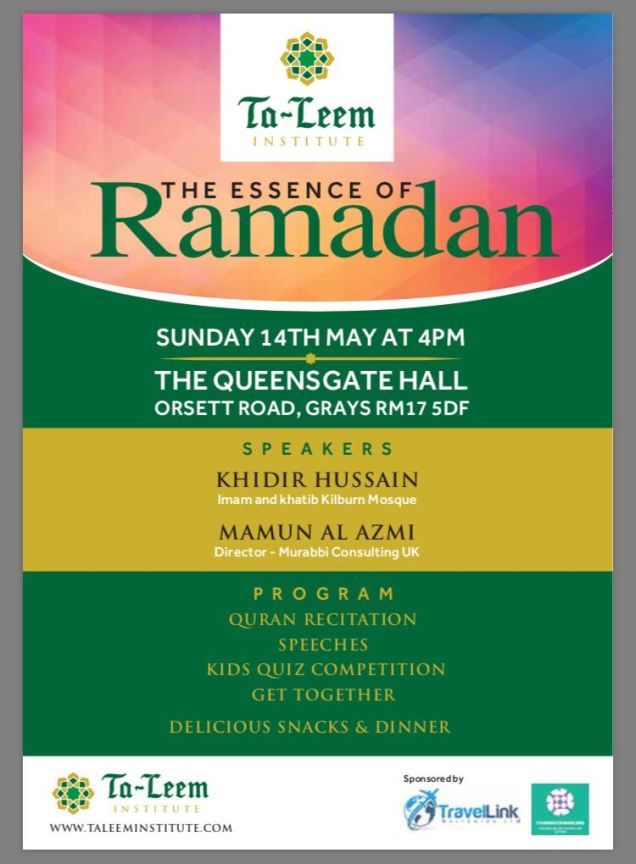
RAMADAN PARTY EVENT IN GRAYS TOWN, THIS SUNDAY 14TH MAY 2017!- LET’S PREPARE FOR RAMADAN 1438!

!! RAMADAN EVENT !!


LET’S PARTY!… HALAL PARTY OF COURSE 🙂

Assalamu Alaykum,
You are cordially invited to our Ramadan Event and Party.

DATE: 14 May, Sunday
TIME: 4:30pm-7:30pm

Please arrive early to ensure you get a space and some food in sha Allah!

VENUE/PLACE:

Queensgate Centre, Orsett Rd, Grays,
RM17 5DF,
Entrance: Next to Griffin Estate Agent

TOPIC:
>Essence of Ramadan &
>Duties of Muslim Family

CONTACT:
Mob: 07713761414


#Delicious Dinner & Snacks will be provided In Sha Allah

*Pls Kindly forward this text to your friends & family and invite other Thurrock Muslim People (including surrounding areas, everyone invited in sha Allah)

Contact us :

← Back

Thank you for your response. ✨

May Allah make us sincere and successful! Allahumma salli alaa Muhammad. Ameen.

Thurrock Muslims Blog

share: http://wp.me/p4GU3D-rN

No more Easter Eggs? Why Muslims do not celebrate Easter…

In the Name of Allah, The One True God


No more Easter Eggs? Why Muslims do not celebrate Easter?


It’s not about the chocolate.

It’s not about the bunnies.

It’s not about the eggs.

It’s about the origins.

It’s about principles.


What exactly is Easter?

In short, Easter is a Christian festival with remnants of Pagan traditions. Christians celebrate the alleged crucifixion and resurrection of Jesus, this is the essence of Easter. The holiday has become rather commercial, with increase in sales of confectionary, chocolate and popular toys. (1)

Christians believe in the Trinity (father,son, holy spirit), which essentially means that they direct their worship to God, Jesus and the Holy spirit. So today, Christianity has polytheistic dimensions and is not a faith of complete monotheism.


Easter and Islam

Islam is absolutely Monotheistic. Muslims worship One God alone (Allah), without rivals. The Islamic narrative about prophet Jesus (peace be upon him) is simple. Jesus is not the son of God (as mentioned above, Christianity purports him to be). Muslims believe that God (Allah) is The Supreme Creator of all, The Self-Sufficient Master, He does not have children or a wife, and He does not need these things. It makes perfect sense, we are servants of The One Supreme Master- Allah. We go to Allah for all our needs, we don’t need any intermediaries! We need Allah, but Allah does not need us. That is the truth. And the truth makes sense.


We believe Jesus (‘Eesa) (peace be upon him) was a mighty prophet of God (Allah), born from the virgin Mary, who was pure and chaste. God does not need children. It’s the creation, humans and animals who need children. If God can create Adam without a father and mother, Eve without a mother, than surely it is easy for God to create Jesus without a father. Jesus’ story is mentioned in detail in Chapter 19 of the Qur’an, called ‘Maryam’.


If you remember the Christmas post a few months back and a few other blogs on Islam Explained, you’ll remember that as Muslims, we MUST believe in Jesus in order for our faith to be complete. Jesus never claimed divinity. Rather, Jesus peace be upon him was a messenger and prophet of Allah.

Jesus was not crucified, rather Allah (The One True God) took Jesus up to Him, while he was still alive, and another man was made to resemble Jesus and that man was killed. Jesus will return to earth, under Allah’s command, during the end times to fight the Anti-Christ (The Dajjal).(2)

Conclusion- Why Muslims don’t celebrate Easter

The Islamic narrative on monotheism and beliefs about Jesus are so markedly different to the Christian narrative. Thus, it’s no surprise Muslims do not commemorate a Crucifixion and resurrection of Jesus, as these didn’t happen in the first place!

Incidentally, there are various members of society and other faiths who do not partake in such festivals either, each with their own reasoning.

Be wise and kind, there’s no need to offend or be offended. Let your peers know gently and respectfully, it’s not the diet that makes you turn down their chocolate treats, it’s your freedom of personal choice and more importantly, your religious belief which you must hold onto with integrity, because a Muslim must be truthful, first and foremost to Allah. Being truthful in word and deed is important in Islam.

Islamic monotheism is our focus, we worship Allah alone.

Just as we cannot force others to believe, we cannot be forced to disbelieve.

The truth is apparent, falsehood is apparent. May Allah guide us all to the truth. Amin.

Peace.

Thurrock Muslims

share http://wp.me/p4GU3D-b9

Links and further reading (browse at your own risk and responsibility) 

Continue reading

THE SACRED MONTHS- 2 months to Ramadan!


In the name of Allah.


THE SACRED MONTHS


Asalamu alaykum dear readers.


We are now in the sacred month of Rajab walhamdulillah and  we would like to remind ourselves about the importance of the four sacred months in Islam. Rajah is the 7th month of the Islamic calendar. They are Rajab, Dhul Qad’ah, Dhul Hijjah and Muharram, the 7th, 11th, 12th and 1st month of the Islamic Hijri calander respectively. (see Surah Tawbah, Qur’an chapter 9 verse 36).  Hear Dr Muhammad Salah clarify things for us:


May Allah forgive us, be merciful to us and guide us, for He is the Most Gracious the Most Merciful, The Ever-Relenting. May Allah enable us to witness and observe many Ramadans in His obedience, with sincerity and strength. Allah bless His final messenger Muhammad ibn Abdillah in abundance. amin


Thurrock Muslims

Rajab 1438

TRIALS, TRIBULATIONS, TESTS- ISLAM’S ANSWER TO THE PROBLEMS WE FACE IN LIFE


TRIALS, TRIBULATIONS, TESTS-

ISLAM’S ANSWER TO THE PROBLEMS WE FACE IN LIFE


Video speaker- Sheikh Navaid Aziz

Please share- http://wp.me/p4GU3D-qs

Thurrock Muslims

‘Will you be my Valentine…’- Do Muslims celebrate Valentine’s Day? What to do if someone asks you out, as a Muslim…

Bismillah


Do Muslims celebrate Valentine’s Day?


‘So will you, won’t you, would you be my Valentine’ he asks…

“Erm, let me check…” she says…

sorry-but-no-pok860“Sorry” she utters, “but no… please don’t cry, I hate to be a heartbreaker…but that’s just not how I roll.”

Feel sorry for the guy? Or the girl?

Perhaps you’ve been in the position of the one pursued…or the one rejected.

Either way, you have your opinions and experiences, but let’s try and understand things from each other’s perspectives.

If you’re wondering whether or not Muslims celebrate Valentine’s day, you’re in the right place. There’s not a great deal of positive press on Islam and Muslims, partly due to our own shortcomings, partly due to misrepresentations and misreporting in mainstream media. It’s high time to reveal the TRUTH. Please read this objectively and share it with your friends 🙂

 WHAT IS VALENTINE’S DAY?

In a nutshell, Valentine’s Day was a Roman, Pagan tradition, which was Christianized and associated with Saint Valentine who was killed for a cause he believed in, namely marriage in lieu of celibacy, as one legend suggests. Today, it has come to be known as the festival of “love” (whatever that means!), and has become heavily commercialised. It’s a day where “romantic love” or “lust” is glorified and advocated, as are casual relationships, pre-marital relationships and extra-marital affairs. It can be argued that it is a day where people indulge in their desires.

Do Muslims celebrate Valentine’s Day? 

Drawing from the above, Valentine’s Day is a festival unfound in the authentic Islamic texts. Particularly due to the nature of the festival, Valentine’s Day contradicts some of the main principles of Islam. Other world religions such as Christianity an Judaism denounce relationships outside of marriage, but many followers of these religions have adopted liberal and secular values instead.

On the contrary, followers of Islam understand that the primary purpose in life is to worship Allah (The One True God) alone, with sincerity and with an unrivalled love. Acts of worship in Islam are only acceptable if they are done solely for Allah, and in accordance to the ‘Sunnah’ or teachings of the final prophet Muhammad (upon him be peace).

In Islam, we have the concept of ‘Halal’ (permitted) and ‘Haram’ (forbidden), which are ultimately derived from the Islamic sources of legislation, namely The Qur’an and The Sunnah.These laws are still valid from the time they were revealed and thus, we don’t change certain principles as time goes on. Islam governs everything we do, from worship, to food laws, to dress code, to interactions with others and relationships.

Valentine’s day, as mentioned above, encourages fornication & adultery among other forbidden deviances regarding carnal desires. Fornication and adultery are among the major sins in Islam, since Islam teaches that people’s honour and lineages are to be protected. As Muslims we must maintain God-conciousness in our lives and avoid wronging or oppressing ourselves and others. We have to resist our long-term Enemy, the Satan, and fight his insinuations to worship our desires.

What relationships are allowed in Islam?

Islam recognises a man’s natural inclination to need a woman and vice versa, but there are legislated guidelines to adhere to in this respect. Essentially, the only permissible outlet to satisfy the natural desires in man, would be through the institution of marriage. Marriage is highly regarded in Islam, and many factors have to be considered before initialising this great contract. Islamic tradition advises people to choose their spouse for their children, that is, choose someone who would be a good father/mother for your future children (since children are a usual consequence of relationships).

Relationships in Islam, are ultimately formed to achieve the primary purpose, to worship Allah. Marriage entails rights and responsibilities, and as Muslims we don’t do the short term flings, it’s all about the long haul. We believe in accountability, that we will be questioned in the afterlife about what we have done, so we take these things seriously. A relationship is something you commit to for life, not for your own convenience until you find something ‘better’.

So please don’t be offended if a Muslim turns you down if you ever pop them the question, it’s likely the response is standard for everyone that comes their way seeking a casual relationship. Please try to understand and respect that, and you need not take it personally. Feel honoured that they had the courage to be genuine and honest.

What to do if someone asks you out, as a Muslim?

It’s simple, if someone asks you out on a date or whatever, as a Muslim, remember

T-R-U-T-H.

Taqwa of Allah, have God-conciousness and don’t be tempted.

Respectfully reject

foster Understanding

by Teaching them the basics of Islam with evidence,

and be Honest, just let them know what Islam’s stance is on the matter.

And Muslim men and women, ponder over these beautiful ayat in the Qur’an…

May Allah guide us all to the straight path, perfect our belief and worship of Him, allow us to follow the sunnah, and protect us from fornication, adultery, major sins and may Allah save us from the enemy Satan. Allah make us the true believers with the ten characteristics at the beginning of Surah Muminoon that cause us to inherit jannat al firdaus. Wasallallahu ala nabiyyina Muhammad, wa ‘alaa Aalihi wa saHbihi aj’maeen. Amin

Until next time, keep smiling 🙂

Thurrock Muslims 

Share this article via this URL: http://wp.me/p4GU3D-oQ

You are free to reblog this as long as you link back to us (www.thurrockmuslims.wordpress.com) along with the URL http://wp.me/p4GU3D-oQ 

  Continue reading

MUSLIM CHARACTER AND SOCIAL CONDUCT – WHERE DO WE STAND?

SHARE : http://wp.me/p4GU3D-nM

Thurrock Muslims


Conditions of Hijab – Top 8 Criteria

Bismillah


Conditions of Hijab– Top 8 Criteria


Did you know that Hijab doesn’t have to be black in colour, it’s not only for beautiful women, and it can be worn by non-Arabian Muslims.

See the previous post “What is Hijab”

The following conditions must be met for Hijab to be complete. Muslim women endeavour to keep up to this standard in obedience to Allah.

winter-pic

  1. The Muslim woman’s garments must cover her entire body, head to toe.
  2. The clothing must not be transparent. It should be opaque so hair and skin and whatever is beneath is not exposed.
  3. The clothing must be loose-fitting, not revealing the body shape.
  4. The clothing must not be perfumed.
  5. The clothing must not be an imitation of the opposite gender.
  6. The clothing must not be glamorous and attractive. The purpose is to cover the adornment!
  7. The clothing should be free of symbols of other religions (such as crosses etc.) and should not contain images of animate beings.
  8. The clothing must not be one of fame and vanity.


It’s worth noting that Muslim men also have to cover their bodies, but to a lesser extent, since males are physically different to women, and the women is adornment! People generally love to admire female beauty, studies and research point to that fact, so its more apt that women cover their bodies to a greater extent.


The intention behind observing Hijab, is an obedience to the command of the Supreme Creator, The One True God, Allah. Muslim men and Muslim women observe the etiquette of Hijab in clothing and conduct, out of faith and God-Consciousness,


Allah says in the Qur’an:

‘Tell the believing men to reduce [some] of their vision and guard their private parts. That is purer for them. Indeed, Allah is Acquainted with what they do. {30}

And tell the believing women to reduce [some] of their vision and guard their private parts and not expose their adornment except that which [necessarily] appears thereof and to wrap [a portion of] their headcovers over their chests and not expose their adornment except to their husbands, their fathers, their husbands’ fathers, their sons, their husbands’ sons, their brothers, their brothers’ sons, their sisters’ sons, their women, that which their right hands possess, or those male attendants having no physical desire, or children who are not yet aware of the private aspects of women. And let them not stamp their feet to make known what they conceal of their adornment. And turn to Allah in repentance, all of you, O believers, that you might succeed. {31}

[Qur’an, 24:30-31]

And Allah says in the Qur’an:

“O Prophet, tell your wives and your daughters and the women of the believers to bring down over themselves [part] of their outer garments. That is more suitable that they will be known and not be abused. And ever is Allah Forgiving and Merciful.” [Qur’an 33:59]

share this post for the reward : ) 

Thurrock Muslims

Please contact us before using images, feel free to share our articles with this URL linking back to our site [http://wp.me/p4GU3D-oA]

Continue reading