Fiqh of Fasting & Zakah Course- TMCC- Islamic University of Madinah Graduate
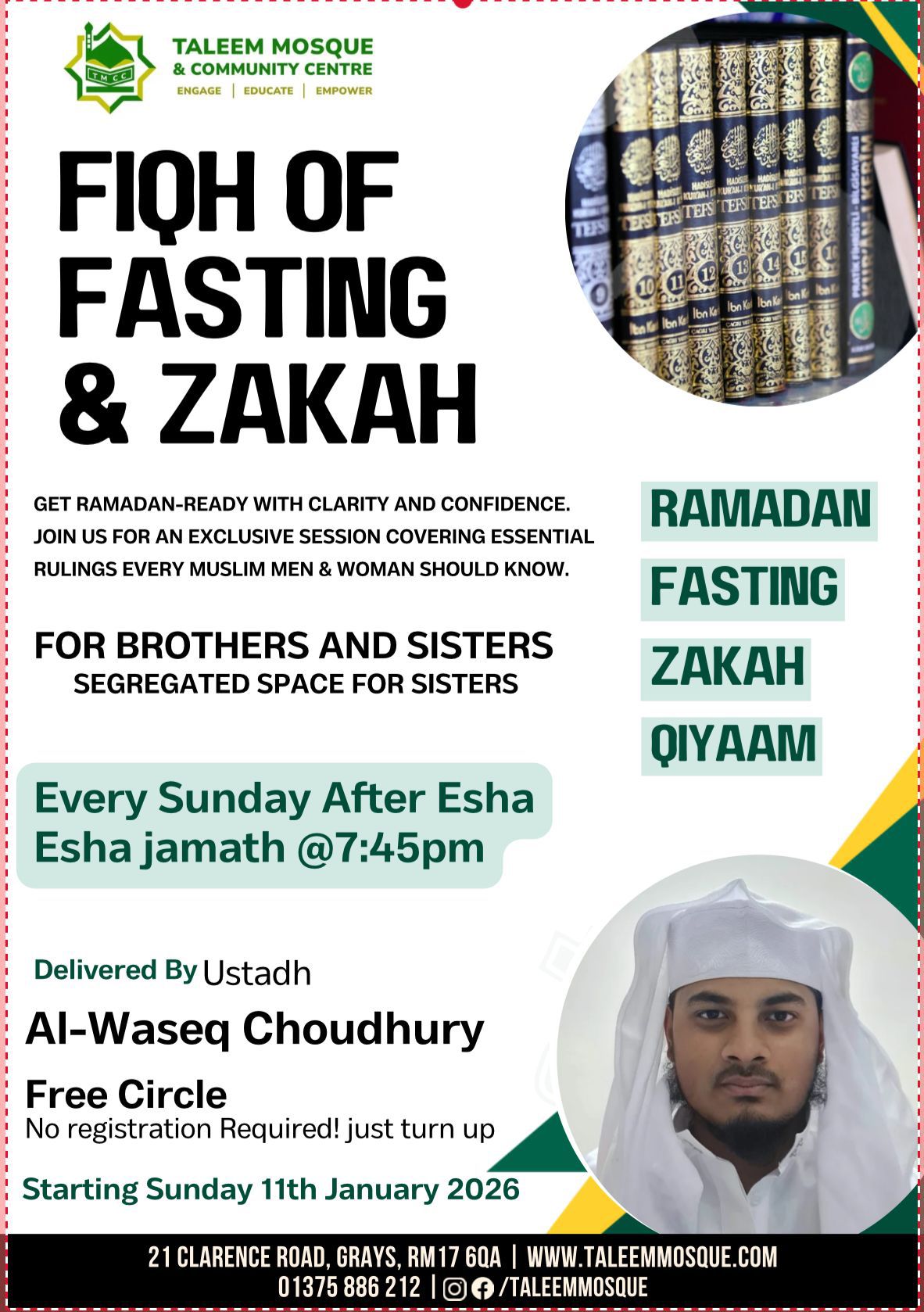
New Course: Fiqh of Fasting & Zakah*
Taleem Masjid will be starting a *new course* in preparation to Ramadan. We will be running *weekly free classes* covering the Fiqh of Fasting & Zakah.
*Date:* Every Sundays
*Time:* After Esha (7:45pm)
*Instructor:* Ustadh Al-Waseq (Madinah University Graduate & Khateeb at Taleem Mosque)
Dear brothers and sisters, with Ramadan just round the corner, lets brush up our knowledge on the dos and donts of fasting, for the sake of Allah.
Here follows the fiqh of fasting regarding the nullifiers. May Allah help us to do that which He loves and is pleased with. May Allah help us to worship Him alone always and may He make us experience many Ramadans to come, in His obedience. ameen.
DISCLAIMER: This is for educational purposes and serves as an introduction to the issues pertaining to fasting. Parents/guardians are advised to supervise the following read as some issues which pertain to married adults have been mentioned. Please consult a knowledgeable Islamic scholar (and trustworthy physician if needed) for details, particularly for questions and advice related to individual circumstances. We are not scholars and thus cannot issue fatwa, however we endeavour to relate to you the words of the scholars who have studied the authentic teachings of Islam from the Qur’an and the Sunnah of prophet Muhammad upon him be peace. And ultimately, Allah knows best.
In the name of Allah
Fiqh of Fasting Part 3
by Sh. Yahya Adel Ibrahim(with external annotations)
What breaks the fast? Can I have a blood test? How about other medical procedures? Am I allowed to apply moisturizers that penetrate the skin? What about eye drops or nasal spray or asthma puffer?
Imam Ibn Qudamah says in al Umdah: (Arabic omitted)
Things that Invalidate Fasting
[The Invalidators of Fasting] Whoever:- eats or drinks (1) or takes anything into his stomach through his nostrils (2)- or through any other route (3)- or intentionally vomit (4)– or masturbates (5)– or kissed or touched [the opposite sex] and subsequently ejaculated semen or had madh-ey (pre ejaculation) (6)– or had hijamah (cupping with bloodletting) (7)-or did it to someone else intentionally and while remembering [that he is fasting] his fast is nullified.
1) Both these and sexual intercourse break one’s fast by consensus, for Allah the Almighty says: “…so now be in contact with them [your wives] and seek what Allah has ordained for you, and eat and drink until the whiteness of the day becomes distinct from the blackness of the night at dawn, then complete the fast till night…” (al-Baqarah 2:187)Eating (by mouth) non-food items invalidates fasting by consensus.
2) Due to the statement of the Prophet sala Allahu alihi wasSalaam “Sniff water far into your nostrils unless you are fasting.” abu Dawud Authentic
3) Medical Care and Fasting (Taken from Judgements of Senior Scholars at the Fiqh Assembly of the OIC Organisation of Islamic Conference):
-Injections (with the exception of nutritious ones), many contemporary scholars believe they do not invalidate the fast. That is the position of the Fiqh Assembly of the OIC (Organization of Islamic Conference).
-Nutritious injections: controversial, but the vast majority considers them to invalidate the fast. That is the position of the Fiqh Assembly.
– Enemas, many contemporary scholars allow them while fasting, because even though they reach the hollow interior of the body (al-Jawf), they do so from a route that is not natural for food or drink; it is not even close to this natural route.- Vaginal suppositories do not break the fast according to (Malikis & Hanbalis) and modern medicine supports that position because there is no connection between the vagina and the stomach. The same applies to the male and female urethra. That is the position of the Fiqh Assembly of the OIC.- Sublingual tablets: many allow them because they are completely absorbed by the mucous membranes of the mouth and do not reach the hollow interior of the body (al-Jawf).
The Fiqh Assembly of the OIC maintains that as long as the patient avoids swallowing it, there should be no harm.- Inhalers and nasal sprays were regarded by the Permanent Fatwa Committee in Saudi Arabia as non-invalidators of the fast.- Nasal drops: controversial, and the scholars who say it invalidates the fast support their view with the previous hadeeth about istinshaq.
The scholars who argue that they do not break the fast maintain that even if a minute amount made it to the stomach, it would still be negligible. The Fiqh Assembly of the OIC maintains that as long as the patient avoids swallowing it, there should be no harm.- Eye drops and eardrops do not invalidate one’s fasting according to many scholars, particularly eardrops because there is no connection between the external ear and the interior of the body except in the case of perforation of the eardrum, and then what may reach the hollow interior of the body (al-Jawf) would be extremely negligible. That is the position of the Fiqh Assembly of the OIC.- Endoscopes, even if they enter from the mouth, they would not break the fast according to many (including the Fiqh Assembly of the OIC) because, they are not nutritious and according to (Hanafis), they do not remain in the abdomen.
The majority of the earlier scholars would consider them invalidators because they enter the hollow interior of the body (al-Jawf). But that seems to not be the correct position.- Skin preparations that are absorbed into the body do not invalidate the fast according to the Fiqh Assembly of the OIC and the vast majority of contemporary scholars and that was the opinion of Imam Ibn Taymiyah.
4) The Prophet sala Allahu alihi wasSalaam said: “He who is overwhelmed by vomiting does not have to make up, but he who intentionally vomits must make up.” (Tirmithi, and authenticated by Ibn Khuzaimah and Ibn Hibban and others)The one who intentionally vomits is the one who brings it on, not the one who vomits because he feels very nauseous.
5)That is the position of the four schools of Fiqh, for in the Divine hadeeth, Allah the Almighty in the hadith QUDSI says about the fasting person:“…he gives up his (sexual) desire, food and drink for Me…”(Agreed upon)And the one who masturbates does not give up his sexual desire. This sinful habit must be given up, here’s how to break the addiction and how to keep away from it.
6) Kissing one’s spouse while fasting with subsequent discharge
The position here above is the agreement of the four schools of Fiqh in the case of the ejaculation of semen, but it is controversial in the case of madhey (pre ejaculation). Many (Shafi’ee scholars and minority of hanbali) argue that it would not break the fast since the Prophet sala Allahu alihi wasSalaam allowed touching and kissing and that is not infrequently associated with madhey.
7) Bloodletting, Blood donation, and Blood tests
That is the correct position of the Hanbali school of thought. The majority (Shafiee,Malik, Abu Hanifa) does not consider hijamah to break one’s fast. The disagreement is because the Prophet sala Allahu alihi wasSalaam said: “Both the one doing bloodletting and the one having it done to him break their fast.” (abi Dawud; Authentic)Yet, many of the sahabah considered this to be abrogated and allowed bloodletting while fasting, and they include Anas Ibn Malik who indicated that it was initially forbidden out of fear that they may become weak.
(Bukhari reports that Ibn ‘Abbaas (may Allah be pleased with him) that he said:”The Prophet had hijamah done to him while he was between Makkah and al-Madeenah while he was fasting and in the state of Ihram.”
Blood donation and tests therefore are acceptable, if they weaken you they are Makrooh but the fast is valid and not broken.
And Allah knows best.
May Allah, Al-Ghaffaar (The Perpetual Forgiver) forgive all our sins, and may He erase them completely, for He is Al-‘Afuww, Ar-Raheem, (The Oft-Pardoning, The Most Merciful). Ameen
We are now in the sacred month of Rajab walhamdulillah and we would like to remind ourselves about the importance of the four sacred months in Islam. Rajab is the 7th month of the Islamic calendar. The sacred months are are Rajab, Dhul Qad’ah, Dhul Hijjah and Muharram, the 7th, 11th, 12th and 1st month of the Islamic Hijri calander respectively. (see Surah Tawbah, Qur’an chapter 9 verse 36).
Watch this video on what to do in Rajab and other sacred months, Sheikh Assim Al Hakim explains:
(We should be extra careful not to sin, all the time, but particularly in the sacred months, and avoid aggression…also a word on Isra’ wal Miraaj and religious innovations/bid’ah…and the importance of holding on to the Sunnah of Rasoolullah peace be upon him)
May Allah forgive us, be merciful to us and guide us, for He is the Most Gracious the Most Merciful, The Ever-Relenting. May Allah enable us to witness and observe many Ramadans in His obedience, with sincerity and strength. May Allah unite us in jannat al firdaus. Allah bless His final messenger Muhammad ibn Abdillah in abundance. Amin
Acc Name – Taleem Foundation Account Number – 1044 3584 Acc Sort Code – 60 02 63
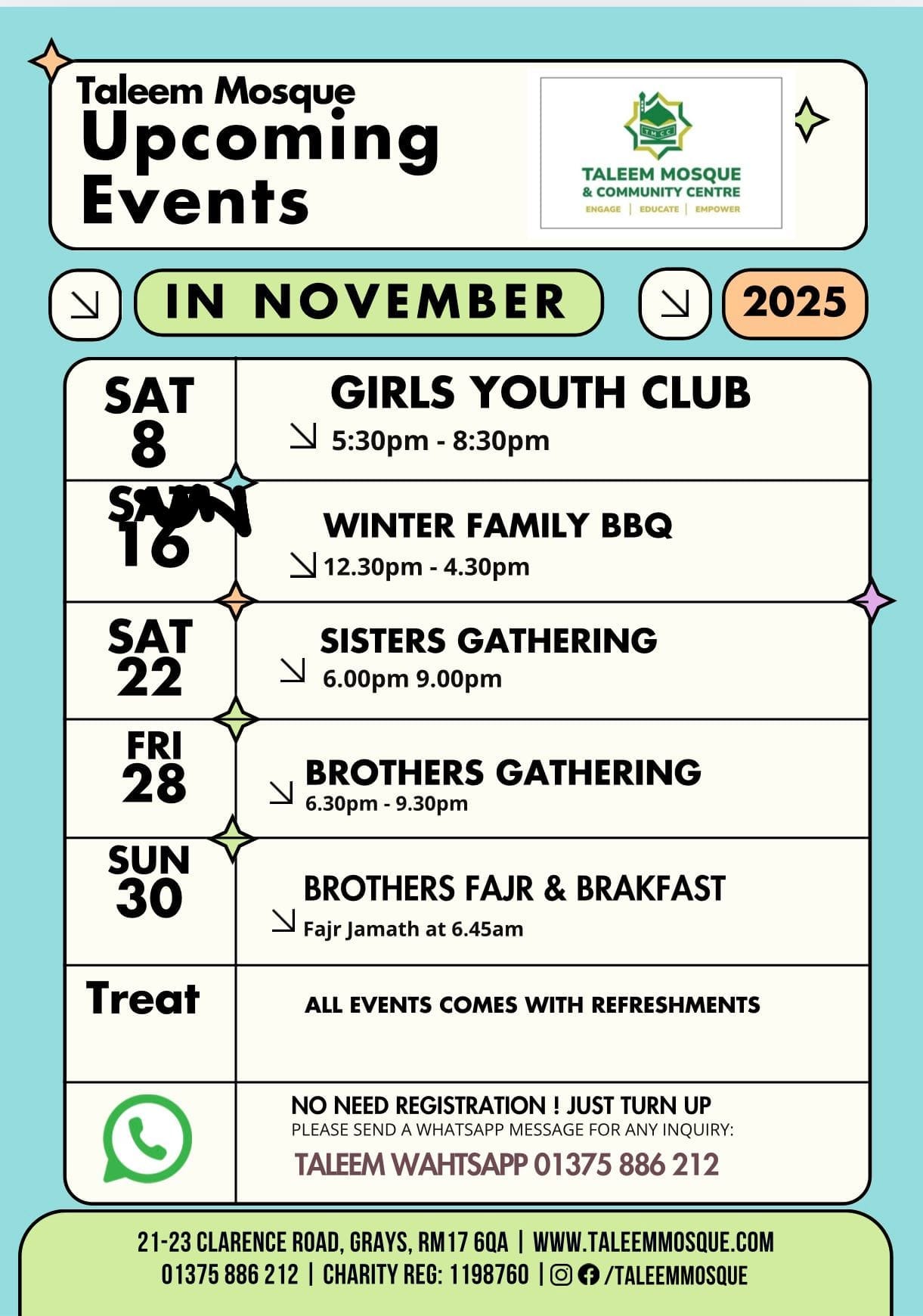
More events for November 2025
This month, there’s lots to do at your local Masjid. Take part in inspirational get-togethers, socialise and make friends and enjoy great food. TMCC is hosting youth club activities, women’s night, men’s evening and breakfast after Fajr prayers.
In the name of Allah, The Most Gracious The Most Merciful.
‘And We have sent you (O Muhammad صلى الله عليه وسلم): not but as a mercy for the ‘Alamin (mankind, jinn and all that exists).'[Qur’an 21: 107]
The final messenger of Allah, Muhammad ibn Abdillah, peace be upon him, the best man who ever lived and walked on the face of this earth. With no comparison, he is known as the most successful man in history and beyond, the best leader, the best warrior, the best businessman, the best husband, the best father, the best companion, the trustworthy, the dignified, the chaste, the modest, the courageous, the morally upright, the epitome of exemplary character…The prophet of Allah, Muhammad, upon him be peace.
Say (O Muhammad صلى الله عليه وسلم to mankind): “If you (really) love Allâh then follow me (i.e. accept Islâmic Monotheism, follow the Qur’ân and the Sunnah), Allâh will love you and forgive you your sins. And Allâh is Oft-Forgiving, Most Merciful.” Qur’an 3:31
Allah says in the Qur’an, (English interpretation) :
‘And Verily, you (O Muhammad صلى الله عليه وسلم) are on an exalted (standard of) character.’ (Qur’an, 68:4)
Muhammad, peace be upon him, had great concern for his nation- he was swift to help those in need, he was gentle and mild tempered, patient and forbearing.
He was ready… ready to listen to the unheard, ready to defend the weak and oppressed, ready to advise sincerely those seeking advice… ready to convey the truth.
He strove through periods of great difficulty to convey the lofty message- a message conveyed by all prophets and messengers, upon them be peace- a message which resonates with the natural disposition of mankind, the message ‘laa ilaha ilallah ‘ – There is no true god worthy of worship except Allah alone.
The final messenger of Allah, Muhammad peace be upon him, did not fail in his task in the least bit. He succeeded. Far and wide, the mesage is known, and the message is followed.
I bear witness that there is no true god worthy of worship except Allah who is alone without partners or associates, and I bear witness that Muhammad peace be upon him is the servant and messenger of Allah.
His teachings, actions, descriptions, sayings and instructions are revered and adhered to, cherished and conveyed. Muhammad peace be upon him taught us to have high moral character and good manners with The Creator (Allah) and the creation. He taught us how to conduct ourselves in the best and most decent manner. He, upon him be peace, said (English interpretation): I have only been sent (by Allah) to complete the good manners [Al-Hakim].
He was a mercy for mankind. He peace be upon him taught us (English interpretation): The merciful ones are granted mercy by the Most Merciful . Show mercy to those who are on earth, and the One above the heavens will show mercy to you. [Ahmad]
Muhammad peace be upon him conveyed the message which would lead to our peace and salvation in this world and for the life to come. Our purpose in life is clear, to worship exclusively The Supreme Self-Sufficient Creator, Allah, and this is the only way to attain peace and eternal bliss.
Only the fair-minded will emancipate themselves from bigotry and ignorance. Those who mock this mighty messenger, are full of hate today, but tomorrow, will be full of regret. This occurred at the time of the prophet Muhammad peace be upon him, he had enemies, mockers and haters among the disbelievers and hypocrites. They intended by their vicious, slanderous profanity and abuse to dissuade the messenger from conveying the message, whilst they knew that all they attributed to him were but fabrications. In the end, these haters failed. They were surely humilated, and what’s to come in the hereafter of humiliation is an unimaginable and inevitable reality. Haters will be haters, but they’ll also be in great loss. Drawing from the wisdom exhibited by the prophet Muhammad peace be upon him throughout his lifetime, we learn that we must deal with all people justly. These people, i.e. the mockers, need help and guidance. Let’s keep unsolicited violence out of the equation. Pity is little we can offer them, but education is far more powerful. May Allah guide us all, ameen.
Isn’t it time we educated ourselves about this remarkable man whose call to Islamic monotheism has been received and accepted by discerning people from all walks of life? Isn’t it time we searched for the real, unadultered truth? Isn’t it about time we learnt who he was, what he stood for, and Whom he called to…
Oh Allah may Your peace and blessings be upon Your final prophet muhammad peace be upon him in great abundance, upon his family and companions and those who follow them in righteousness! Ameen! May Allah make us of Muhammad’s followers, peace be upon him, for indeed Allah commanded us to obey and follow the messenger, and this is the only way to true success.
“Indeed in the Messenger of Allâh (Muhammad [sal-Allâhu ‘alayhi wa sallam]) you have a good example to follow for him who hopes for (the Meeting with) Allâh and the Last Day, and remembers Allâh much.” {Al Ahzaab: 21}
Want resources? Start to read the book entitled ‘The Sealed Nectar’ (Ar-Raheequl-Makhtum), a biography of the Final messenger of Allah, Prophet Muhammad peace be upon him, by Safiur-Rahman Al-Mubarakpuri.
Of the best ways to love the prophet Muhammad peace be upon him, is to follow his sunnah. May Allah grant us ability to follow the sunnah of the final messenger Muhammad peace be upon him.
Embark on this journey to discover #WhoIsMuhammad (peace be upon him), with the following series:
May Allah forgive us, for He is the Oft-Forgiving, The Most Merciful. And may the peace and blessings of Allah be upon Muhammad sallallahu alayhi wasallam. ameen
Muharram is a month of great virtue. It is of the four sacred months out of twelve months in the Islamic calendar.
Allaah says (interpretation of the meaning):
“Verily, the number of months with Allaah is twelve months (in a year), so was it ordained by Allaah on the Day when He created the heavens and the earth; of them four are Sacred (i.e. the 1st, the 7th, the 11th and the 12th months of the Islamic calendar). That is the right religion, so wrong not yourselves therein”
[al-Tawbah 9:36]
Allah, The Almighty, has made it a sacred month of great virtue. May He allow us to abstain from sins, to turn to Him in repentance, and to run back to Him with good deeds, for verily, the good deeds remove the evil deeds.
And Allah is The Most Generous. Oh Allah we ask for Your peace and blessings upon The final prophet Muhammad peace be upon him. Ameen ya Rabb al ‘aalameen.
It is encouraged to fast in Muharram, particularly the 10th (Ashoora’), and the preceding day with it (9th/ Tasooaa’). Let us take advantage of these beautiful days, in sha Allah.
It was proven from the Prophet (peace and blessings of Allaah be upon him) that the best fasting after Ramadaan is fasting in the month of Muharram.
It was narrated that Abu Hurayrah (may Allaah be pleased with him) said: The Messenger of Allaah (peace and blessings of Allaah be upon him) said: “The best fasting after Ramadaan is the month of Allaah Muharram, and the best prayer after the obligatory prayer is prayer at night.” Narrated by Muslim, 1163.
**Ashura dates and fasting reminders**
Regarding the significance of fasting on Ashoora’ :
The reason why the Prophet (peace and blessings of Allaah be upon him) fasted on the day of ‘Ashoora’ and urged the people to do likewise is mentioned in the hadeeth narrated by al-Bukhaari (1865) from Ibn ‘Abbaas (may Allaah be pleased with him), who said: The Prophet (peace and blessings of Allaah be upon him) came to Madeenah and saw the Jews fasting on the day of ‘Ashoora’. He said, “What is this?” They said, “This is a good day, this is the day when Allaah saved the Children of Israel from their enemy and Moosa fasted on this day.” He (peace and blessings of Allah be upon him) said, “We are closer to Moosa than you.” So he fasted on this day and told the people to fast.
Fasting the day of ‘Ashoora’ does expiate (minor sins) for the past year, because the Prophet (peace and blessings of Allaah be upon him) said: “Fasting the day of ‘Arafah I hope Allaah will expiate thereby for the year before it and the year after it, and fasting the day of ‘Ashoora’ I hope Allaah will expiate thereby for the year that came before it.” Narrated by Muslim, 1162.
‘Abd-Allaah ibn ‘Abbaas (may Allaah be pleased with him) said: When the Messenger of Allaah (peace and blessings of Allaah be upon him) fasted on the day of ‘Ashoora and told the people to fast, they said, “O Messenger of Allaah, this is a day that is venerated by the Jews and Christians.” The Messenger of Allaah (peace and blessings of Allaah be upon him) said, “Next year, if Allaah wills, we will fast on the ninth day.” But by the time the following year came, the Messenger of Allaah (peace and blessings of Allaah be upon him) had passed away.
Narrated by Muslim, 1916.
It is expected that 9th Muharram 1445 will coincide with 4th July 2025 and 5th Jul 2025 will be the 10th, or Ashoora’. May Allah grant us sincerity and the ability to seize the opportunity this Ashoora’ by fasting to gain His reward, love and forgiveness, through implementing the Sunnah of His final messenger Muhammad sallallahu alayhi wasallam. Ameen
What is meant by udhiyah (sacrifice)? Is it obligatory or Sunnah?.
Praise be to Allaah. The word udhiyah means an animal of the ‘an’aam class (i.e., camel, cow, sheep or goat) that is slaughtered during the days of Eid al-Adha because of the Eid and as an act of worship, intending to draw closer to Allaah thereby.
This is one of the rituals of Islam prescribed in the Book of Allaah and the Sunnah of His Messenger (peace and blessings of Allaah be upon him), and according to the consensus of the Muslims.
In the Qur’aan:
1 – Allaah says (interpretation of the meaning):
“Therefore turn in prayer to your Lord and sacrifice (to Him only)”
[al-Kawthar 108:2]
2 – Allaah says (interpretation of the meaning):
“Say (O Muhammad): Verily, my Salaah (prayer), my sacrifice, my living, and my dying are for Allaah, the Lord of the ‘Aalameen (mankind, jinn and all that exists).
He has no partner. And of this I have been commanded, and I am the first of the Muslims”
[al-An’aam 6:162]
The word nusuk (translated here as sacrifice) means sacrifice; this is the view of Sa’eed ibn Jubayr. And it was said that it means all acts of worship, including sacrifice, which is more comprehensive.
3 – Allaah says (interpretation of the meaning):
“And for every nation We have appointed religious ceremonies, that they may mention the Name of Allaah over the beast of cattle that He has given them for food. And your Ilaah (God) is One Ilaah (God Allaah), so you must submit to Him Alone (in Islam). And (O Muhammad) give glad tidings to the Mukhbitoon [those who obey Allaah with humility and are humble from among the true believers of Islamic Monotheism]”
[al-Hajj 22:34]
In the Sunnah:
1 – It was narrated in Saheeh al-Bukhaari (5558) and Saheeh Muslim (1966) that Anas ibn Maalik (may Allaah be pleased with him) said: “The Prophet (peace and blessings of Allaah be upon him) sacrificed two white rams speckled with black. He slaughtered them with his own hand, said ‘Allaahu akbar’ and put his foot on their necks.”
2 – It was narrated that ‘Abd-Allaah ibn ‘Umar (may Allaah be pleased with him) said: “The Prophet (peace and blessings of Allaah be upon him) stayed in Madeenah for ten years, offering sacrifice (every year on Eid).” Narrated by Ahmad, 4935; al-Tirmidhi, 1507; classed as hasan by al-Albaani in Mishkaat al-Masaabeeh, 1475.
3 – It was narrated from ‘Uqbah ibn ‘Aamir (may Allaah be pleased with him) that the Prophet (peace and blessings of Allaah be upon him) shared out sacrificial animals amongst his companions, and ‘Uqbah got a sheep that was six months old. He said, “O Messenger of Allaah, I got a sheep that is six months old.” He said, “Offer it as a sacrifice.” Narrated by al-Bukhaari, 5547.
4 – It was narrated from al-Baraa’ ibn ‘Aazib (may Allaah be pleased with him) that the Prophet (peace and blessings of Allaah be upon him) said: “Whoever offers a sacrifice after the prayer has completed his rituals (of Eid) and has followed the way of the Muslims.” Narrated by al-Bukhaari, 5545.
The Prophet (peace and blessings of Allaah be upon him) offered sacrifices, as did his companions (may Allaah be pleased with them). And he said that sacrifice is the way of the Muslims.
Hence the Muslims are unanimously agreed that it is prescribed in Islam, as was narrated by more than one of the scholars.
But they differed as to whether it is Sunnah mu’akkadah (a confirmed Sunnah) or it is obligatory and it is not permissible to omit it.
The majority of scholars are of the view that it is Sunnah mu’akkadah. This is the view of al-Shaafa’i, Maalik and Ahmad according to his most well-known view.
Others were of the view that it is obligatory. This is the view of Abu Haneefah and one of the views narrated from Ahmad. This was also the view favoured by Ibn Taymiyah who said: “This is one of the views narrated in the madhhab of Maalik, or it appears to be the view of Maalik.”
From Risaalat Ahkaam al-Udhiyah wa’l-Dhakaah by Ibn ‘Uthaymeen (may Allaah have mercy on him).
Shaykh Muhammad ibn ‘Uthaymeen (may Allaah have mercy on him) said: “Udhiyah is Sunnah mu’akkadah for the one who is able to do it, so a person should offer the sacrifice on behalf of himself and the members of his household.”
Fataawa Ibn ‘Uthaymeen, 2/661.
REMINDER:
If a person wants to offer an udhiyah, then it is haraam – according to the more correct view – for him to remove anything from his hair or nails until he offers his sacrifice, regardless of whether he offers his sacrifice at the beginning of the time for it, immediately after the Eid prayer, or at the end of the time, i.e., before sunset on the thirteenth of Dhu’l-Hijjah.
That is because of the report narrated by Muslim in his Saheeh (1977) from Umm Salamah (may Allah be pleased with her), who said: The Messenger of Allah (blessings and peace of Allah be upon him) said: “Whoever has an animal to sacrifice, when the new moon of Dhu’l-Hijjah appears, let him not remove anything from his hair or nails, until he has offered his sacrifice.”